Detecting Fake Accounts: Behind the Profile
A finance team receives a message from what looks like their CEO's personal account, asking for an urgent wire transfer before a call. The profile picture matches, the writing style is close enough, and the request comes with just enough pressure to skip a second look. It's only after the transfer goes through that anyone checks the account's history and finds it was created two weeks earlier, copying a real executive's photos and posts almost exactly.
This is the problem fake accounts create at scale: they are built to survive a glance, not a review. To detect them reliably, investigators have to move beyond what a profile claims to be and examine the identity signals connected to it.
In this article, we examine why fake accounts have become harder to distinguish from real ones, what a recent mass takedown reveals about how these networks actually operate, and how identity resolution turns individual indicators into a repeatable investigation workflow.
Not every inauthentic account is the same kind of problem. A fake account is built from scratch to represent a person or business that doesn't exist, or to misrepresent who is behind it. An impersonation account copies a real, identifiable person's name and photos without their involvement. A compromised account is different again: a real person's real account, taken over by someone else, which is why it can be the most convincing of the three.
Bot accounts and sock puppets sit somewhere between fake and functional. Bots are typically automated and used to inflate engagement, distribute content, or interact at scale. Sock puppets are manually operated but built around a false identity, often to appear as a neutral or credible voice in a conversation the operator has a stake in. Both are designed to blend into normal activity rather than stand out.
These categories matter because each one demands a different response. Reporting an account for impersonation doesn't solve an account takeover, where the legitimate owner instead needs to regain control and secure the credentials that were compromised. Removing one fake profile may also do little if it belongs to a larger operation running dozens of related identities. Before deciding what action to take, investigators first need to establish what kind of account they are actually dealing with.
Once an investigator has placed an account into a category, the next question is whether that category is even accurate, since none of it has been verified yet. Every account, real or fake, arrives with the same set of visible signals to work from.
The obvious place to start is the profile itself. Investigators can check whether a profile photo appears elsewhere online, whether a username has been reused across platforms, whether the account's history matches the identity it claims, and whether its connections appear organic. These checks are useful, but none of them proves authenticity on its own.
Each check has a blind spot built in. A copied photograph can expose an impersonation account, but a unique photograph doesn't prove the person exists. An old account can still be compromised. An AI-generated profile image may have no previous appearance online at all. Even apparently legitimate connections can be manufactured or accumulated over time.
The more reliable signal is what an account connects to, not what it displays. An email address may appear across several platforms under different names. A username may link profiles that supposedly belong to different people. A phone number may tie an apparently isolated account to other identities entirely. This is where fake-account detection stops being a profile-review problem and becomes an identity-resolution problem.
In June 2026, Meta joined the U.S. Department of Justice's Scam Center Strike Force, the FBI, the Royal Thai Police, and other partners in the largest coordinated disruption of criminal scam networks conducted to date. The operation removed more than 1.4M accounts, Pages, and Groups across Facebook and Instagram, and the intelligence shared across agencies contributed to 63 arrests, according to Meta's own H2 2026 Transparency Report.
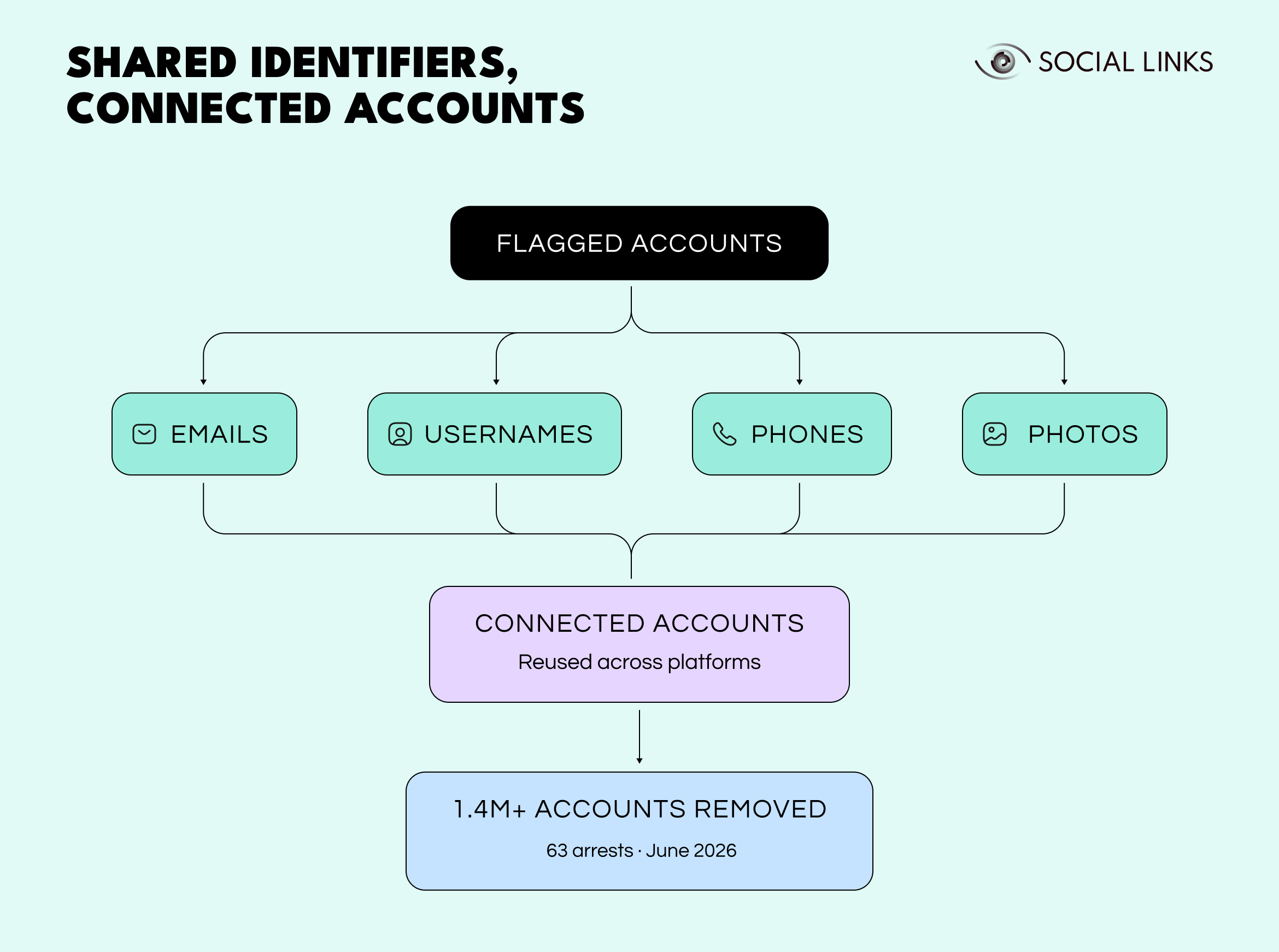
What makes this figure worth examining isn't just its size, but what operations at this scale reveal about the value of network-level investigation. Shared identifiers, infrastructure, contact details, and behavioral patterns can expose relationships between accounts that appear unrelated when reviewed individually. Instead of treating every suspicious profile as an isolated case, investigators can use those connections to identify wider clusters of activity.
The same principle applies at a much smaller scale. An individual investigator or trust and safety team doesn't have the visibility of a major platform, but the investigative logic remains similar: start with the available identifiers, find where they overlap, and use those connections to determine whether a suspicious account is part of something larger.
Identity resolution treats the suspicious account as one data point among many, rather than the whole picture. A typical investigation starts with a single known identifier, such as an email address, a username, a phone number, or an image, and enriches that identifier against other available sources to surface associated accounts, aliases, and additional identifiers.
The important part isn't collecting more data, it's comparing what comes back. If the same email is tied to profiles using several unrelated names, that discrepancy is worth pursuing. If a username has a long-standing footprint across services that consistently points to the same person, that strengthens the case for a real identity. If an account claiming to belong to a particular executive instead connects to identifiers tied to entirely different personas, the investigation moves in the opposite direction.
One identifier tends to lead to another. A suspicious account supplies an email or username, enrichment against that identifier surfaces a second account, that account carries its own identifiers, and the process repeats until an isolated profile turns into a mapped set of connected entities, the same pattern the Meta takedown demonstrates at platform scale. This is also why removing a single account rarely solves the underlying problem: if several identities share infrastructure, whatever triggered the initial report is often just one visible piece of a larger cluster.
Doing this manually, one identifier at a time, is exactly where investigations lose time. At scale, repeatedly cross-referencing photos, usernames, emails, and other identifiers across platforms quickly becomes a bottleneck. Structured, API-based access changes the sequence: known identifiers get submitted programmatically, enriched against relevant sources, and returned in a format that plugs directly into an existing fraud detection, trust and safety, or case management system, so a team spends its time evaluating what's already been assembled rather than assembling it by hand.
Consider a corporate security team that receives a report from an employee contacted by a "recruiter" offering a role at a well-known company. The profile has a professional photo, a plausible employment history, and several genuine-looking connections. Nothing immediately proves the account is fraudulent, but something about the outreach is unusual enough to warrant a closer look.
The team starts with the identifiers it already has. A reverse image search shows the recruiter's photo appears on a stock photography site under a different name, a first discrepancy, though not yet definitive proof. The recruiter's email address becomes the next input: enrichment against that address surfaces two more accounts on unrelated platforms, one using a different name, another claiming a different employer, and a reused username that opens a further pivot into additional connected profiles.
What began as one questionable message has become a set of conflicting identity signals tied together by shared identifiers, the same kind of cluster that shows up at platform scale, just found before anyone had to report it.
SL API turns the identity-resolution process described above into something a team can run without leaving their existing tools. Rather than opening a separate research interface for each account, an investigator or an automated pipeline can query an email, username, phone number, or image directly and get back the linked profiles, aliases, and identifiers that query would otherwise mean manually chasing down platform by platform.
For fake-account investigations, this makes it easier to move beyond the profile that triggered the initial check. Broader source coverage can reveal identifiers and accounts reused across platforms, while structured access lets teams follow those connections without turning each new lead into a separate manual search. The result is a more complete view of the identity behind the account and any wider network it may be connected to.
The output also fits into whatever a team already uses to manage a case. Results return in a structured format that can feed a fraud detection system, a trust and safety queue, or a case management tool, so enrichment becomes part of an existing pipeline rather than a separate manual task bolted onto it.
Fake accounts, impersonations, and compromised accounts each demand a different response, but they expose the same limitation: a profile alone rarely provides enough information to establish who is actually behind it. Effective investigation therefore moves outward, from the profile to its identifiers, from those identifiers to associated accounts and attributes, and ultimately to the wider network they may reveal.
By checking what an account displays against outside data, such as whether its profile photo appears elsewhere online, whether its username or contact details link to other accounts, and whether its activity history is consistent with a genuine, long-standing presence.
A fake account is built from scratch around a false or copied identity. A compromised account is a real person's genuine account that someone else has taken over, which is why it often looks more convincing than an account created purely to deceive.
Often, though not always with full certainty. Shared identifiers like a reused email address, phone number, or photo can link a fake account to other accounts or infrastructure the same operator has used, even when the account itself gives no direct information.
It's the process of confirming how a genuine account was accessed by someone other than its owner, typically by reviewing login activity, recovery changes, and the timeline of when control shifted, in order to restore access and prevent further misuse.
The same identity-resolution approach still applies, since an AI-generated profile still needs contact details, a network, and activity to function. What changes is that the photo itself may not reverse-search to an existing source, which is often a signal in its own right rather than a dead end.
Want to see how identity resolution can turn a single lead into a mapped network? Book a personalized demo to see how SL API helps investigative and trust and safety teams enrich emails, usernames, and phone numbers, surface connected accounts, and integrate structured OSINT data within their existing workflows.