
Misinformation Detection: Reading the Signal Before It Spreads
A false claim about a contaminated product line appears on a niche forum at 2 a.m. By the time a communications team sees it flagged in a morning news digest, it has already moved through three platforms, picked up a coordinated push from a cluster of low-follower accounts, and reached a regional news outlet looking for comment. The claim was never true. But by the time anyone caught it, truth was no longer the variable that mattered. Reach was.
What made the claim dangerous was never its content. Nothing about it was especially convincing, and a single fact-check would have settled the matter in minutes. What mattered was that nobody was watching closely enough to catch it while it was still small enough to correct quietly. That gap, between the moment a false claim enters circulation and the moment anyone with the authority to respond actually notices it, is where most of the damage gets done, and it widens every year as more channels, languages, and formats compete for the same limited attention.
In this article, we examine how misinformation detection actually works, how it differs from investigating a single bad actor after the fact, and what continuous monitoring looks like for organizations that need to catch a narrative while it is still small enough to matter.
Misinformation is false or misleading information shared without the intent to deceive. It covers the outdated statistic still circulating in a group chat, the mistranslated headline, the well-meaning repost of a claim nobody checked. It spreads through ordinary human behavior rather than orchestration, which is part of what makes it hard to police: there is no single author to hold accountable, only a chain of people who believed something and passed it along.
Sources range widely. Satirical content taken out of context, outdated news recirculated as current, screenshots stripped of their original framing, and AI-generated text or images mistaken for authentic footage all fall under the same umbrella. None of these require malicious intent to cause real damage once they gain traction.
Why misinformation spreads comes down to incentive structures built into most platforms. Content that provokes a strong emotional reaction, whether outrage, fear, or vindication, tends to be shared faster than content that requires careful reading. Algorithms built to maximize engagement do not distinguish between a claim that is emotionally compelling and one that is also true. That gap is where monitoring earns its value: the same platform dynamics that spread misinformation also leave a trail wide enough to detect it early, if something is actively watching for the pattern.
The two terms are often used interchangeably, but the distinction matters for how an organization responds. Misinformation is false information shared without knowledge that it is false. Disinformation is false information created and spread deliberately, usually with a specific outcome in mind, whether that is financial gain, reputational damage to a competitor, or influence over public opinion.
Intent versus accidental sharing is the practical dividing line. A customer who reposts an outdated safety warning is spreading misinformation. A coordinated network of accounts built specifically to push that same warning back into circulation ahead of a product launch is running disinformation. The content can look identical on the surface. The behavior around it, timing, account patterns, cross-platform coordination, is what separates the two.
Monitoring teams distinguish between them because the response differs. Misinformation is usually addressed through correction: clear, timely, accurate information released through the right channels. Disinformation requires understanding who benefits from the narrative and how the network behind it operates, since correcting the content alone does little if the same network can simply relaunch it. Treating a disinformation campaign as an isolated misinformation incident tends to under-respond to a problem that will resurface.
A narrative that goes unnoticed for even a few hours can be difficult to unwind days later. Regulators, business leaders, and platform trust and safety teams increasingly treat this as a structural risk rather than a communications inconvenience. The World Economic Forum's Global Risks Report 2026 places misinformation and disinformation as the second-ranked global risk over a two-year outlook, behind only geoeconomic confrontation, ahead of most conventional security and economic threats organizations plan around.
Public trust in the surrounding information environment is also shifting in ways that make early detection more valuable, not less. The Reuters Institute's Digital News Report 2026 found that concern about fake news and misinformation online reached 62 percent of respondents globally, a four-point increase from the prior year, alongside a broader move toward social platforms as the primary place people encounter news in the first place. A false claim no longer needs to reach a major outlet to do damage. It only needs to reach the platform a target audience already trusts.
Public safety, elections, brand reputation, and cybersecurity all sit downstream of the same dynamic. A fabricated safety alert can trigger real-world panic before anyone corrects it. A coordinated narrative timed to an election cycle can shape turnout in a district before fact-checkers publish a response. A brand rumor seeded across a handful of accounts can outrun an official statement by hours. In every case, the cost is driven less by the falsehood itself than by how long it moved unwatched.
Detection starts with knowing what to listen for. Continuous monitoring tracks keywords, entities, and known narrative fragments across platforms, flagging clusters of activity that deviate from normal conversation around a topic, brand, or event, rather than waiting for a claim to reach a visibility threshold before anyone looks at it.
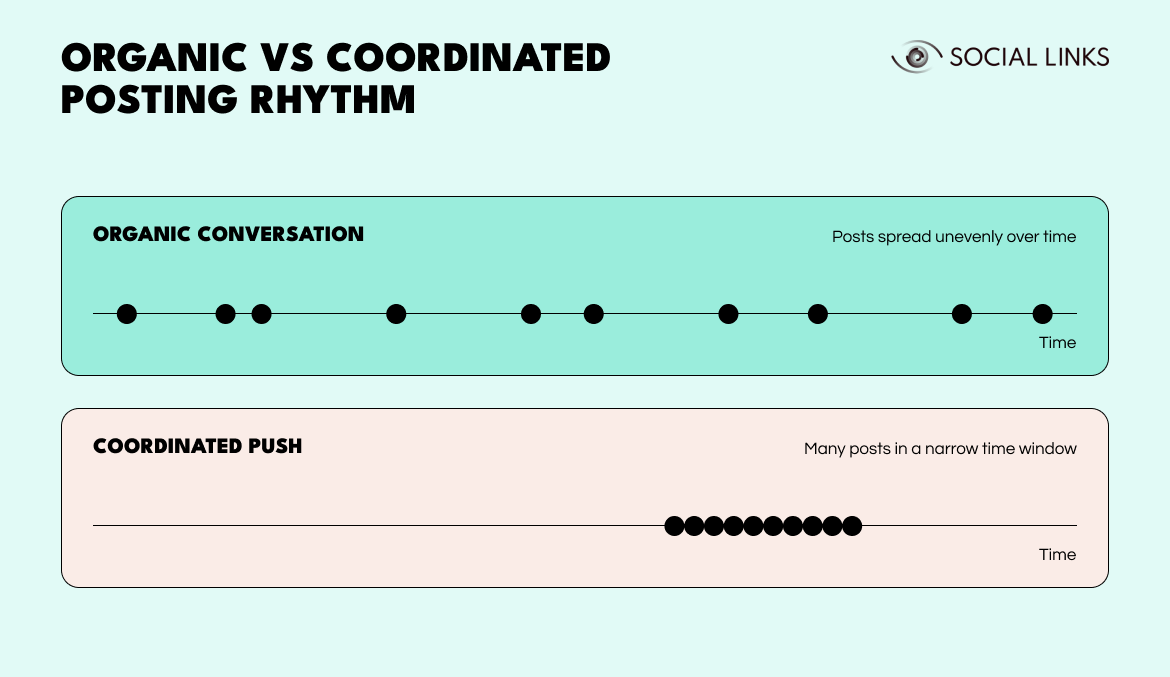
Coordination shows up in timing and structure rather than content. Accounts created within a short window of each other, posting near-identical phrasing within minutes, or amplifying a narrative across platforms in a synchronized push all point toward direction rather than organic interest. Genuine grassroots reaction tends to build unevenly, with gaps and variation in tone; coordinated activity tends to be smoother than that.
AI supports this work but does not replace it. Natural language processing and image analysis catch linguistic patterns and reused media faster than manual review, reducing the volume a human team has to sort through, but they also produce false positives around satire and legitimate breaking news that happens to resemble a coordinated pattern in its early hours. Human verification remains the step that turns a flagged pattern into a confirmed one.
Detection covers text, image, and video together, not just the written claim. Since misinformation increasingly travels as a photo or a clip, SL Monitor evaluates the media alongside the account posting it, flagging AI-generated or manipulated content with a confidence score attached directly to the alert.
A claim is tracked as one narrative as it moves across platforms, rather than as separate, disconnected posts. This is also how impersonation of public figures and organizational leadership gets caught, by matching an account's name and imagery against known identities even without an explicit tag.
A flagged narrative carries its context forward. When an alert warrants deeper investigation, its source data and engagement metrics move into SL Crimewall without starting the process over.
Consider a hypothetical example. A mid-sized retailer's communications team picks up an unusual spike in mentions of a product safety claim, still contained to a small cluster of accounts with almost no organic engagement history. The claim itself is not new; a version of it circulated months earlier and was debunked at the time. What is different now is the posting pattern: a dozen accounts, most created within the same week, pushing near-identical phrasing across three platforms within a thirty-minute window.
Because the monitoring system flags the cluster before it crosses into wider visibility, the team has time to do two things a reactive approach would not have allowed. First, they verify the pattern is coordinated rather than a coincidence, checking account creation dates, posting overlap, and prior engagement history. Second, they prepare a factual response and brief customer-facing teams before the claim reaches anyone outside the original cluster. In this scenario, the narrative never gains the momentum it would have needed to reach a news outlet, not because it was suppressed, but because it was addressed while it was still small enough to address quietly.
Trusting a single source of truth is a frequent failure point. A claim that looks credible on one platform can look entirely different once cross-referenced against its original context, timestamp, or the account that first posted it.
Relying on engagement metrics as a proxy for accuracy leads teams astray. A high share count says a claim spread. It says nothing about whether the claim is true, and treating virality itself as evidence of legitimacy is exactly the assumption bad actors rely on when seeding a coordinated push.
Overreliance on automated detection without human review produces its own failure mode. Automated systems are fast and consistent, but they lack the judgment to catch satire or legitimate news that happens to resemble a coordinated pattern in its earliest hours.
A verification checklist keeps response times fast without sacrificing accuracy. Confirming the original source, checking the timestamp against related events, and reviewing the posting account's history takes minutes when built into a standard workflow, and considerably longer when improvised under pressure during an actual incident.
Escalation criteria should be set before an incident happens, not during one. Defining in advance what volume, coordination pattern, or platform spread triggers escalation to leadership removes the guesswork that slows down a response when a narrative is actively moving.
Misinformation detection is fundamentally a timing problem. The content itself is rarely sophisticated. What makes a false narrative dangerous is the speed and coordination behind its spread, and both of those are visible early to a system built to watch for them continuously rather than respond after the fact. Organizations that treat monitoring as an ongoing baseline, rather than a reaction triggered by a crisis already underway, consistently catch coordinated activity while it is still small enough to address quietly.
Misinformation detection is the process of identifying false or misleading information as it circulates, using verification techniques, source analysis, and pattern recognition to distinguish accurate content from claims that are false, outdated, or manipulated.
Misinformation is false information shared without knowledge that it is false, while disinformation is created and spread deliberately, usually to achieve a specific financial, political, or reputational outcome. The distinction shapes the appropriate response, since correcting content alone does little against a network built to relaunch it.
AI tools can flag linguistic patterns, reused media, and unusual posting behavior faster than manual review, but they also generate false positives around satire and breaking news. Most reliable monitoring workflows use AI to surface candidates for review rather than to make final determinations.
Coordinated campaigns are identified through behavioral signals rather than content alone, including account creation timing, posting rhythm, and cross-platform propagation patterns that distinguish organic conversation from organized amplification.
A narrative caught while confined to a small cluster of accounts can be verified and addressed quietly. Once it crosses into wider visibility, correction competes with an established narrative that has already shaped opinion, making the same factual response far less effective.
Want to see how a narrative can be tracked from its first mention to full amplification, before it reaches critical mass? Book a personalized demo with one of our specialists and discover how SL Monitor helps communications, trust and safety, and intelligence teams track emerging narratives, map coordinated networks, and alert on spread patterns as they form, in real time, across every platform they need to watch.