OSINT in Public Safety Intelligence: Building the Picture

In January 2020, an image of Australia spread across social media, showing a continent dotted with bright orange, apparently a satellite photograph of a country on fire. It was actually a digital visualization of NASA fire-detection data, complete with a glow effect that a real satellite photograph would not show at that scale. The fires were real, and so was the underlying data, but the claim attached to the image was false. For public safety teams, closing the distance between real data and a reliable reading of it is most of the job.
Open-source intelligence (OSINT), meaning information drawn from publicly available sources, can inform a decision only after it has been verified and interpreted. That means turning raw material such as posts, images, and public records into an assessment a decision-maker can rely on, with a clear statement of what is known, what is inferred, and what remains uncertain. It does not predict or prevent every incident, and it works best as one input among several.
In this article, we examine what this field covers, where OSINT supports investigations and emergency response, and a six-step workflow that takes a claim from first sighting to a reviewed brief. We also look at verification techniques, tool criteria, privacy safeguards, common mistakes, and two hypothetical scenarios that show the method in practice.
It is the collection, verification, and assessment of information to help organizations protect people from harm and respond to incidents. It supports decisions across policing, fire and rescue, emergency medical services (EMS), and emergency management, and it keeps what was observed separate from what was concluded.
The field is broader than policing, and three ideas are worth keeping apart.
The mission is protecting people and property and responding when something goes wrong, whether the cause is crime, a flood, or a failed utility.
Intelligence is analysis in service of a specific decision. It answers a question someone needs answered, by a certain time, for a certain area.
Investigations establish what happened and who or what was involved, using records that can withstand later review.
Public information and an assessed finding are also different things. A post, photo, or report becomes a finding only after someone has checked where it came from, when it was captured, and where it was taken, weighed other explanations, and recorded how confident they are and why.
OSINT is one input to that process, alongside official reports, sensor data, and restricted operational databases that fall outside the scope of this article.
During an incident, information arrives from every direction at once: calls, official reports, sensor data, and a steady stream of public posts. That last category is substantial, since 53 percent of U.S. adults say they at least sometimes get news from social media, which means much of the public's picture of an event takes shape on those platforms.
That picture is not always trusted. Across the Reuters Institute's 2026 survey markets, the share of respondents concerned about fake news online rose to 62%, up four points, and that doubt applies to analysts and responders as much as anyone.
A shared operating picture means a team agrees on what is confirmed, what is probable, and what is still being checked. It helps analysts decide which reports deserve verification first, and it gives organizations responding to the same incident one version of events, the premise behind frameworks such as the U.S. National Incident Management System (NIMS). It does not promise a faster response; it lowers the chance of acting on the wrong one.
An analyst's output is useful only when tied to the decision it supports: who needs to act, by when, and over which area. A feed of posts is not a verified operational assessment, however current it is.
OSINT in public safety rarely delivers answers on its own. It delivers leads and context, which then need checking. Three common uses show the pattern: each draws on different public sources, supports a different decision, and carries its own limitations.
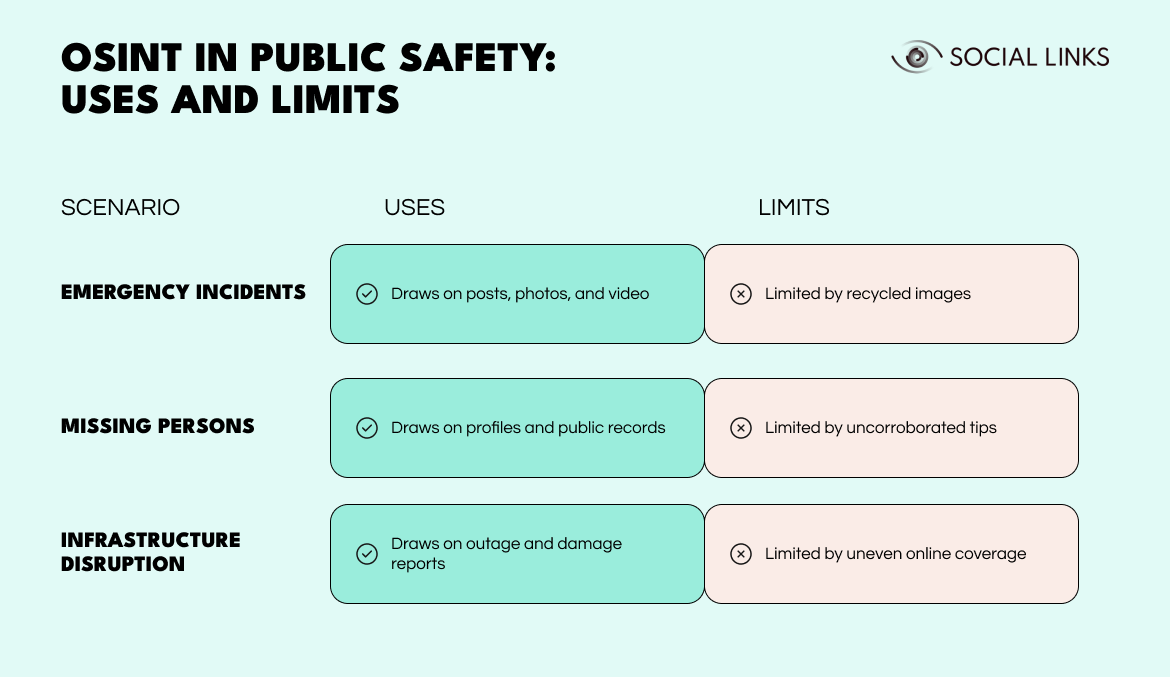
Emergency incidents. Public posts, photos, and videos from people at a scene can help confirm that something is happening, roughly where, and at what scale, which informs where resources go and what residents are told. The limitation is recycled images. Photos are often old or misdated, and a location tag may show where something was uploaded, not where it was taken.
Missing persons. Public profiles and public records can suggest a last known location, a person to contact, or another investigative lead, which informs where follow-up begins. The limitation is uncorroborated tips. Community posts and other public tips need corroboration before anyone acts on them, and sensitive personal details should not be republished.
Infrastructure disruption. Public outage and damage reports help emergency management teams gauge how far a disruption reaches and brief neighboring organizations, with no criminal element involved. The limitation is uneven online coverage: reports cluster where more people are online, so a quiet area is not evidence that nothing is wrong.
Public information can also reveal early indicators of risk, but an indicator is a reason to look closer, not a finding.
A repeatable workflow keeps verification from depending on who happens to be on shift. Each of the six steps below produces one output and passes through one review checkpoint, so a supervisor can see where a claim stands at any moment. Collection stays limited to publicly available information, and nothing in this workflow involves bypassing access controls.
Defining the question and authorized scope. The output is a written operational question that names the recipient, the decision it supports, the deadline, and the geographic area. The checkpoint is a supervisor confirming that the purpose is authorized and the limits are documented before collection begins.
Planning sources and collecting relevant material. The output is a short source plan and a set of captures that each record the URL, capture time, and time zone. The checkpoint is a reviewer confirming that collection stayed within the defined scope.
Verifying source, time, location, and context. The output is, for each key claim, the earliest source found, the time it was published, and the place it was checked against. The checkpoint is a second person confirming that corroboration is independent, since copied or syndicated posts count as one source, not several.
Assessing alternatives and confidence. The output is an assessment that states at least one competing explanation, a confidence level with its rationale, and the evidence that would change the conclusion. The checkpoint is a reviewer challenging whether each statement is an observation, an inference, or a recommendation.
Sharing a reviewed, audience-specific brief. The output is a brief written for the recipient's decision, with sources kept separate from interpretation. The checkpoint is a designated reviewer approving release and removing sensitive personal details the recipient does not need.
Reviewing outcomes, retention, and corrections. The output is a short record of how the brief was used, any corrections issued, and a date for review or deletion. The checkpoint is a supervisor confirming that corrections reach everyone who received the original.
Each step feeds a single record, and the record is what makes the work reviewable. A compact source-to-assessment template needs only three groups of fields.
What was seen. The operational question, the source URL, the publication time, the capture time and time zone, and the observation itself, written without interpretation.
How it was checked. Corroborating sources and contradictory evidence, kept side by side so disagreement stays visible. Copied or syndicated posts do not count as independent corroboration.
What it means and who acts. The assessment, the confidence level and rationale, known limitations, the reviewer, the recipient, and a date for review or deletion.
With a record like this, a supervisor can tell the underlying source from the analyst's interpretation and see the next verification action at a glance. The Berkeley Protocol on Digital Open Source Investigations offers a rigorous model for handling digital source material, though it was written for international criminal and human rights investigations and should be adapted, not copied, for other settings.
Verification is where public safety investigations catch unreliable claims, and a few habits do most of the work.
Finding the original. Tracing an image or claim to its earliest appearance exposes recycled material, and conflicting reports often turn out to share a single origin.
Checking time. A displayed timestamp may reflect when something was uploaded, not when it happened, and shown times shift with the viewer's time zone, so each capture records both.
Checking location. Landmarks, signage, and terrain can be compared against maps and satellite imagery, while a location tag is treated as a claim to test, not a fact.
Resolving entities. Common names, reused usernames, and similar accounts invite mistaken identity. A matching username or proximity on a map is a lead, not proof of identity or involvement.
Separating source reliability from claim confidence. A usually dependable source can be wrong about a specific claim, and an unfamiliar account can be right. Rating the two separately keeps one from standing in for the other.
Tool selection should follow the workflow, not the other way around. Capability categories matter more than any single product, and the useful questions are about evidence rather than features.
Collection. Source coverage across the platforms and records a team actually needs, with captures that preserve the original URL and time.
Analysis. Support for entity resolution, link analysis, and geospatial checks, so relationships and locations can be examined without drifting into guilt by association.
Preservation and audit. Exports, audit logs, access controls, and retention settings that make each finding traceable and each deletion deliberate.
Analyst effort. How much manual checking a tool saves, and whether it saves it without hiding where a result came from.
Public-source inputs should also be kept distinct from restricted operational databases, since the two carry different rules. AI can help with triage, translation, and grouping similar posts, but it cannot verify a claim by itself. Every AI-assisted output needs traceable sources and an analyst's review before it reaches a recipient.
Public availability does not automatically permit every form of collection or reuse, and the rules differ by jurisdiction and purpose, so any legal requirement needs review for the place where it applies. Several practices apply across public safety work, whatever the jurisdiction.
Keeping collection proportionate. An authorized purpose, documented limits, and data minimization tie collection to the question being asked. In the United States, the Bureau of Justice Assistance publishes privacy and civil liberties guidance for fusion centers and state, local, and tribal justice agencies, one example of how such policies are developed.
Controlling who receives what. Briefs go only to recipients who need them, in the form they need. Fusion centers are one U.S. channel for passing threat-related information among federal, state, local, tribal, territorial, and private sector partners, and each handoff should state what was verified and what was not.
Resisting false positives. Lawful speech or group membership is not a threat indicator, and a keyword match is not an assessment. Review and correction procedures need a named owner.
Watching for bias. Search terms, language coverage, and source choice all shape what an analyst sees, so review should ask what is missing as well as what is present.
Three mistakes recur even in careful teams.
Treating volume as corroboration. Many accounts repeating a claim may trace back to one origin, and repetition is not independence.
Letting a lead harden into a conclusion. A lead that was never checked a second time tends to be repeated until it sounds settled.
Skipping the record under pressure. The moments when documentation feels least affordable are the ones where a later review will need it most.
Both scenarios below are hypothetical training examples, not real incidents.
An outdated flood image. Consider a hypothetical example: during a severe storm, a photo spreads showing a flooded underpass in a named district, captioned to say that roads are impassable. An image search finds the same photo posted months earlier, and the visible signage does not match any road in the district. The revised assessment is that the claim is not supported and the image is probably recycled, though flooding elsewhere in the district cannot be ruled out. The claim is withheld from the operational brief and flagged to communications staff as circulating misinformation, and a request goes out for current, verified imagery.
Conflicting outage reports. In this scenario, several public posts say power is out across a neighborhood, others say it is not, and one account claims a substation fire. Plotting the posts by time and place shows the outage reports clustering in one part of the area, while the fire claim traces back to a single post with no photo and no second source. The assessment is that an outage affecting part of the area is probable, with moderate confidence and an unknown cause, and that the fire claim is single-source and unverified. The brief goes to the emergency operations liaison stating what is probable, what is unconfirmed, and what would change the assessment, such as confirmation from the utility or from responders on scene.
Useful measures are modest and specific: the proportion of claims that were corroborated, analyst review time, the correction rate, and whether recipients found the brief useful for their decision.
Each measure needs a denominator and a collection period, since a count of corrections means little without the number of briefs it came from. More alerts or more collected profiles do not establish better outcomes, and error and relevance deserve as much attention as speed.
Public safety work depends on decisions made under pressure, and decisions are only as good as the information beneath them. OSINT adds valuable material to that picture, but material is not the same as an assessment. What turns one into the other is a workflow that defines the question, checks the source, states the uncertainty, and keeps a record someone else can review.
Done well, intelligence in this field is less about collecting more and more about knowing what has been confirmed, what has not, and who needs to hear which. A post, a map, or a model output is a place to begin, never a place to stop.
It covers the work of protecting people and property and responding to incidents. That includes policing, fire and rescue, emergency medical services, and emergency management, along with the coordination between them. Intelligence supports all of these, though the questions differ: a fire service may need an incident's scale, while an investigator may need a lead.
OSINT in public safety supplies leads and context from public sources such as posts, photos, and public records. Those leads then go through verification before anyone relies on them. A matching username or a nearby location can point investigators toward where to look, but it does not establish identity or involvement on its own.
Intelligence is analysis that guides decisions, while evidence is material handled to meet the standards of a particular legal process. A useful lead may never become evidence, and what counts as evidence depends on the jurisdiction. Documented sources, capture times, and handling help, but they do not replace legal review.
No. Public availability does not remove privacy, data protection, or organizational obligations, and the rules vary by jurisdiction and purpose. Teams need an authorized purpose, documented limits, and a policy for retention and sharing, with legal requirements confirmed for the place where the work is done.
No. AI can speed up triage, translation, and grouping of similar posts, but it can make errors with convincing confidence. A threat assessment needs traceable sources, an analyst's review, and a stated level of uncertainty before it reaches a decision-maker. A model's output is a starting point for verification, not the verification itself.
Want to see a verification workflow run end-to-end? Book a personalized demo with one of our specialists and discover how SL Crimewall helps investigators gather public-source material, connect it across sources, and document the reasoning behind every finding.