Asset Tracing: Beyond the Transaction Trail
When money disappears through fraud, corruption, or financial misconduct, the first question is usually where it went. In serious cases, though, that is only the beginning. The harder question is how the money was hidden, who now controls it, and what links still connect it to the original scheme. That is where asset tracing becomes essential.
In this article, we examine how investigators trace concealed assets across jurisdictions, why some cases recover far more than others, and how deeper analysis exposes the structures used to hide wealth. We also look at the role of open-source intelligence, financial analysis, and technology in modern asset tracing investigations.
Asset tracing is the process of identifying, following, and documenting assets that may have been hidden, transferred, disguised, or misappropriated. The goal is not just to locate money or property, but to understand who controls it, how it moved, and whether it can be linked back to fraud, corruption, breach of duty, or other unlawful conduct.
In practice, asset tracing often involves:
This matters because proving misconduct is only part of the job. Investigators also need to identify what can still be frozen, recovered, or used to support enforcement action.
Asset tracing is used whenever value has been concealed, diverted, or moved out of reach.
Fraudsters rarely leave money in one place. They move it, layer it, convert it, and try to make it look disconnected from the original scheme. In these cases, asset tracing helps investigators identify where value was transferred, who now controls it, and what recovery options still exist.
In corruption cases, tracing helps connect illicit proceeds to private assets. Those assets may sit behind family members, offshore vehicles, or corporate structures designed to create distance between the official and the wealth.
Asset tracing is also used in shareholder disputes, insolvency matters, judgment enforcement, divorce litigation, and internal corporate investigations. In those settings, the issue is often whether assets were diverted, concealed, or moved beyond the reach of creditors or counterparties.
Not all asset tracing investigations go equally far. Some stop at direct transfers. Others push into ownership structures. The strongest ones map the wider network used to hide value.
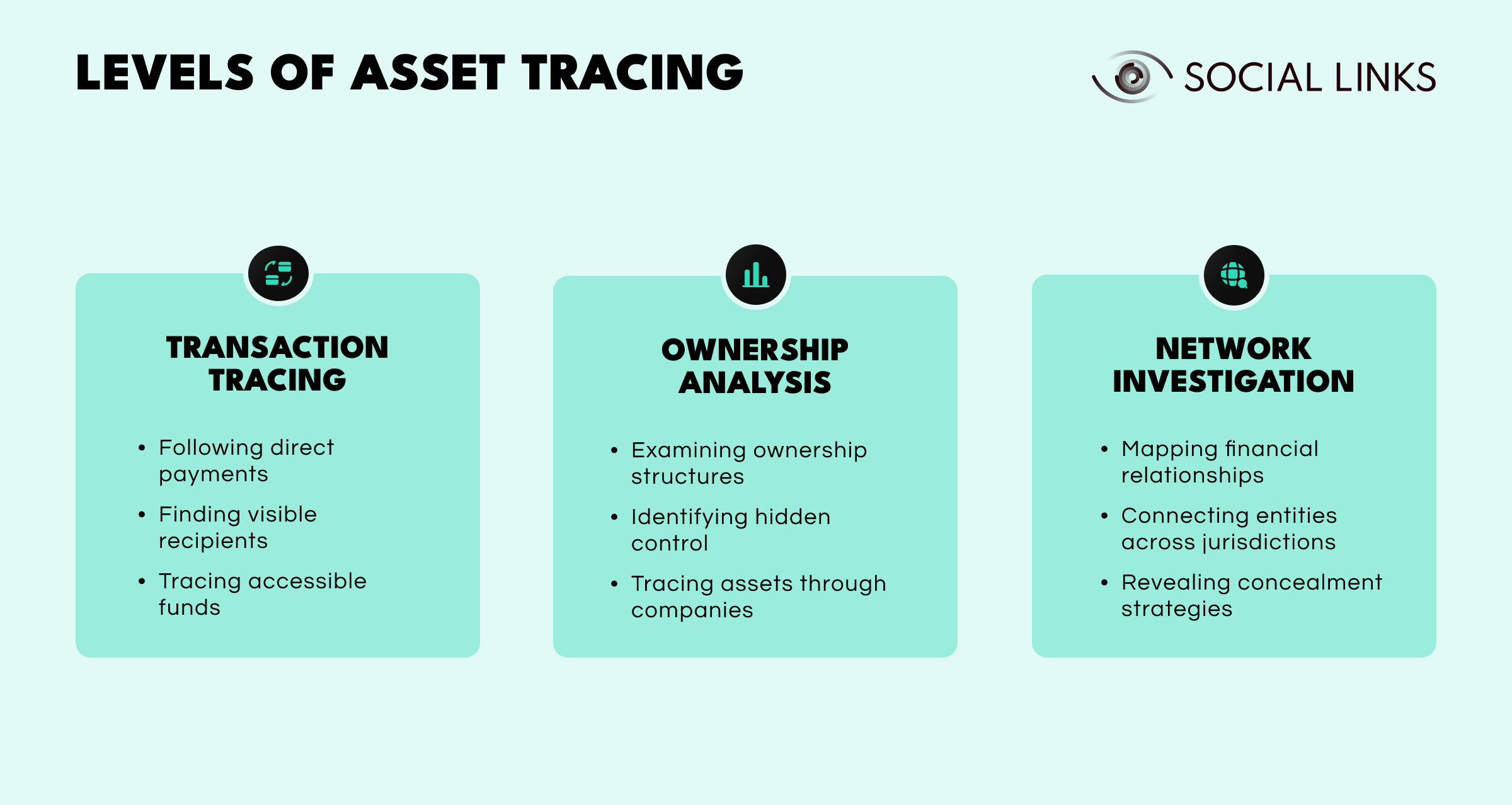
At the most basic level, investigators follow direct payment flows to identify immediate recipients.
This usually involves:
This works when assets remain visible and concealment is limited. But it often misses money that has already been moved into companies, converted into other assets, or placed under nominee ownership.
As investigations deepen, analysts begin examining corporate structures, beneficial ownership, and control relationships.
This level often includes:
This is where investigators begin connecting companies, properties, and accounts to the people behind them, even when formal ownership has been disguised. The limitation is that structure alone does not always reveal the full picture, especially when trusts, proxies, or multiple jurisdictions are involved.
At the most advanced level, investigators treat concealment as a coordinated system rather than a collection of isolated transactions or entities.
This level often includes:
Instead of looking at each company or payment in isolation, investigators map how the pieces fit together. Shared directors, repeated intermediaries, common addresses, transaction timing, and ownership patterns often reveal the real structure behind the concealment.
In asset tracing, the first visible transfer is rarely the whole story. A case may begin with a bank account, a payment trail, or a company name, but the real question is whether investigators stop at the first recoverable asset or keep going until the wider concealment structure comes into view.
Imagine a case involving $5 million in misappropriated funds. A narrow tracing effort follows the initial transfers and freezes $1.2 million sitting in an account under the suspect’s name. That is useful, but it captures only the portion of the scheme that remained exposed.
A deeper investigation keeps going. Analysts move from transfers to company records, property filings, and beneficial ownership data. What first looked like a single account turns out to be part of a larger structure involving seven shell companies across three jurisdictions, along with properties, business interests, and additional accounts tied to the same controller. By the time freezing orders are coordinated, the investigation is no longer recovering what happened to remain visible. It is recovering what was deliberately hidden.
The more fully investigators understand the structure behind the movement of funds, the more likely they are to preserve meaningful value rather than only the assets that were easiest to find.
Shallow tracing often fails because concealment is designed to create distance, noise, and delay.
Fraudsters do not usually make money disappear. They make it look ordinary, distant, or unrelated.
Common methods include:
Offshore tracing often involves layered company structures that appear independent on paper but are linked through common addresses, repeated directors, nominee services, or the same beneficial owner operating behind several entities.
More sophisticated concealment structures are dynamic. Assets move while the investigation is underway. Accounts are closed, properties are refinanced, and ownership is re-papered. In those cases, the goal is not to catalog every transaction, but to isolate the transactions that explain the scheme.
Open-source intelligence matters because many concealment structures still rely on public-facing infrastructure. People register companies, buy property, litigate disputes, attend events, publish biographies, and leave digital traces. None of that proves ownership on its own, but together it can expose patterns that justify deeper scrutiny.
Corporate registries remain one of the most important sources in asset tracing. They can reveal directors, shareholders, incorporation dates, registered addresses, and filing histories. Even incomplete registry data can support ownership analysis when compared across jurisdictions.
Useful questions include:
Property records, land registries, insolvency filings, and security interests help identify fixed assets and financing structures tied to the target. Court filings can also reveal disputes, creditors, or financial relationships that are not visible elsewhere.
Social media is not a substitute for formal records, but it can reveal relationships, assets, and lifestyles that support hidden wealth investigations. Photos, business announcements, travel patterns, and personal connections can all help link a person to an entity or asset that appears separate on paper.
The strongest tracing work combines multiple sources into a coherent ownership and control picture.
Important sources include:
The value comes from correlation, not volume.
Even strong investigations run into recurring obstacles.
Cross-border tracing becomes harder when entities are formed in secrecy-heavy jurisdictions or where ownership disclosure is limited. The challenge is not just access to records, but delay, fragmentation, and the legal effort required to move from intelligence to recovery.
Formal ownership is often misleading. The real controller may sit behind trusts, proxies, family members, or layered companies spread across multiple countries.
Some structures are built precisely to ensure that no single record looks suspicious on its own. That makes network analysis essential.
Assets do not always sit still. Accounts are closed, properties are sold, and ownership is transferred while the investigation is still developing. That creates pressure to work quickly and coordinate across jurisdictions.
Technology helps investigators process large volumes of financial and corporate data, identify anomalies, and connect relationships that would otherwise remain fragmented.
Key capabilities include:
Technology does not replace investigative judgment, but it does make deeper tracing possible at scale.
Asset tracing is becoming more data-rich and more cross-border at the same time. Investigators now have access to more registries, leaked datasets, public records, and digital footprints than ever before. At the same time, concealment strategies are becoming faster, more international, and more adaptive.
Several trends are shaping the field:
The core challenge has not changed: finding what someone does not want found. The methods are simply becoming sharper.
Effective asset tracing requires more than locating accounts or identifying visible property. It requires understanding how value, ownership, and control have been structured when someone is trying to hide them.
Investigations that move from transaction tracing to ownership analysis to network investigation recover more because they expose the systems used to conceal wealth, not just isolated assets.
The strongest tracing efforts combine corporate research, beneficial ownership analysis, financial intelligence, and open-source investigation to turn fragments into actionable evidence and support meaningful recovery.
Asset tracing is the process of identifying and following assets that may have been concealed, transferred, or misappropriated. It is used in fraud, corruption, insolvency, and legal disputes to support recovery efforts and show who controls hidden wealth.
Investigations often start with limited leads such as a payment record, company name, property, or known associate. Investigators then expand outward using corporate registries, ownership records, and financial analysis to identify connected assets and entities across jurisdictions.
The main challenges are offshore jurisdictions with limited disclosure, hidden beneficial owners using proxies and nominees, complex corporate networks designed to obscure control, and dynamic structures where assets move while the investigation is underway.
OSINT helps investigators use public records, corporate registries, media reports, and digital footprints to reveal ownership connections and financial relationships. It is especially useful when formal records alone do not show the full concealment structure.
Investigations typically progress through three levels: transaction tracing (following direct payment flows), ownership analysis (examining corporate structures and beneficial owners), and network investigation (analyzing financial relationships and concealment strategies). Deeper investigation exposes the systems used to hide assets, not just the most visible funds.
Want to see how intelligence platforms support asset tracing investigations? Book a personalized demo with one of our specialists and discover how SL Crimewall helps investigators map ownership structures, analyze financial networks, correlate corporate data, and support cross-border asset recovery through integrated analytical workflows.