Investigative Journalism and OSINT: Reporting in the Digital Age

Investigative journalism has always focused on uncovering what powerful institutions try to conceal. What has changed is the environment in which reporters operate. Corporate registries, social media networks, satellite imagery, procurement databases, and archived web content now generate a constant stream of publicly available data. That information has become an additional investigative layer, expanding how journalists trace relationships, verify claims, and follow complex structures across borders.
In this article, we examine how investigative journalism functions in digital environments, how open-source intelligence (OSINT) integrates with traditional reporting, and how combining both approaches strengthens network analysis, source verification, and cross-border investigations.
Investigative journalism goes beyond reporting events. It uncovers hidden facts, exposes abuse of power, and examines systems that affect the public interest. Unlike daily news coverage, investigations involve sustained research, careful verification, and deliberate publication decisions.
Core elements include:
Investigations prioritize depth and accuracy over speed. They often take months or even years to complete, particularly when they involve complex financial structures or cross-border activity.
Modern investigative reporting increasingly operates across three interconnected layers. Each contributes something distinct, and their combined use strengthens the overall investigation.
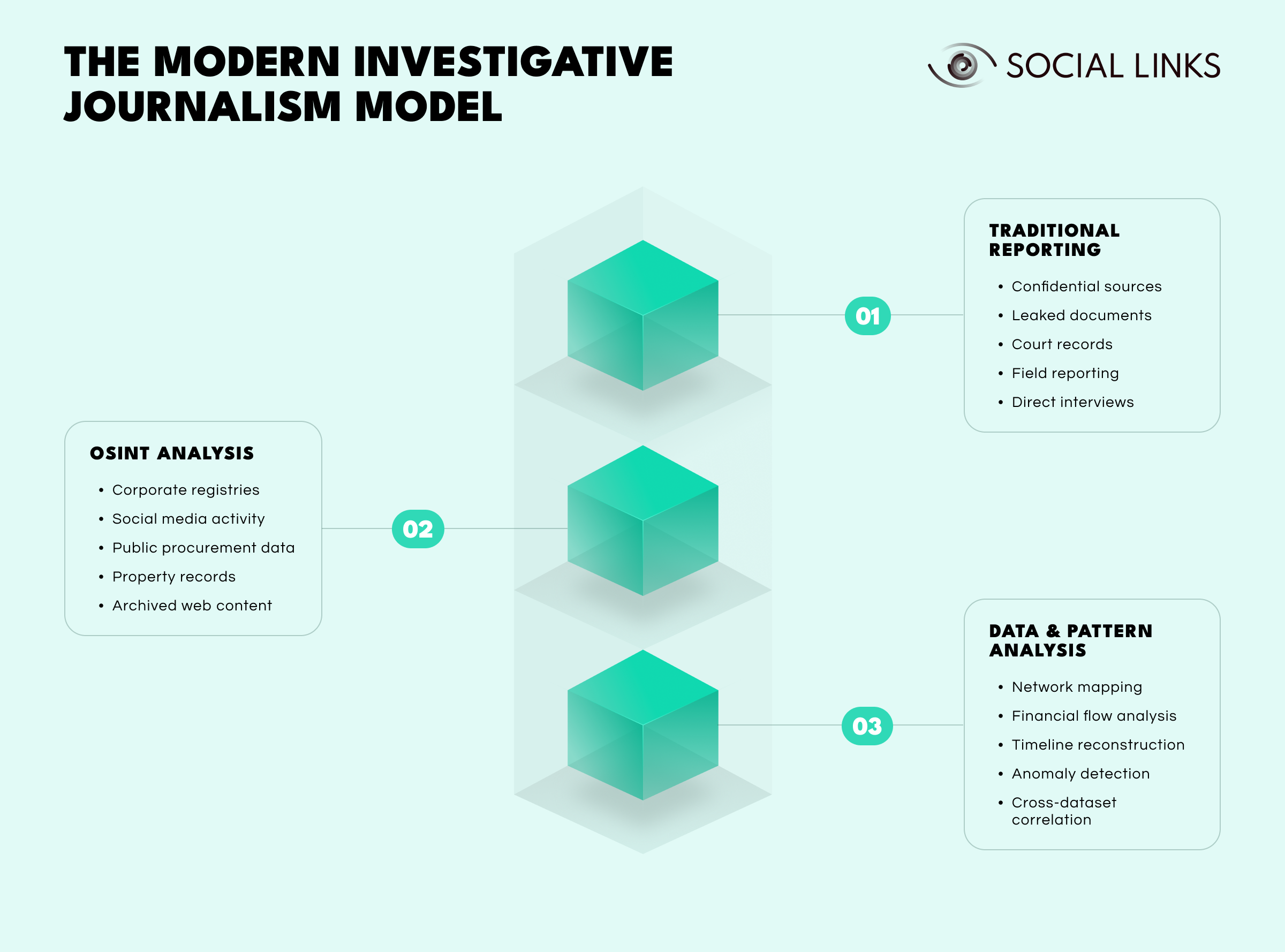
This includes:
Traditional methods provide depth, human insight, and context. They help explain intent and internal decision-making. However, they are time-intensive and limited in scale. A reporter cannot manually review thousands of filings across multiple jurisdictions without structured support.
The OSINT layer involves systematic analysis of publicly available information, such as:
OSINT offers breadth and cross-border visibility. It reveals structural connections—shared directors, repeated addresses, coordinated online activity—that may not be obvious from interviews alone. However, public data shows structure, not intent. Findings require interpretation and verification.
Because misinformation and outdated records are common, public information must be validated carefully before publication.
The third layer processes large datasets to detect patterns at scale, including:
Data analysis highlights patterns that might otherwise remain hidden. It can identify unusual transaction flows or overlapping corporate structures, but it cannot explain motives without additional reporting context.
Investigations are strongest when these layers reinforce one another.
Consider a typical example:
A leaked document identifies a shell company. Public registries reveal that the same directors appear across multiple entities. Data analysis shows overlapping financial flows between those entities. Field reporting confirms that registered addresses correspond to real operations. Confidential sources then clarify how the structure was used.
No single layer produces the full picture. The story emerges from their integration.
Investigations weaken when layers remain isolated—when leaked documents are not cross-checked against public records, when OSINT findings are not validated through reporting, or when data patterns lack human context.
Open-source intelligence addresses several practical gaps in traditional reporting.
Shell companies, nominee directors, and offshore entities are often designed to obscure ownership. By cross-referencing public records, journalists can trace shared addresses, recurring directors, and timing patterns in company formation. This allows them to map networks rather than focus on isolated entities.
Financial crime and corruption frequently span jurisdictions. Public records across countries can be correlated without relying exclusively on confidential leaks or formal cooperation agreements. OSINT makes cross-border analysis more feasible and systematic.
Public statements can be compared against:
This approach strengthens verification by moving beyond anecdotal contradiction toward documented comparison.
Many investigations hinge on sequence. Archived content, filing dates, procurement announcements, and geolocated imagery provide objective timestamps. These anchors reduce reliance on contested testimony and support stronger narrative reconstruction.
Monitoring public registries, asset transfers, or coordinated online behavior can surface signals worth deeper reporting. OSINT does not replace editorial judgment, but it expands the pool of verifiable leads.
Effective OSINT depends more on methodology than on specific tools.
Common sources include:
Verification practices typically involve:
Public availability does not guarantee reliability. Findings must be confirmed with the same rigor applied to confidential sources.
OSINT expands investigative capacity, but it introduces constraints.
Public data often contains misinformation or deliberate manipulation. Privacy laws and platform policies restrict how information can be collected and published. Online identities are easily fabricated, increasing the risk of misattribution. Content can disappear without warning, requiring careful archiving. Sustained OSINT work also demands time, technical skill, and editorial discipline.
Maintaining credibility requires consistent standards of verification and ethical judgment.
Today’s investigative journalist combines traditional reporting skills with digital literacy. Core capabilities include:
Journalists do not need to become programmers, but they must understand digital environments well enough to evaluate evidence critically and collaborate effectively with data specialists.
Many newsrooms now operate interdisciplinary teams that integrate reporters, data analysts, and OSINT practitioners.
Digital investigations carry tangible risks that extend beyond the reporting process itself. Journalists examining corruption, financial crime, or coordinated influence operations may encounter surveillance, legal intimidation, strategic lawsuits, or sustained online harassment. The digital trail that enables investigative work can also expose reporters and their sources to scrutiny.
Managing these risks requires more than caution. Secure communication practices, careful data handling, and clear protocols for source protection are now part of investigative discipline. Newsrooms also need institutional legal support and defined ethical standards to guide publication decisions in complex cases. Strong reporting depends not only on evidence, but on protecting the people involved in uncovering it.
Investigative journalism has not changed its mission; it has expanded its methods. Traditional reporting continues to provide depth and human context. OSINT offers broader structural visibility. Data analysis adds scale and pattern recognition.
When these layers are integrated thoughtfully, journalists are better equipped to trace financial flows across borders, expose hidden ownership structures, reconstruct timelines, and document abuses of power with greater precision.
The most effective investigations do not treat these methods as competing approaches. They combine them. In a digitally complex environment, that integration has become central to accountability reporting.
Investigative journalism focuses on uncovering hidden facts, corruption, or abuse of power through sustained research and verification. Unlike daily reporting, it prioritizes documentation, depth, and public interest over immediacy.
OSINT enables journalists to analyze public records, map networks, verify claims systematically, and reconstruct timelines across jurisdictions. It complements traditional reporting by expanding visibility and scale.
OSINT in journalism refers to the structured analysis of publicly available information—such as corporate registries, social media, procurement records, and satellite imagery—to support investigative reporting.
The primary risks include misinformation, misattribution, legal exposure, and data volatility. Strong verification standards and ethical safeguards help mitigate these risks.
Want to see how structured intelligence platforms support investigative research and complex analysis? Book a personalized demo with one of our specialists and discover how SL Crimewall helps journalists and researchers correlate multi-source data, map networks, and validate findings through unified analytical workflows designed for investigative integrity.