Mapping the Trade: Inside Drug Trafficking Investigations
The global narcotics trade operates through organized criminal networks that span continents, exploit digital technologies, and constantly adapt to enforcement pressure. Disrupting these operations requires more than intercepting shipments at borders. It requires investigations that reveal how trafficking groups are structured, how they communicate, and how drugs and profits move across jurisdictions.
In this article, we examine how drug trafficking investigations progress from isolated signals to coordinated disruption. We explore how investigators move from detecting suspicious activity to mapping criminal structures and developing operational intelligence. Along the way, we look at how open-source intelligence, financial analysis, and network mapping help reveal the people and infrastructure behind narcotics trafficking.
Drug trafficking involves the illegal production, transportation, and distribution of controlled substances. These activities are typically coordinated by organized criminal groups operating across multiple countries.
To reduce risk, trafficking organizations divide responsibilities among different participants. This separation protects leadership and allows the network to continue operating even when some members are arrested.
Most trafficking organizations operate through layered structures that separate leadership from day-to-day activity.
Production groups manage cultivation or synthesis in source regions, often far removed from the consumer markets where drugs are ultimately sold.
Logistics coordinators organize transportation across borders. They arrange smuggling routes through maritime containers, air cargo, land crossings, or human couriers. Routes shift frequently as organizations respond to enforcement pressure.
Distribution managers oversee regional sales. They recruit street-level distributors, coordinate deliveries, and collect proceeds from local markets.
Financial facilitators move profits through laundering mechanisms designed to conceal the origin of funds.
This structure protects senior figures from direct exposure. Arresting a courier or local distributor rarely reveals who is coordinating the wider operation.
Digital tools have significantly changed how trafficking groups coordinate activity. Encrypted messaging platforms allow participants in different regions to communicate while maintaining operational security, while online marketplaces enable direct sales to consumers.
Social media also plays a role. It may be used to recruit distributors, advertise products through coded language, or coordinate logistics.
Even when communication is encrypted, digital activity still produces traces. Usernames, wallet addresses, contact patterns, and posting behavior create signals that analysts can examine to understand how individuals are connected.
Most drug trafficking investigations begin with isolated signals—a seizure, suspicious financial activity, or online indicators. As analysts connect those signals to people, money flows, and logistics routes, the investigation develops into a broader effort to understand and disrupt the trafficking network.
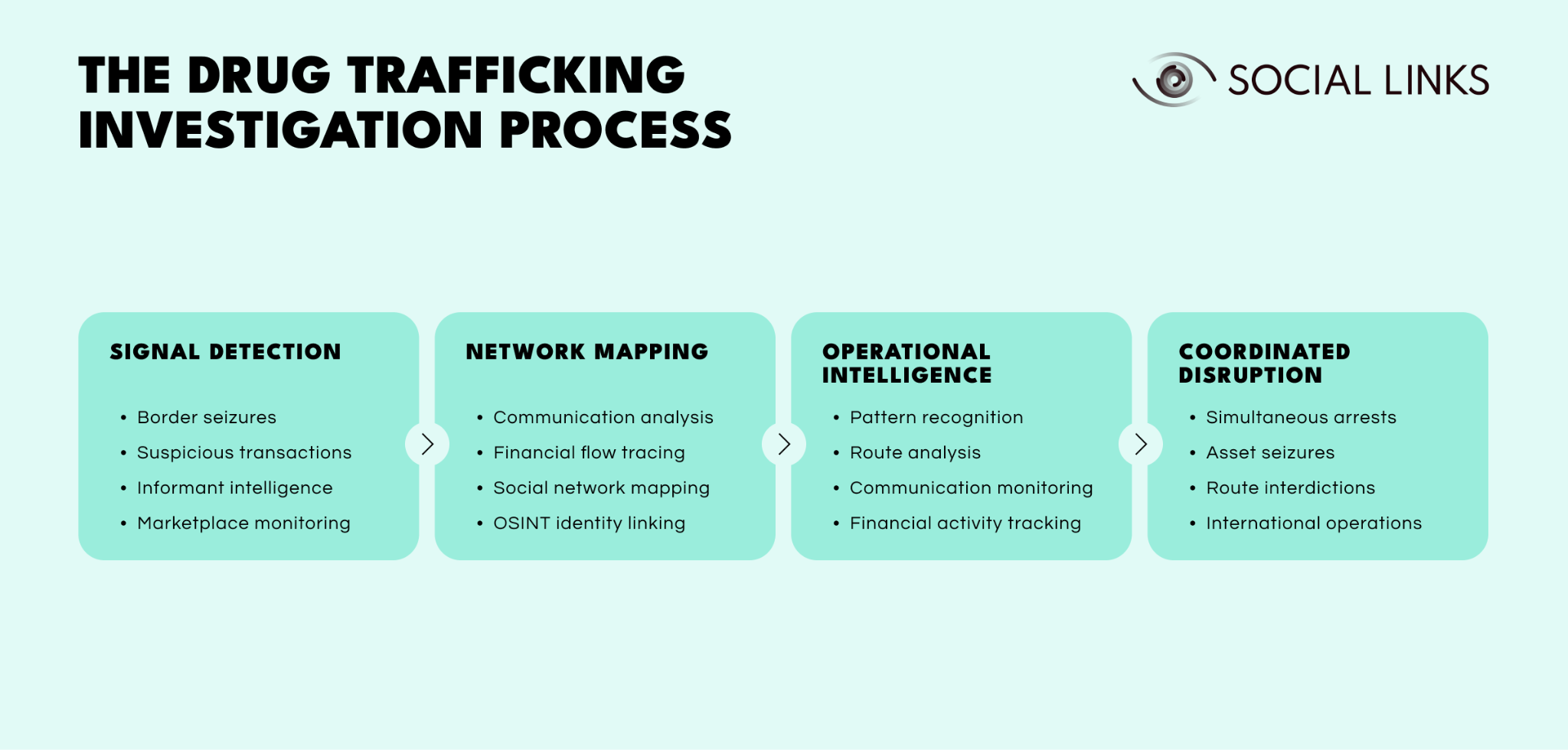
Investigations usually begin when indicators suggest possible trafficking activity.
Signals may come from:
At this stage investigators have isolated signals but limited insight into the broader organization behind them.
For example, customs officers may intercept a shipment containing concealed narcotics. The courier is arrested, but little is known about who organized the shipment, how often the route is used, or who ultimately receives the drugs.
Once the initial signals are validated, the investigation shifts toward identifying the people involved and understanding how they are connected.
Several analytical approaches help reveal these relationships:
As these pieces come together, investigators begin to see how suppliers, logistics coordinators, distributors, and financial facilitators interact within the trafficking network.
With the network structure understood, investigators can begin anticipating trafficking activity before it occurs.
This stage focuses on identifying patterns associated with operational planning.
For example, analysts monitoring a known trafficking network may observe communication patterns similar to those seen before previous shipments. At the same time, financial transfers may appear that match known logistics funding behavior. Together, these signals allow authorities to anticipate shipments rather than relying on chance interceptions.
The final stage involves coordinated actions designed to degrade or dismantle the trafficking network.
Disruption strategies may include:
For example, authorities may coordinate arrests in several countries while intercepting shipments and freezing financial accounts at the same time.
These operations succeed because investigators first mapped the network and understood how the organization functions, allowing enforcement actions to target the organization as a whole rather than isolated participants.
The difference between a tactical seizure and a strategic investigation often comes down to how far the investigation develops. Consider two responses to the same border seizure.
Agents intercept a shipment and arrest the courier. Drugs are removed from circulation, but the network quickly replaces the courier and continues operations.
The same seizure triggers communication analysis, financial tracking, and network mapping. Analysts identify multiple participants across several countries. Coordinated arrests target leadership and logistics coordinators while additional shipments are intercepted.
The initial signal is identical. The difference lies in how far the investigation progresses.
Open-source intelligence supports every stage of the investigation.. Publicly available information helps validate signals, identify participants, and refine operational understanding.
Trafficking participants often use social media for recruitment, communication, or product promotion.
Monitoring these platforms can reveal:
Online patterns of association often reveal relationships that traditional intelligence sources miss.
Dark web marketplaces have become significant retail channels for narcotics distribution.
Analysts examine:
Accounts that appear independent may actually belong to the same organization. Linking them can reveal the true scale of an operation.
Even anonymous actors leave traces online.
Usernames reused across platforms, email addresses tied to accounts, cryptocurrency wallets appearing in multiple transactions, and posting behavior all create identifiable patterns.
Connecting these signals helps link digital personas to individuals and organizations involved in trafficking activity.
Following the money remains one of the most effective ways to identify trafficking participants and facilitators.
Drug trafficking generates large amounts of cash that must be laundered before it can be used safely.
Indicators often include:
Financial facilitators who specialize in laundering often support multiple criminal groups. Identifying one facilitator can expose several otherwise unrelated operations.
Cryptocurrency now plays a bigger role in online drug markets.
Although transactions are pseudonymous, blockchain analysis allows investigators to trace wallet activity, identify transaction patterns, and detect relationships between participants.
Unlike traditional banking transactions, blockchain records remain permanently visible, allowing investigators to reconstruct financial activity long after it occurs.
Modern drug investigations increasingly rely on analytical tools capable of processing large volumes of data.
Network analysis platforms visualize relationships between individuals, accounts, communication events, and financial transactions. These tools help identify central coordinators and hidden intermediaries.
Data analytics systems process communication records, financial data, and travel activity to identify patterns associated with trafficking operations.
Integrated investigation platforms combine communication data, financial intelligence, open-source information, and law enforcement databases into a unified analytical environment.
Bringing these data sources together helps reveal connections that would otherwise remain hidden.
Even well-developed investigations face persistent obstacles.
Trafficking networks operate internationally, while law enforcement authority remains jurisdictional. Evidence collected in one country may not be admissible in another, making international cooperation essential.
Organizations such as INTERPOL and the United Nations Office on Drugs and Crime support intelligence sharing and joint operations.
Criminal groups increasingly rely on encrypted messaging and anonymization technologies. Even when message content cannot be accessed, metadata analysis can still reveal communication patterns.
Developing investigations beyond early detection stages requires sustained resources. Network mapping, intelligence analysis, and international coordination demand specialized expertise and long-term monitoring.
As a result, many investigations never progress beyond early stages and produce limited strategic impact.
Several developments are shaping the future of narcotics investigations.
Artificial intelligence and machine learning are improving the ability to detect patterns in large datasets. Blockchain analysis tools are increasing transparency around cryptocurrency transactions.
Public-private partnerships are also expanding as financial institutions and technology companies cooperate more closely with law enforcement.
Most importantly, intelligence-led policing models are gaining wider adoption. Agencies increasingly recognize that focusing on networks rather than isolated seizures produces far greater long-term disruption.
Drug trafficking investigations achieve the greatest impact when they move beyond isolated enforcement actions and develop a deeper understanding of criminal structures.
Effective investigations progress through four stages: detecting signals, mapping networks, developing operational intelligence, and coordinating disruption.
Agencies that invest in analytical capabilities, international cooperation, and intelligence-driven methods are far better positioned to disrupt trafficking organizations and limit the reach of the global narcotics trade.
Drug trafficking investigations are law enforcement efforts to identify and disrupt criminal networks involved in narcotics production, transportation, and distribution. Effective investigations progress through stages: detecting intelligence signals, mapping network structure, developing operational intelligence, and coordinating disruption across jurisdictions.
Open-source intelligence helps investigators analyze social media activity, dark web marketplaces, and digital footprints to identify network participants, understand distribution methods, and link online identities. OSINT complements traditional intelligence by revealing connections visible in publicly available information.
Financial intelligence helps investigators track money laundering, identify financial facilitators, and understand organizational structure. Following money flows often reveals network participants who are not directly involved in moving drugs but who profit from operations.
Trafficking networks operate across multiple countries. Effective disruption requires coordinated operations involving law enforcement from all affected jurisdictions. International cooperation enables intelligence sharing, simultaneous arrests, and action against networks that exploit jurisdictional boundaries.
Want to see how unified intelligence platforms support drug trafficking investigations and criminal network analysis? Book a personalized demo with one of our specialists and discover how SL Crimewall helps law enforcement agencies map criminal networks, analyze financial flows, and coordinate multi-jurisdictional investigations through integrated analytical workflows.