Public Safety: Intelligence and OSINT in Modern Investigations
Public safety threats no longer appear only as sudden incidents on the ground. Many of them develop gradually across digital spaces—through social media activity, online coordination, and open platforms—before they take shape in the physical world. This shift means that protecting public safety is no longer just about responding to events, but about recognizing early signals scattered across open sources.
In this article, we examine how intelligence-led approaches strengthen public safety operations, how OSINT enables earlier risk detection and stronger situational awareness, and how law enforcement agencies use publicly available data to identify emerging threats, support public safety investigations, and make more informed operational decisions.
Public safety intelligence is the structured use of information to support threat detection, operational planning, and community protection. It is not simply about collecting data. It is about turning fragmented information into clear, actionable insight that law enforcement agencies can actually use.
Instead of waiting for incidents to occur, public safety intelligence works continuously across multiple open sources, including:
The result is earlier visibility into risk patterns, emerging coordination, and potential threats. This allows security agencies and law enforcement officers to prioritize resources before situations escalate.
Traditional public safety models are built around response. An incident occurs, units are deployed, evidence is collected, and an investigation follows. This model remains essential and will always be a core part of public safety work.
However, modern threats are faster, more coordinated, and often organized online. By the time an incident becomes visible, critical warning signals may have already existed for days or weeks.
Intelligence-led public safety adds a continuous analytical layer. Instead of relying only on post-incident investigation, agencies monitor trends, detect patterns, identify risks early, and adjust operations accordingly. The goal is not prediction for its own sake. The goal is better timing, better prioritization, and more precise response.
In many cases, the real issue is not a lack of data. It is that available intelligence is collected but never fully integrated into day-to-day operational decision-making.
Open-source intelligence, or OSINT, refers to the systematic analysis of publicly available information from sources including social media, open databases, public records, and digital platforms. OSINT in public safety expands visibility without relying solely on classified channels or delayed reporting.
This approach strengthens public safety intelligence in several practical ways:
Most importantly, OSINT enables law enforcement agencies to connect signals across platforms and over time. A single data point may seem insignificant. A pattern across multiple sources often reveals something operationally relevant.
Digital signals rarely confirm criminal activity on their own. Their value comes from patterns, consistency, and correlation across sources. When analyzed properly, these indicators help uncover hidden risks and support more focused public safety investigations.
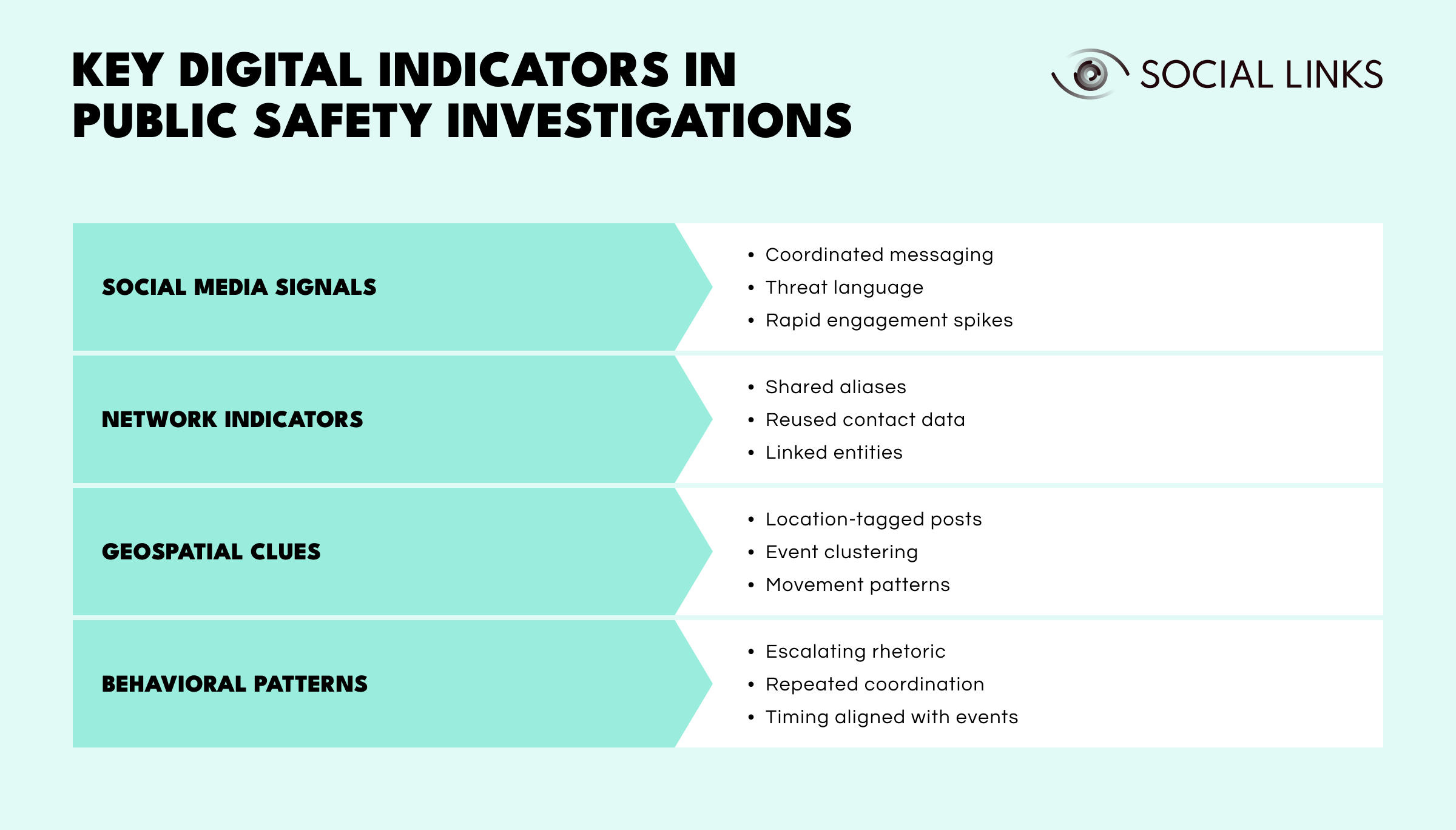
Coordinated messaging, threat language, and sudden engagement spikes can indicate mobilization, organized campaigns, or escalating intent. These signals are especially important during large-scale events or developing incidents.
Shared aliases, reused contact data, and linked entities across platforms can reveal organized activity rather than isolated behavior. This type of analysis helps map relationships that would otherwise remain invisible.
Location-tagged posts, event clustering, and movement patterns provide real-world context. They support situational awareness and help security agencies understand how digital activity connects to physical locations.
Escalating rhetoric, repeated coordination attempts, and timing aligned with real-world events can indicate preparation rather than random online activity. Over time, these patterns help law enforcement officers distinguish noise from credible risk.
The operational value increases when these indicators are analyzed together. One concerning post may be irrelevant. Coordinated messaging combined with linked accounts and geospatial activity presents a very different risk profile.
Operational value is where public safety intelligence becomes practical rather than theoretical. OSINT is not only useful for analysis; it directly supports day-to-day investigative workflows, real-time response planning, and cross-agency coordination in complex environments.
OSINT supports criminal investigations by linking digital footprints across platforms and jurisdictions. An alias connected to one case may also appear in public records, online marketplaces, or additional accounts. This broader context helps investigators understand network scope faster and allocate investigative resources more effectively.
During protests, concerts, sporting events, or other large-scale gatherings, OSINT improves real-time situational awareness. Monitoring open sources can reveal emerging flashpoints, crowd movement patterns, and coordination signals. This enables law enforcement agencies to adjust deployment and response before situations escalate.
One of the most valuable uses of OSINT in public safety is early risk detection. Escalating online behavior, discussions about targets, or coordinated messaging can act as early warning signals. When validated through multiple data sources, these indicators support timely intervention and preventive action.
Criminal activity often spans multiple regions. Because OSINT relies on open sources, it provides a shared analytical baseline for different law enforcement agencies. This supports coordination even when formal intelligence-sharing processes are still in progress.
Taken together, these applications show that OSINT in public safety is less about isolated data collection and more about operational context. By linking signals across sources and time, law enforcement agencies gain clearer visibility, faster prioritization, and more coordinated responses in evolving investigations.
Despite its value, OSINT in public safety operations comes with clear limitations that must be managed carefully.
Information overload is a major challenge. Open sources generate large volumes of data, and without proper filtering, analysts can be overwhelmed rather than informed. Verification is equally critical, as public information may include misinformation, satire, or deliberate deception.
Legal and privacy considerations also shape how OSINT can be collected, stored, and used. Security agencies must operate within established regulatory and ethical frameworks. In addition, platform policies and content removal can disrupt investigative workflows, while misattribution risks require disciplined analytical methodology.
These constraints do not reduce the importance of OSINT. They simply reinforce the need for structured processes, trained analysts, and validated intelligence workflows.
Public safety has evolved alongside the digital environment. Threats that once appeared suddenly now often leave detectable signals across open platforms before manifesting in the real world.
Intelligence-led public safety strengthens traditional response models by adding continuous analysis, broader visibility, and earlier risk identification. OSINT enables law enforcement agencies to uncover patterns, improve situational awareness, and support proactive public safety investigations using publicly available information.
Ultimately, the key question is not whether relevant signals exist in open sources. It is whether agencies have the analytical structure, validation discipline, and operational integration needed to turn that information into actionable public safety intelligence.
OSINT in public safety investigations involves analyzing open sources such as social media, registries, and public platforms to identify risk indicators, uncover networks, and support criminal investigations. It provides early context that complements traditional investigative methods.
Public safety intelligence is the ongoing process of collecting and analyzing information from multiple data sources to support law enforcement operations. It improves situational awareness, prioritization, and decision-making in complex investigations.
OSINT in public safety provides real-time data about events, online coordination, and emerging risks. This helps law enforcement officers adapt their response based on current developments rather than delayed reports.
Yes. Public safety intelligence enables law enforcement agencies to analyze information across jurisdictions and open sources, making it particularly valuable for large scale and multi-agency investigations.
Key risks include misinformation, attribution errors, legal constraints, and data overload. Strong validation practices, clear governance, and structured analytical workflows help reduce these risks while maintaining investigative integrity.
Want to see how structured intelligence platforms support public safety investigations and threat analysis? Book a personalized demo with one of our specialists and discover how SL Crimewall helps law enforcement agencies correlate multi-source data, identify risk patterns, and support intelligence-led operations through unified analytical workflows.