Trust: The Central Currency of the AI Agent Economy
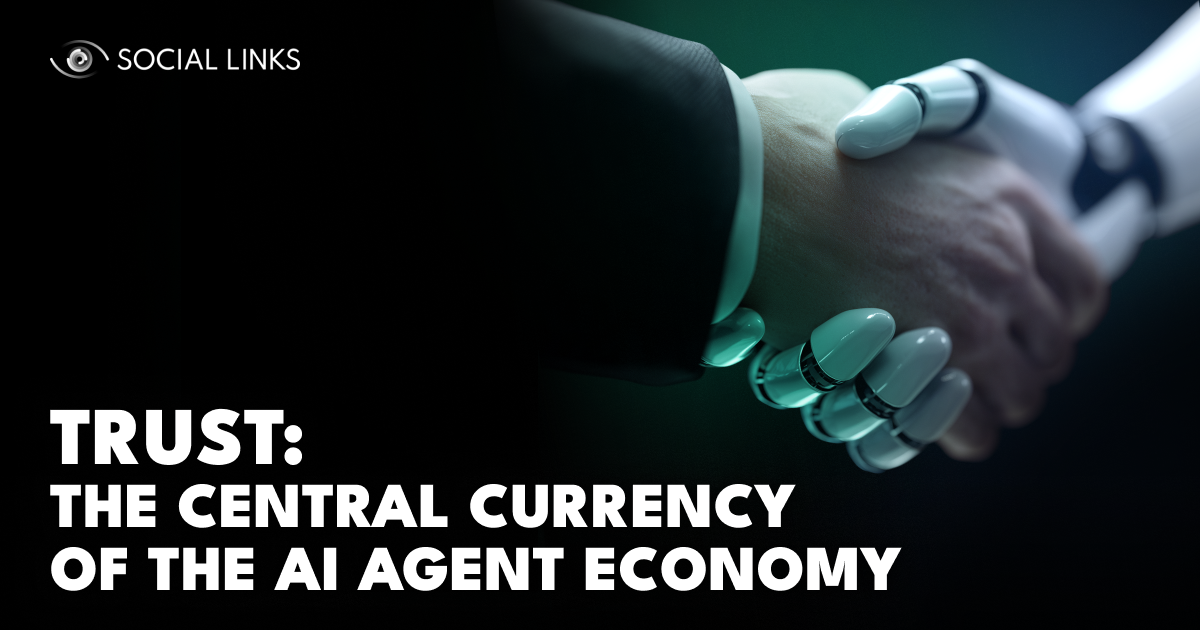
As Nobel Laureate Kenneth Arrow once observed, every economic transaction involves an element of trust. Today, as transactions are increasingly handled by AI agents, that trust is coming under new pressures. While global trust levels are in decline, the presence of AI agents in our daily lives and business systems is rapidly increasing.
In a pessimistic scenario, this could erode confidence. In an optimistic one, it opens pathways to reimagine trust and to fuel economic growth. Indeed, the connection between societal trust and economic performance is well documented—Deloitte Insights claim a 10 pp increase in a country’s trusting demographic would raise annual per capita GDP growth by about 0.5 pp.
While this relationship will evolve as we move beyond human-to-human interactions towards agentic exchanges, there’s a constant—trust will continue to shape outcomes in the AI-powered economy. In light of this, certain questions come to the fore: What kind of trust will matter most—and how do we build it?
The digital economy is becoming agentic. AI agents are moving from assistive tools to autonomous entities that can execute transactions, allocate resources, and make decisions.
While AI has matured over decades, we’re at the threshold of a tipping point. According to Gartner's Hype Cycle for Artificial Intelligence, AI agents are at the very forefront of the paradigm shift, with an expected implementation period of just 2 to 5 years. If true, this means that by 2028, ~33% of enterprise software applications will include agentic AI with at least 15% of day-to-day work decisions being made autonomously through AI agents.
The AI agent economy will represent a fully-fledged new reality requiring entirely new forms of accountability, collaboration, and of course trust—at the heart of which lies two foundational components: competence (the ability to execute) and intent (the purpose behind actions). While few now question the competence of advanced technologies, intent remains a foggy frontier.
Research shows that trust in AI varies significantly across regions and demographics. According to research by KPMG and the University of Melbourne, people in advanced economies are less trusting in AI (39% vs. 57%) and accepting (65% vs. 84%) compared to emerging economies. From a sociological perspective, in these environments, trust remains grounded in interpersonal relationships or traditional institutions.
The latest Edelman Trust Barometer Global Report describes the current environment as a “crisis of grievance”. The greater the sense of grievance, the deeper the suspicion toward AI. Individuals who feel a heightened sense of injustice or discontent are significantly less likely to trust AI—and are notably more uneasy with its use by businesses.
As trust in institutions erodes, so too does comfort with AI’s growing role in business and governance. Understanding how trust is formed will be essential.
As autonomous agents proliferate, we must rethink how trust functions across three key domains:
One of the greatest challenges to trust in AI remains a lack of clarity around agent intent. For example, autonomous vehicles may be statistically safer than human drivers, yet they are still distrusted by many due to uncertainty about the values guiding their decisions. This points to a broader need for transparent, explainable intent within AI systems—not just capabilities, but motivations.
From a systems perspective, we also face technical challenges: how to ensure seamless and secure data exchange, how to verify agent identity across platforms, and how to create common protocols that allow for the transmission of not just information, but trust itself.
But perhaps the most difficult challenge lies in mindset. As Sequoia Capital venture firm has pointed out, success in the agent economy requires more than new technology—it demands a new kind of leadership, one that understands what AI agents can and cannot do, and how they should be governed.
The next five years offer a narrow but critical window for shaping how trust functions in a world of autonomous agents. With the global AI agents market size projected to reach $50.31B by 2030, the potential for businesses is vast. Yet so too is the potential security issue—fraud and other threats could multiply exponentially unless robust trust frameworks are established.
As autonomous AI agents evolve, the possibilities for fakes and fraud will only expand. This is a horizon fraught with a decrease in trust and volatile economic indicators. Deloitte’s Center for Financial Services predicts that GenAI could enable fraud losses to reach $40 billion in the United States alone. Extrapolated across the global economy, this would mean losses that exceed the market size of agentic AI.
Now is a time of critical decisions—we can choose to be laissez-faire in a climate of growing mistrust, driven by confusion, manipulation, and digital overload. Or we can take the bull by the horns and build new trust architectures that are grounded in clarity, consistency, and shared human values.