Anticipating Risk: The Power of OSINT in Brand Intelligence
Brand intelligence once focused on tracking mentions, measuring sentiment, and monitoring media coverage. That model worked when brand risk moved slowly and stayed mostly reputational. Today, brands operate inside fragmented digital ecosystems where impersonation, fraud, misinformation, counterfeit activity, and coordinated manipulation can emerge and scale in days. A brand is no longer just a name or logo. It is an identity surface spread across domains, platforms, infrastructure, and online communities—each creating new exposure and operational risk.
This article examines how open-source intelligence reframes brand intelligence from passive monitoring into an investigative discipline. It explains why visibility across open digital ecosystems matters more than raw mention volume, how OSINT-driven workflows reveal real exposure and emerging risk, and what organizations should prioritize as brand intelligence becomes a core operational capability rather than a reporting function.
Traditional brand monitoring answers visibility questions: how often a brand appears, where it is mentioned, and whether sentiment trends are positive or negative. While these metrics still matter, they rarely explain causality, coordination, or responsibility. A spike in mentions may signal attention, but it does not reveal who is driving it, how it spreads, or whether it represents real risk.
OSINT changes the starting point. Instead of treating mentions as the primary unit of analysis, it treats entities and behavior as the core objects of investigation. A brand becomes a network of connected assets: domains, social accounts, marketplaces, advertising infrastructure, creative materials, and human operators. Each public trace can be verified, linked, and tracked over time.
This difference becomes clear in practice. A fake storefront appears on a marketplace. A similar domain launches days later. Social accounts promote the same offer. Paid ads drive traffic. Complaints surface in forums and review sites. In isolation, each signal looks unrelated. When correlated through OSINT, they form a single operational pattern with shared infrastructure and coordination. What looks like scattered noise becomes a measurable campaign.
Brand intelligence means shifting from counting signals to understanding how systems behave.
Modern brand risk extends far beyond reputation. Financial loss, regulatory exposure, customer harm, and long-term trust erosion often follow quickly once abuse scales. The problem is not a lack of data. Organizations already collect massive volumes of digital signals. The real challenge is connecting weak signals early enough to act with confidence.
Investigative visibility allows teams to answer operational questions that surface monitoring alone cannot resolve:
When teams can link identities, infrastructure, and behavior, they stop reacting to individual alerts and start managing campaigns. Attribution improves prioritization. Correlation reduces false urgency. Early visibility shortens response timelines without increasing workload.
Visibility without attribution creates noise. Attribution without context leads to fragile conclusions. OSINT bridges that gap.
From an intelligence perspective, a brand exists as a living digital footprint rather than a static asset. OSINT maps this footprint across several connected layers:
Digital identities. Official and unofficial social profiles, impersonation accounts, marketplace sellers, app listings, and influencer channels.
Infrastructure. Domains, hosting providers, certificates, redirects, tracking services, and delivery networks that support activity.
Narratives and amplification. Media coverage, coordinated messaging, influencer networks, misinformation campaigns, and amplification behavior.
Operational exposure. Fraud schemes, counterfeit distribution, phishing operations, abuse networks, and customer targeting behavior.
Each layer provides partial insight. Real value emerges when these layers connect. A suspicious account links to a domain. The domain links to hosting patterns. Those patterns link to prior campaigns. Over time, attribution strengthens, recurrence becomes visible, and risk becomes measurable rather than speculative.
At this point, brand intelligence begins to resemble investigative work rather than analytics.
With investigative visibility in place, OSINT starts translating into practical use cases across security, risk, and strategy teams.
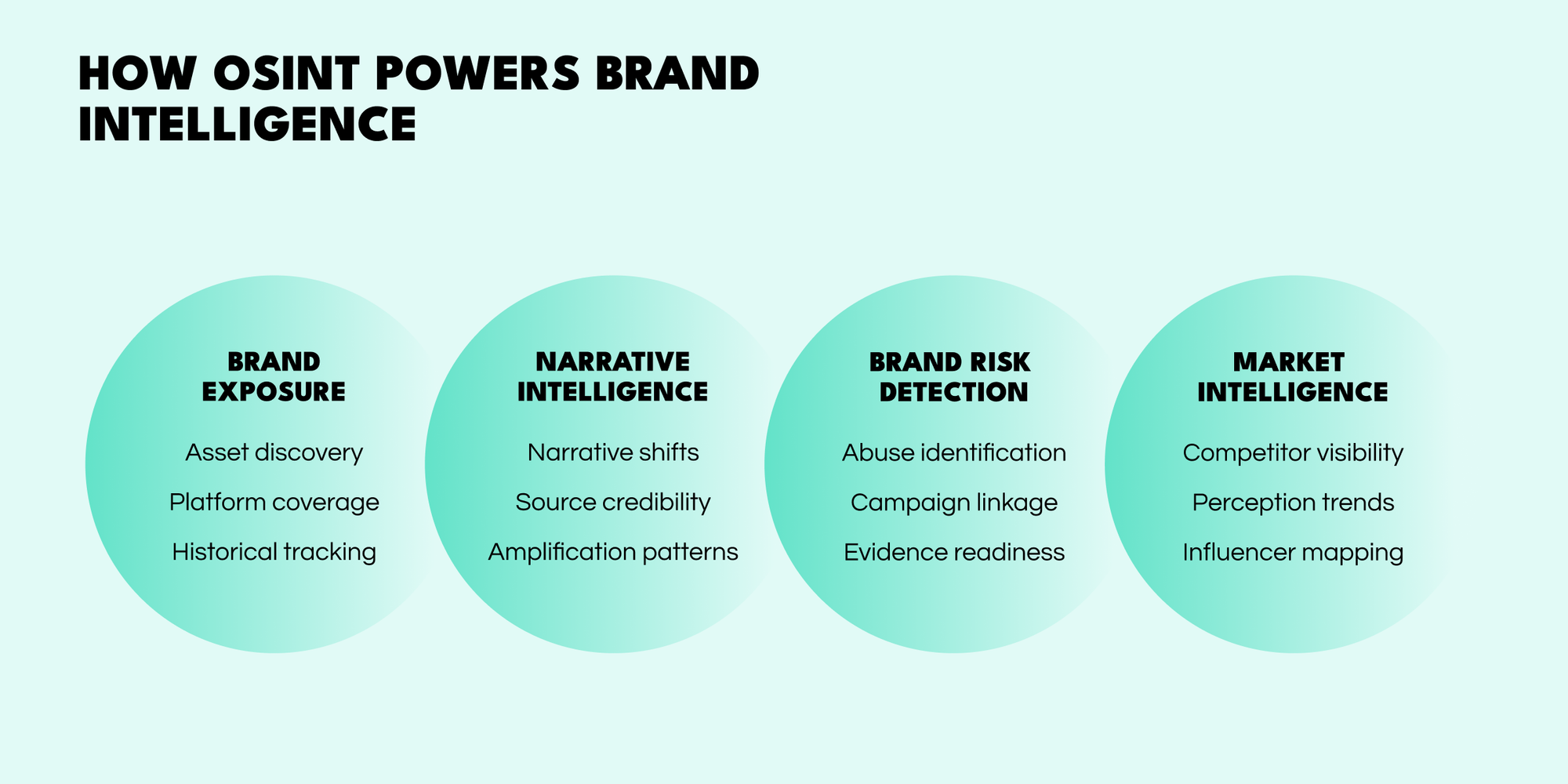
Brand exposure focuses on understanding where and how a brand exists across open digital ecosystems—both officially and unofficially. This includes shadow domains, impersonation profiles, unauthorized marketplace listings, advertising artifacts, and supporting infrastructure that rarely surfaces through basic monitoring.
Instead of tracking mentions, OSINT builds an inventory of brand-linked entities and observes how they evolve over time.
Teams gain:
Exposure visibility creates the foundation for enforcement planning and long-term risk tracking.
Narrative intelligence examines how stories, claims, and perceptions about a brand form, spread, and gain influence. Rather than relying only on sentiment metrics, OSINT evaluates source credibility, amplification patterns, coordination signals, and message consistency.
This helps teams understand not just what is being said, but how narratives move and why certain messages gain traction.
Teams gain:
Narrative intelligence supports proactive crisis detection and reputational risk management instead of reactive damage control.
Brand risk detection focuses on identifying operational abuse tied to fraud, counterfeiting, impersonation, phishing, and coordinated exploitation. OSINT correlates domains, social accounts, creative assets, hosting infrastructure, and behavioral signals to surface organized activity rather than isolated incidents.
Investigations move beyond surface alerts toward attribution and pattern recognition.
Teams gain:
Brand protection becomes intelligence-led rather than purely reactive.
Market intelligence applies OSINT to understand how competitors position themselves, how narratives gain traction, and how audiences respond across digital ecosystems. This includes monitoring messaging strategies, media alignment, influencer relationships, and emerging trend signals.
Rather than relying only on surveys or closed datasets, OSINT captures real-world market perception at scale.
Teams gain:
Market intelligence supports informed positioning based on observable behavior rather than intuition.
OSINT-driven brand intelligence shifts organizations from reacting to isolated alerts toward managing exposure, attribution, and risk as ongoing operational realities. Instead of treating brand signals as surface metrics, teams track identities, infrastructure, and behavior over time. Patterns emerge, attribution strengthens, and decisions rest on evidence rather than volume.
This shift enables earlier intervention, more precise enforcement, and stronger confidence across security, legal, and compliance teams. Organizations that adopt investigative visibility gain control over their digital brand footprint before issues scale. Those that rely only on monitoring will continue discovering problems after impact rather than ahead of it.
Brand intelligence analyzes how a brand operates across digital ecosystems using open-source intelligence and entity correlation. Brand monitoring focuses mainly on mentions and sentiment. Brand intelligence supports investigation, attribution, and risk management.
Brand intelligence solutions collect public data from domains, social platforms, marketplaces, and media. OSINT techniques correlate identities, infrastructure, and behavior to uncover coordinated activity and emerging risk.
A brand intelligence tool typically provides alerts and dashboards. A brand intelligence platform supports investigation workflows, historical linkage, compliance, and evidence management for operational use.
Brand intelligence identifies coordinated fraud, impersonation, phishing, and counterfeit networks. OSINT enables attribution, evidence preservation, and enforcement planning.
OSINT-driven brand intelligence analyzes narratives, amplification behavior, and competitive positioning across open sources. This supports trend detection and informed strategy decisions.
Want to turn brand monitoring into actionable intelligence? Book a personalized demo to see how SL Crimewall helps teams collect open-source intelligence, correlate digital identities and infrastructure, investigate brand abuse, and manage brand risk within a single, compliant investigative platform.