Social Media and OSINT: Sources That Fuel Modern Investigations
Social media has become one of the most revealing environments for open-source intelligence. Every post, comment, tag, or shared image leaves traces that help investigators understand identity, behavior, relationships, and intent. Unlike static public records, social platforms capture real-time human activity, shaped by conversation, community dynamics, and cultural moments. This makes them one of the most valuable starting points for anyone working with OSINT.
This article explores the major social media sources used in investigations and explains the types of intelligence each platform can provide. As Part 1 of a two-part series, it focuses entirely on the platforms themselves, highlighting how their unique signals and user behaviors support modern investigative work and lay the foundation for deeper analysis.
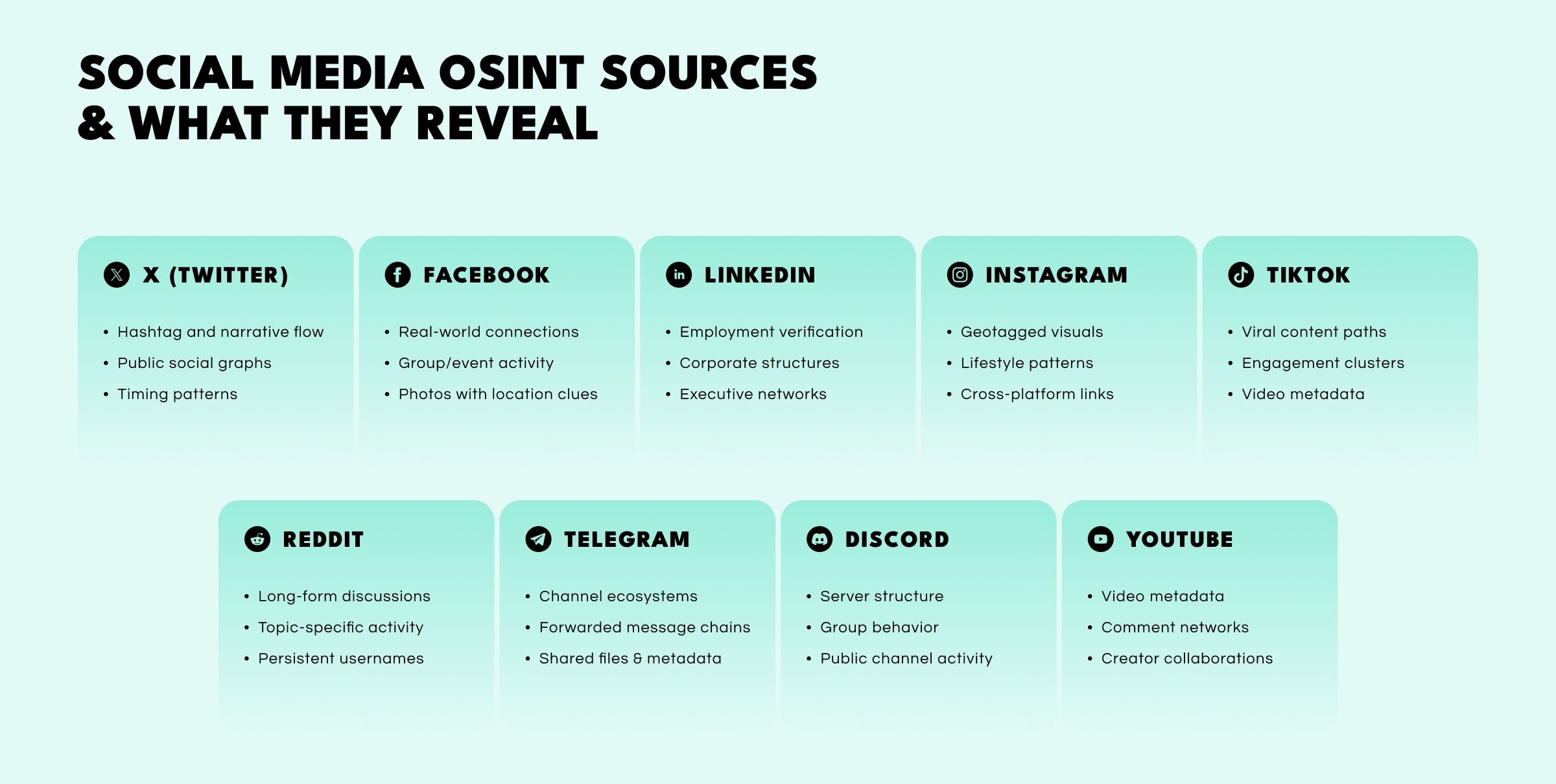
Each platform provides a different lens into identities, communities, and online activity, enabling investigators to observe what people say, how they interact, and which networks they belong to.
Social media OSINT is powerful because it provides:
Understanding these sources is the foundation of modern intelligence gathering.
Below is a detailed look at the most widely used social media platforms in OSINT investigations, the intelligence they provide, and the contexts where they matter most.
X is the digital equivalent of a public square—fast, noisy, reactive, and extremely transparent. People use it to express real-time opinions, join conversations, respond to global events, and amplify narratives. For investigators, this makes X one of the best platforms for observing behaviors as they happen, not days or weeks later.
What X Provides:
OSINT Value: X is uniquely suited for temporal analysis and influence tracking. Analysts can observe narrative spread, detect sockpuppet behavior, identify linguistic patterns, map social clusters, and trace broker accounts shaping discourse. For crisis intelligence and geopolitical monitoring, X remains irreplaceable.
Despite being older than most platforms, Facebook still reflects “real life” more than any other digital ecosystem. People connect with family, document local events, and interact within community groups—making Facebook a goldmine for identity validation and relationship mapping.
What Facebook Provides:
OSINT Value: Facebook is invaluable for lifestyle reconstruction, identity resolution, and social graph mapping. Analysts use it to confirm offline relationships, validate personal claims, detect inconsistencies, and trace shared media histories.
LinkedIn is where people maintain their professional identities. Because reputations and careers are tied to profiles, users tend to be accurate and much less anonymous—making it one of the most reliable OSINT sources.
What LinkedIn Provides:
OSINT Value: Essential for due diligence and corporate intelligence. Analysts verify résumés, map executive networks, uncover shell-company behavior, and identify suspicious employment clusters.
Instagram showcases the visual side of daily life—travel, relationships, routines, hobbies. Even casual content contains metadata, patterns, and visual clues that can reveal more than users intend.
What Instagram Provides:
OSINT Value: Ideal for behavioral profiling and visual intelligence. Analysts identify geographic markers, recurring companions, hidden metadata, and lifestyle inconsistencies.
TikTok represents fast-moving, algorithm-driven culture. It’s highly viral, strongly community-based, and rich in interactional signals.
What TikTok Provides:
OSINT Value: Crucial for trend analysis and narrative emergence. OSINT teams follow how ideas spread, identify coordinated messaging, and map influencer ecosystems.
Reddit is a structured archive of long-form, topic-driven discussions—often deeply technical, niche, or community-specific.
What Reddit Provides:
OSINT Value: A rich source of contextual intelligence. Investigators analyze user behavior across niche communities, detect early indicators of cyber activity, and extract technical insights or sentiment patterns.
Telegram sits between traditional social media and messaging apps. Public channels and groups make it one of the most transparent semi-private ecosystems used by activists, scammers, and threat actors alike.
What Telegram Provides:
OSINT Value: Crucial for threat intelligence and extremism monitoring. Analysts map channel ecosystems, identify admins, trace content propagation, and monitor illicit marketplaces.
Discord has evolved beyond gaming into a hub for online communities, creators, and topic-driven collectives. Its semi-private nature makes it both valuable and underutilized.
What Discord Provides:
OSINT Value: Useful for community intelligence and group dynamics. Analysts observe coordination patterns, leadership structures, niche subgroups, and multi-server behavior.
YouTube functions as both a publishing platform and a massive social network. Videos, comments, and creator relationships generate significant metadata and behavioral signals.
What YouTube Provides:
OSINT Value: Key for radicalization tracking, influence mapping, and content attribution. Investigators map content networks, analyze ideological clusters, and use metadata for timeline reconstruction or geolocation.
Across these ecosystems, OSINT investigators commonly extract:
These data points become the raw material for intelligence gathering, pattern analysis, and identity resolution.
Social media remains one of the most dynamic, information-rich environments available to OSINT investigators. Each platform—whether a global network like Facebook or a niche Reddit community—offers unique behavioral and contextual signals that deepen an analyst’s understanding of identities, relationships, and digital ecosystems.
As online behavior continues shifting across mainstream, emerging, and decentralized platforms, the investigators who understand how to navigate these spaces will be best positioned to gather meaningful, defensible intelligence. The key is not collecting everything, but recognizing which signals matter—and how they fit into the broader investigative narrative.
They analyze posts, interactions, metadata, and relationship graphs to understand identity, behavior, and network activity in real time.
Each one offers different signals: X for narrative flow, Facebook for real-life networks, LinkedIn for professional verification, Instagram/TikTok for visual clues, Reddit/Discord/Telegram for community behavior, and YouTube for metadata and influence mapping.
Common data points include usernames, emails, phone numbers, timestamps, geotags, visual metadata, follower networks, and engagement patterns.
Because it reflects real-time human behavior, not static records. This helps analysts detect patterns, verify claims, and uncover risks earlier.
It can be—as long as investigators cross-verify findings, preserve metadata, and validate patterns across multiple platforms.
Want to analyze social media ecosystems with precision, map relationships across platforms, and uncover the signals that matter most? See how SL Crimewall unifies social media OSINT, link analysis, and real-time data gathering into one powerful investigative workspace.