Digital Footprint Investigations: Following the Trail
In 2013, the FBI identified the operator of Silk Road, an online marketplace running on the anonymous Tor network, through a Stack Overflow post. Investigators found a coding question about connecting to a Tor hidden service, posted under a username called "frosty." One detail gave it away: the post had briefly appeared under the poster's real name, Ross Ulbricht, before being corrected a minute later. That single reused username later turned up in the server's encryption key, connecting an anonymous dark web operation to a real identity.
That is what digital footprint investigations look for: the small, often accidental traces people leave across the internet, and what those traces reveal once someone connects them. Usernames, email addresses, old posts, and forgotten accounts rarely mean much on their own. Together, they can identify a person, verify a claim, or expose a network that was never meant to be found.
In this article, we examine what a digital footprint actually is, why it matters across cybersecurity and investigative work, and how OSINT investigators trace, verify, and correlate these signals into something usable.
A digital footprint is the trail of data a person or organization leaves behind through online activity, whether they intend to or not. It includes everything from a LinkedIn profile to a comment left on a forum a decade ago.
Active footprints are created deliberately: a social media post, a forum comment, a submitted form.
Passive footprints are created without direct intent, such as IP addresses logged by a website, metadata embedded in an uploaded photo, or a mention in someone else's post. Passive traces are often the most revealing precisely because nobody thought to hide them.
Personal versus organizational footprints work differently too. A person's footprint spans personal and professional accounts, old usernames, and years of scattered activity. An organization's footprint includes employee accounts, domain registrations, code repositories, and vendor relationships, any of which can expose more than the company intended.
Digital footprints matter because they are often the only evidence available before a formal investigation begins. A username or an old email address can be the single thread that connects a series of otherwise unrelated data points.
OSINT investigations frequently start from almost nothing: a name, a phone number, an alias glimpsed once. Digital footprint analysis is how that single identifier expands into a fuller picture.
Cybersecurity teams use it in reverse, mapping their own organization's exposed footprint before an attacker does, since reconnaissance is the first stage of most intrusions.
Fraud investigations compare what a person or business claims against what their footprint actually shows. Fabricated identities and shell companies tend to have thin, inconsistent, or newly created footprints that don't hold up to scrutiny.
Due diligence and background investigations work the same way, checking declared employment history and affiliations against what is independently observable online.
That scrutiny runs both directions. 60% of hiring managers surveyed in 2025 believe every candidate's social profile should be reviewed before hiring, which means a person's digital footprint is often assessed long before any formal investigation ever starts.
Footprints also persist longer than people expect. An analysis of more than 19 billion leaked passwords found that 94 percent were reused or duplicated across multiple accounts, which means a credential exposed in one breach routinely unlocks accounts the original breach never touched. That is exactly the kind of reuse that connected Ulbricht's Stack Overflow account to his server credentials.
A digital footprint is built from many small, distinct pieces, and investigators rarely rely on just one.
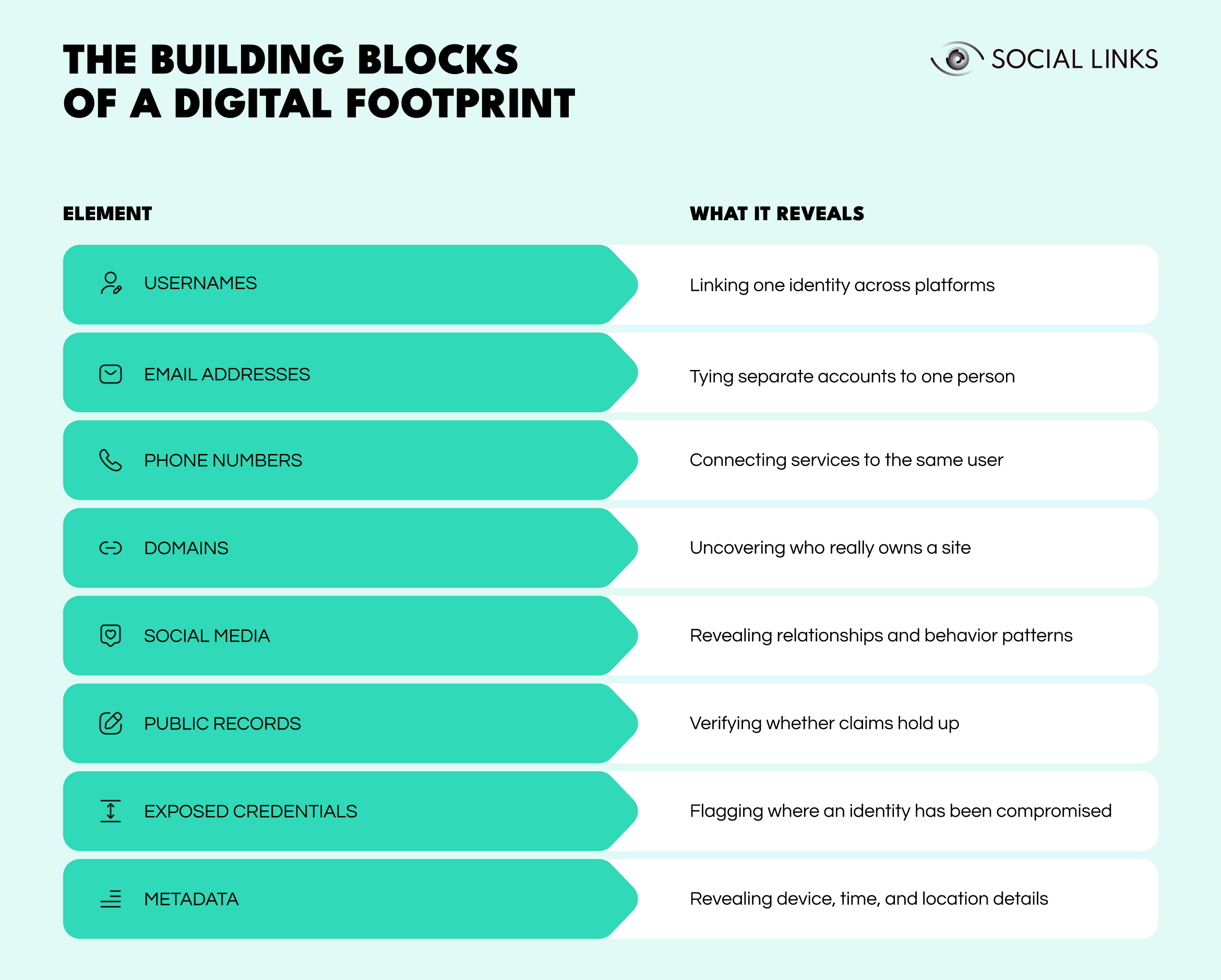
Usernames are often reused across platforms out of habit, making them one of the strongest starting points for correlation.
Email addresses work similarly and frequently appear in leaked breach data long after the original account is forgotten.
Phone numbers connect messaging apps, delivery accounts, and verification records that people rarely think to disconnect from each other.
Domains registered by a person or company can reveal ownership history, hosting choices, and infrastructure shared with other projects.
Social media contributes photos, connections, locations, and behavior over time.
Public records, including corporate filings and court documents, ground online findings in verifiable, official sources.
Exposed credentials are an underused resource in legitimate investigative work: Have I Been Pwned alone indexes tens of billions of compromised records, searchable by email address, showing where and when a given identifier has been exposed.
Metadata embedded in photos and documents, timestamps, device information, and sometimes GPS coordinates, rounds out the picture with details the poster never meant to share.
A digital footprint investigation is not a single search. It moves through five connected stages, each of which narrows a starting point into something defensible.
Starting from one identifier. Almost every investigation begins somewhere small: a username, an email, a phone number, or a name. The choice of starting point shapes everything that follows, so investigators pick the identifier most likely to be unique rather than the one most convenient to search.
Correlating connects that identifier to others across platforms and sources. A username on one forum leads to an email on another; an email leads to a domain registration. This is where isolated data points start becoming a coherent trail, the same process that turned a Stack Overflow username into a link between two identities that were never meant to touch.
Attributing asks whether the connected data actually belongs to the same person. Shared usernames and similar photos can be coincidence, so attribution requires more than a superficial match before a finding gets treated as solid.
Validating checks the attribution against independent sources: public records, corroborating accounts, or timestamps that confirm the sequence of events makes sense. A technically valid match that doesn't hold up under scrutiny should be discarded, not stretched to fit.
Reporting documents where each piece of evidence came from and when it was observed, since a finding that can't be traced back to its source is far less useful in any legal, regulatory, or operational context later on.
Several core techniques make up most digital footprint investigations, and they are usually combined rather than used in isolation.
Username pivoting searches a known username across platforms to find other accounts belonging to the same person, working on the assumption that most people reuse handles more often than they realize.
Email pivoting follows an email address through breach databases, account recovery pages, and services that allow lookups by address, often surfacing accounts the person forgot even existed.
Reverse image searches trace a photo back to its original source, exposing reused profile pictures, stock photos passed off as real people, or the same image appearing across supposedly unrelated accounts.
Domain investigations look at registration records, hosting history, and shared infrastructure to connect websites that appear unrelated on the surface.
Cross-platform analysis pulls all of the above together, checking whether the picture built from one platform is consistent with what other platforms show. Inconsistencies are often more informative than the matches, since a real footprint tends to hold together, and a fabricated one tends not to.
A handful of recurring mistakes undermine otherwise solid digital footprint work.
Confirmation bias leads investigators to weigh evidence that supports an early hypothesis more heavily than evidence that contradicts it. Once a working theory forms, it takes discipline to keep testing it rather than just building a case for it.
Assuming ownership based on a single matching detail, a shared name or a similar photo, without independent corroboration is one of the most common ways an investigation goes wrong. A username match is a lead, not a conclusion.
Ignoring timestamps can lead to sequencing evidence incorrectly, drawing a connection between events that happened years apart as though they were related.
Lack of source validation compounds all of the above, since findings built on unverified or low-credibility sources rarely hold up when someone else checks the work.
A digital footprint is rarely dramatic on its own. It's a scattered collection of usernames, old posts, and forgotten accounts that only becomes meaningful once someone takes the time to connect them. That is the actual work of OSINT: not finding information, but establishing what it means once it's found.
Investigators who treat digital footprint analysis as a disciplined process, starting from a single identifier, correlating carefully, and validating before concluding, produce findings that hold up under scrutiny. Those who skip steps to move faster tend to produce findings that don't. A reused username or a recycled password rarely feels significant in the moment. Connected to the right sources, it can be the detail that identifies the person behind an anonymous account entirely.
A digital footprint is the trail of data a person or organization leaves behind through online activity, including active traces like posts and accounts, and passive traces like metadata and server logs that are created without direct intent.
Yes, using OSINT techniques such as username pivoting, email pivoting, reverse image searches, and breach data lookups. The reliability of the result depends on how many independent identifiers corroborate each other.
It depends on the sources used, the jurisdiction, and the purpose of the investigation. Working from publicly or commercially available information is generally permitted, but investigators should stay within applicable law and organizational policy.
Active footprints are created deliberately, such as a social media post or a forum comment. Passive footprints are created without direct intent, such as metadata, IP logs, or a mention in someone else's content.
By corroborating multiple independent attributes, such as a username, an email address, and a photo, against public records or other sources, rather than relying on any single matching detail.
Want to see how digital footprint investigations work in practice? Book a personalized demo with one of our specialists and discover how SL Crimewall helps investigators expand a single identifier into a full picture, correlating usernames, emails, and public records into a verified digital footprint.