SOCMINT: Investigating the Social Web
In 2026, researchers at Group-IB traced a single fraudulent investment platform back to a much larger network: the same contact details turned up across 23 other supposedly unrelated platforms, and the same hosting server turned up behind 208 more. Victims were reached through geo-targeted social media ads and deepfake videos impersonating real financial professionals. On their own, a shared email address or phone number barely registers. Connected across dozens of platforms, they exposed a fraud ecosystem worth an estimated $187 million.
That is the core problem SOCMINT is built to solve. Profiles, posts, images, and digital relationships can reveal identities, networks, and connections that formal records rarely show. But the value lies in connecting those signals, not just accessing them.
In this article, we examine how SOCMINT turns fragmented signals into useful intelligence: the types of information investigators can uncover, the workflows used to collect and verify it, and the practices that turn social media findings into defensible intelligence.
SOCMINT stands for social media intelligence: the collection, verification, analysis, and interpretation of information from social media for intelligence or investigative purposes. That definition is deliberately broader than social media monitoring, which typically asks what people are saying about a company or how sentiment is shifting.
SOCMINT is more investigative. It asks who is behind an account, which other identities may belong to the same person, who they interact with, and whether observable activity supports or contradicts an investigative hypothesis. A SOCMINT investigation might begin with a username, or a single reused contact detail, and expand into associated profiles, aliases, images, locations, and infrastructure.
The information itself may be public. Intelligence comes from connecting it.
Open-source intelligence covers information collected from publicly or commercially accessible sources across the wider information environment, including corporate registries, government databases, news archives, and domain records. SOCMINT focuses specifically on the social layer of that environment.
A LinkedIn profile showing where someone works is SOCMINT. A corporate registry showing that the same person directs another company is broader OSINT. Combining both produces a more defensible finding than relying on either alone, which is why SOCMINT works best as part of a wider OSINT investigation rather than as an isolated discipline.
The collection environment has also changed. Early social media investigation benefited from platforms that were relatively open and accessible through APIs. That has narrowed considerably: platforms now restrict API access, limit unauthenticated browsing, and place more information behind privacy controls.
Europol's Innovation Lab has noted that police increasingly face large, complex datasets that traditional tools cannot manage, grouping OSINT and SOCMINT together with natural language processing as approaches that can reshape how modern law enforcement handles that volume. Investigators now combine platform-native research, archives, specialist tools, and cross-platform correlation rather than depending on one API or method.
People conduct an enormous part of their public lives through digital platforms: maintaining professional profiles, joining communities, sharing images, and interacting with associates. Those activities create an investigative layer that formal records often cannot provide, and different investigative functions draw on it for different purposes.
Law enforcement uses social media for leads on identities, associates, locations, and networks, particularly when an investigation begins with limited identifiers such as a username or phone number. INTERPOL's Project Trace, for example, trains investigators to understand how OSINT and SOCMINT streams can support criminal investigations.
Threat intelligence teams use SOCMINT to examine the human and social layer around technical indicators, aliases, and reused infrastructure that malware signatures alone cannot provide. That human layer is often where an intrusion actually starts: the human element was a significant factor in breaches analyzed in Verizon's 2025 Data Breach Investigations Report, and reconnaissance for that kind of targeting routinely draws on the same profiles and personal details SOCMINT investigates.
Fraud investigations rely on SOCMINT to compare claimed identity against observable behavior, since fake businesses and impersonation schemes all depend on believable personas that leave a social footprint. The scale of that problem has grown sharply: nearly 30 percent of people who reported losing money to a scam in 2025 said it started on social media, with reported losses reaching $2.1B, an eightfold increase since 2020.
Due diligence teams use social media to test whether declared professional history and business activity align with observable reality, signals that indicate where further verification may be necessary. Brand protection teams use SOCMINT to investigate whether apparently separate incidents belong to the same network of actors, a problem that is larger than it looks: Meta's own transparency reporting estimates that roughly 4 percent of its more than 3 billion monthly active users are fake, a volume that makes manual review alone unworkable.
SOCMINT is often described by platform, but for investigators it is more useful to think in terms of what type of intelligence a source provides.
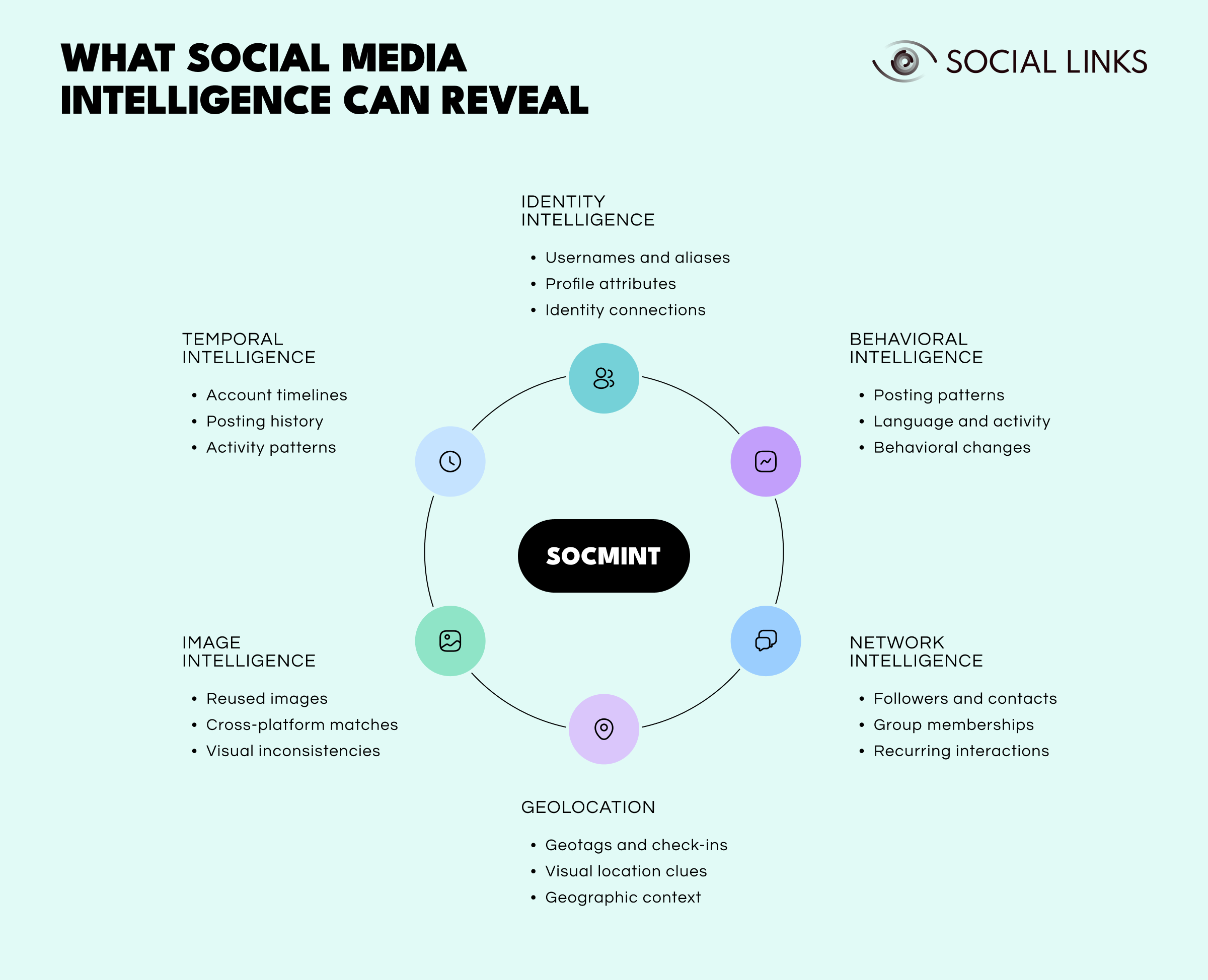
Identity intelligence establishes who is behind an online presence, using usernames, names, photographs, and employment details. A single match rarely establishes identity; confidence increases when multiple independent attributes align.
Behavioral intelligence looks at posting schedules, language, and recurring patterns to understand how an individual or group behaves online. It is most useful as supporting context rather than definitive attribution.
Network intelligence treats social media as fundamentally relational, using followers, group memberships, and repeated interactions to reveal connections that are invisible when profiles are reviewed independently.
Geolocation draws on geotags, photographs, and contextual references to contribute geographic information, though it is rarely as simple as reading a single data point.
Image intelligence treats photographs as investigative pivots, comparing images across platforms to identify reused material or expose inconsistencies between identities.
Temporal intelligence looks at how activity changes over time. Account creation dates, posting histories, and sudden bursts of activity can help investigators reconstruct how an identity or network developed.
Effective social media investigations are defined by whether the collection answers a specific investigative question, not by how much information an analyst can gather. A useful workflow moves through six connected stages.
Planning starts with a clear question: Who controls this account, or is this company genuinely associated with this individual, along with the legal and evidentiary boundaries for collection.
Collecting gathers relevant profile information, posts, and observable attributes selectively. More data does not automatically produce better intelligence.
Verifying checks findings against independent sources. A matching profile does not necessarily mean a matching identity, so investigators need other indicators before connecting an account to a person.
Correlating connects verified findings across platforms and sources, a username leading to an email, an email to a domain, a domain to an organization, which is where SOCMINT begins to merge with broader OSINT.
Analyzing asks what those connections actually mean. Investigators separate strong links from weak ones and check whether a technically valid match also makes sense in context.
Reporting documents sources, timestamps, and reasoning so the finding is reproducible, since screenshots alone rarely establish the provenance a later decision may require.
The workflow stays broadly consistent across platforms, but the evidence available at each stage varies by source, so investigators adapt the same methodology to the strengths and limitations of each environment.
There is no universal social media investigation method because each platform exposes different types of information.
Facebook is valuable for identity and relationship investigation through profiles, groups, and historical interactions.
Instagram is strongest for visual, lifestyle, and location intelligence.
LinkedIn is especially valuable for professional identity and organizational relationships that may not appear in formal corporate records.
Telegram provides identity and network intelligence within closed or semi-public communities, particularly in cybercrime and fraud cases.
X offers strong temporal and network intelligence for tracing how narratives and communities develop.
TikTok contributes video, identity, and behavioral information through visible locations and recurring collaborators.
Reddit offers pseudonymous community context, though identity attribution requires particular caution.
Discord requires attention to access controls, since most content sits inside private servers.
Forums often preserve longer histories than mainstream platforms, making them valuable for cross-forum identity reuse.
INTERPOL's Fundamentals of Open-Source Investigation training reflects this breadth directly, covering metadata search, personal identity investigation, phone and email research, and geospatial research as connected skills rather than platform-specific tricks.
Searching for the best SOCMINT tools can be misleading, since no single tool solves every social media investigation problem. The better question is what capability the investigation requires.
Platform-native search remains important for current profiles and posts, though historical access is often restricted.
Search engines and web archives extend investigation beyond platform interfaces, surfacing cached pages and old URLs.
Browser-based tools support targeted tasks like username discovery but become cumbersome at scale.
Open-source tools offer flexible workflows for technically capable teams, with the trade-off of ongoing maintenance as platforms change.
Commercial platforms focus on broader source coverage and evidence management, becoming more valuable as investigations scale beyond what manual pivoting can handle.
Tool selection should follow the investigation rather than the other way around, weighing source coverage, evidence preservation, and auditability rather than the size of a tool list.
Social media intelligence has become more valuable at the same time that collection has become more difficult.
Platform restrictions. Privacy settings, API limits, and interface changes mean a collection method that works today may not work in six months.
False positives. Common names, reused usernames, and copied photographs create false connections. A single matching attribute should be treated as a lead, not a conclusion.
Identity deception. Synthetic personas and stolen photographs mean investigators must verify both the information attached to an account and the assumption that it represents who it claims to. With an estimated 4 percent of Meta's monthly active users being fake, that verification step is not an edge case.
Privacy and legal considerations. Public availability does not eliminate legal or ethical obligations, and rules governing collection and use vary by jurisdiction and purpose.
Evidence preservation. Social media evidence is unusually fragile. Posts are edited, accounts disappear, and platforms remove content. NIST's guide to integrating forensic techniques into incident response applies directly to social media evidence.
The difference between finding information and producing intelligence usually comes down to methodology.
Verifying across sources. Attributing an identity because one username matches is rarely sufficient. Strong investigations look for independent corroborating attributes before drawing conclusions.
Separating facts from inference. A visible connection between two accounts is a fact. What it means may still be an analytical judgment, and treating the two as equivalent is one of the most common analytical errors in social media investigation.
Preserving provenance. Recording where information came from and when it was observed is what makes a finding reproducible and defensible later on.
Working from hypotheses. Collection should answer specific investigative questions rather than accumulate information without direction.
Considering alternative explanations. Strong analysis attempts to disprove a hypothesis as well as confirm it. A technically valid correlation can still be contextually wrong.
Connecting SOCMINT to broader OSINT. Findings become considerably stronger when corroborated against corporate records, domains, and public records, the combination that turned a single suspicious platform into a mapped $187 million network in the Group-IB case.
These practices do not change between investigations. What changes is how much pressure there is to skip them. The strongest SOCMINT work comes from teams that treat methodology as fixed regardless of deadline, because shortcuts in collection and verification are rarely recoverable once a finding has been acted on.
SOCMINT has become an important part of modern digital investigation because social media contains something many traditional sources do not: the observable relationships and behavior surrounding an identity. But access to social media data does not automatically produce social media intelligence.
Effective SOCMINT requires investigators to collect selectively, verify across sources, correlate identities and relationships, and preserve the reasoning behind their conclusions. The strongest investigations also recognize the limits of the discipline: social media is one layer of the wider open-source environment, and combining it with corporate records and domains produces a more complete picture than any platform can provide alone.
Social media provides the signals. Investigation establishes what they mean.
SOCMINT, or social media intelligence, is the structured collection and analysis of information from social media for investigative or intelligence purposes, including identity analysis, network mapping, and verification.
OSINT covers intelligence derived from publicly or commercially accessible sources across the wider information environment. SOCMINT focuses specifically on social media and is usually one component of a broader OSINT investigation.
It depends on jurisdiction, source, access method, and purpose. Public availability does not remove privacy, data protection, or organizational obligations, and investigators should operate within applicable law and internal policy.
There is no universally best platform. LinkedIn is valuable for professional identity, Instagram for visual and location intelligence, and Telegram for community and network investigation. The right source depends on the investigative question.
The best tools depend on the task. Investigators commonly combine platform-native search, open-source utilities, and commercial investigation platforms, prioritizing verification and evidence preservation over the size of a tool list.
Want to see how SOCMINT fits into a broader OSINT investigation? Book a personalized demo with one of our specialists and discover how SL Crimewall helps investigators expand digital identities, connect profiles across sources, map relationships, and turn fragmented online signals into actionable intelligence.