Incident Response: The Attribution Problem
Extortion groups now post claims of responsibility within hours of a breach, sometimes before the affected organization has finished scoping the damage. Security teams are left holding a partial log trail, a screenshot from a leak site, and no reliable way to know whether the claim is genuine, opportunistic, or a copycat looking to extract a payment for an attack they did not commit.
What rarely happens is a genuinely fast investigation. Analysts pivot manually between registries, forums, and leak sites. Attribution takes days. The organization is left making disclosure and containment decisions well behind the pace the attacker has already set publicly, and the gap between what a claim says and what can actually be confirmed becomes the organization's problem to solve under pressure.
In this article, we examine how open source intelligence is changing incident response, specifically how OSINT investigation compresses the time between a fragment of evidence and a confirmed conclusion during an active investigation.
OSINT investigations apply structured analytical methods to public data investigators have always relied on: domain registration histories, certificate transparency logs, social media activity, forums, and leaked credential markets. What changes when OSINT is integrated into incident response is not the source material but how systematically and quickly it can be searched, linked, and cross-referenced against an active case.
This matters because incident response has always depended on two related but different capabilities: detecting that something happened, and understanding who is behind it and why. Detection has been automated and accelerated considerably over the past decade. Investigation, the work of determining who is responsible, whether a claim is credible, and what infrastructure connects to a broader campaign, has remained largely manual. That is the gap OSINT is built to close.
Most incident response programs are built around automated correlation. Detection tools flag anomalies, SIEM platforms aggregate logs, and threat intelligence feeds enrich alerts with known indicators. This correlation layer is necessary and it operates in near real time. It is not the same thing as investigation.
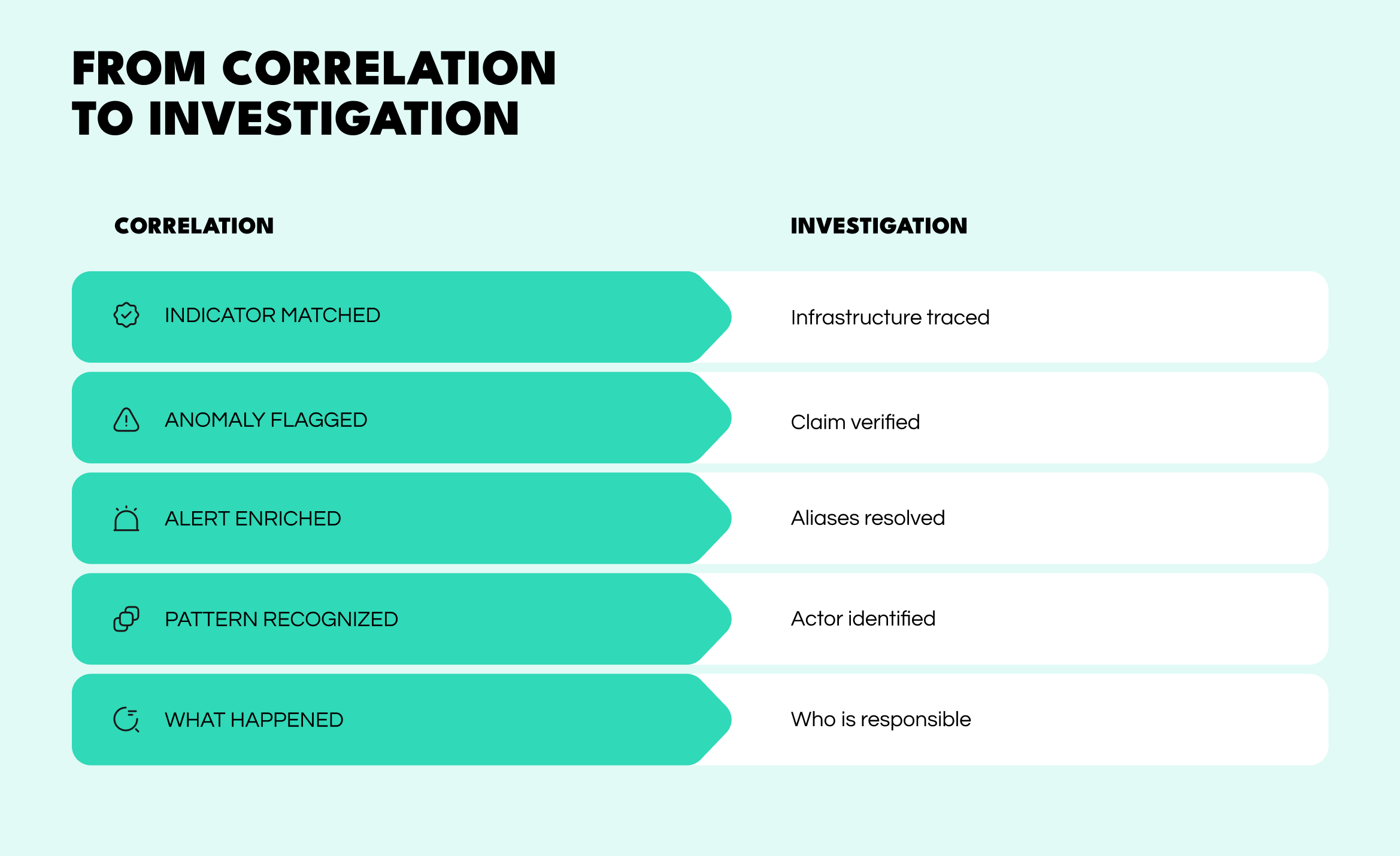
When a known indicator matches a threat feed, correlation confirms the match. Investigation traces the infrastructure behind it, following hosting history, registrar patterns, and certificate reuse to surface what the indicator actually connects to.
When an anomaly is flagged, correlation records the deviation. Investigation checks whether a claim of responsibility is genuine, opportunistic, or fabricated, by examining the group's prior activity across forums and leak sites.
When an alert is enriched with existing IOC data, correlation adds what is already known. Investigation resolves the aliases, email addresses, and wallet identifiers that appear unconnected on the surface and confirms whether they belong to the same actor.
When a pattern matches a known signature or behavior profile, correlation recognizes it. Investigation determines who is behind it and whether the current incident connects to prior campaigns.
The gap between what correlation confirms and what investigation reveals is where attribution delays tend to concentrate. Correlation answers what happened. Investigation answers who is responsible. Both are necessary. They operate at very different speeds, and most incident response programs have invested heavily in the first while leaving the second largely manual.
For most of its history, incident response was primarily a technical containment function. Analysts reviewed logs, isolated affected systems, and restored operations, with attribution treated as a secondary concern handled later, if at all, by a specialist threat intelligence team.
Several developments have changed that model considerably.
Third-party and vulnerability exposure. Third-party involvement in breaches doubled to 30% of cases and vulnerability exploitation surged 34% year over year according to Verizon's 2025 Data Breach Investigations Report. Investigators are increasingly tracing infrastructure the affected organization never directly controlled in the first place, which makes open source investigation essential rather than supplementary.
Compressed disclosure timelines. Extortion groups now publicize claims, leak samples, and countdown clocks as pressure tactics, which forces organizations to make containment and communication decisions before a traditional investigation would normally conclude. The pace at which attackers move publicly has made slow attribution operationally costly in ways it was not before.
Volume beyond manual capacity. Registries, leak markets, and social platforms generate far more signals than a single analyst can search by hand within a useful timeframe. The volume of public data relevant to any single incident has grown well beyond what manual review can reasonably cover, making structured OSINT workflows a practical necessity rather than an optional enhancement.
OSINT investigation is not a single capability. Different moments in an active incident call for different investigative approaches, and mature response functions combine several of these simultaneously.
Infrastructure attribution traces a malicious domain or IP address through hosting history, registrar patterns, and certificate reuse, connecting it to prior campaigns and identifying related infrastructure that internal telemetry alone would not surface.
Claim verification checks an extortion group's stated responsibility against leak sites, forums, and prior activity attributed to that group, distinguishing a genuine claim from an opportunistic or fabricated one. This is often the most time-sensitive task in an active incident involving public extortion.
Entity resolution links an alias, an email address, and a wallet address that appear unconnected on the surface, confirming whether separate identifiers actually belong to the same actor. This type of cross-source correlation is where structured OSINT investigation produces findings that manual pivoting consistently misses.
Cross-case pattern matching identifies when infrastructure, tooling, or behavior in a current incident resembles a previous unrelated case, surfacing campaign-level connections that a single analyst working one case at a time is structurally unlikely to catch.
Brand and impersonation tracing identifies fraudulent domains, spoofed executive profiles, or fake support accounts connected to an active incident, which matters increasingly as attackers use impersonation alongside technical intrusion as part of the same operation.
Most effective response programs move through a similar sequence, though the depth applied at each stage varies with the nature of the incident and the maturity of the team.
Scoping defines what is known, what systems and data are potentially affected, and what level of confidence is required before any external communication or containment action is taken. Without clear scoping, investigations either expand without direction or stall without boundaries.
Evidence gathering expands from internal telemetry into open source data. Registries, forums, and leak markets are searched in parallel rather than in the sequence a manual investigation would require, producing a broader picture faster than sequential pivoting allows.
Analysis connects individual findings into a coherent picture. Infrastructure is mapped, aliases are resolved, and claims are weighed against prior group behavior. This is the stage where investigative judgment matters most, and where the difference between a confirmed attribution and an incorrect one is determined.
Decision converts findings into action: which systems to isolate, whether a claim warrants a public response, and whether other organizations should be warned of shared infrastructure or tactics.
Documentation records not just the conclusion but the investigative trail behind it, since that trail often becomes part of a later regulatory, legal, or insurance record. An investigation that cannot be explained and evidenced is difficult to defend when scrutinized.
Response programs that integrate OSINT investigation effectively share several characteristics that distinguish them from teams relying on detection output alone.
Human judgment at every decision point. OSINT investigation surfaces connections and patterns for analysts to evaluate. The judgment involved in interpreting those connections, particularly before any public statement or legal action, belongs to the analyst rather than the investigative tool.
Documented reasoning behind conclusions. Recording why a particular connection was flagged and how it was validated preserves the investigation's credibility if it is later reviewed, challenged, or used as evidence in legal or regulatory proceedings.
Defined confidence thresholds. Not every finding warrants the same response. Effective programs define in advance what level of investigative confirmation is required before acting on a lead, rather than making that judgment under deadline pressure during an active incident.
Institutional memory across cases. Investigations that feed findings back into a shared knowledge base make subsequent investigations faster. Teams that start from zero with each new incident consistently take longer than those building on prior case knowledge.
Organizations that had tested incident response plans and invested in security operations saved close to $1.9M per breach compared to those that had not, according to IBM's Cost of a Data Breach Report 2025. The operational case for closing the attribution gap is no longer speculative.
Incident response has always depended on two different speeds: the near-instant pace of automated detection and the historically slower pace of investigation and attribution. OSINT investigation closes that gap by bringing structured, systematic analysis of public data into the active incident workflow, without removing the analyst's judgment from the decisions that actually matter.
As attackers increasingly operate through third-party infrastructure, publicize claims before organizations have finished scoping damage, and use impersonation alongside technical intrusion, organizations that build investigative capability into their response process are positioned to reach confident conclusions at a pace that matches how fast incidents now unfold.
Detection identifies that something suspicious occurred by matching activity against known patterns. Investigation determines who is responsible, whether a claim is credible, and how the infrastructure connects to broader activity. Detection operates in near real time. Investigation has historically been the slower, more manual part of the process.
OSINT investigation searches public registries, forums, leak sites, certificate data, and social platforms to trace infrastructure, verify claims, resolve entity connections, and identify campaign-level patterns. It surfaces the picture that internal telemetry alone cannot provide.
It depends on the case and the evidence available, but structured OSINT investigation working across multiple sources in parallel consistently produces results faster than sequential manual pivoting. Final confirmation still depends on analyst review before any action is taken.
Claim verification is the process of checking an extortion group's stated responsibility against their known prior activity, leak site behavior, and forum presence to determine whether a claim is genuine, opportunistic, or fabricated. It is often the most time-sensitive investigative task during a public extortion incident.
Smaller teams often benefit the most. They typically lack the staff to manually run the kind of broad, cross-source investigation that structured OSINT enables, allowing a small team to investigate at a pace and depth closer to a much larger one.
Want to see how open-source intelligence supports faster attribution and case-building during active incidents? Book a personalized demo with one of our specialists and discover how SL Crimewall helps incident response teams verify claims, trace infrastructure, and resolve entity connections across open sources.