Sentiment Analysis: Tracking the Shift
During Hurricane Sandy, researchers mapped the sentiment of tweets posted from within the storm's path and found something a simple read-through would have missed: sentiment shifted measurably with distance from the hurricane's center, giving emergency responders a rough proxy for where distress was concentrated in something close to real time. No single tweet made that pattern visible. It only emerged once thousands of individual posts were scored and mapped against location.
That's the value sentiment analysis adds at scale: it turns an unmanageable volume of text, most of it not written for any analyst's benefit, into a structured signal that can actually be tracked over time. A single comment or post rarely tells an organization much. The same signal aggregated across thousands of them, and watched as it rises, falls, or splits by topic, tells a very different story.
In this article, we examine what sentiment analysis actually measures, the different levels of granularity it can operate at, the workflow that turns raw text into a usable signal, the methods behind the classification, and where the results are most likely to mislead an analyst who treats them as more certain than they are.
Sentiment analysis is the classification of text according to the opinion it expresses, typically as positive, negative, or neutral. It works by scoring language for polarity, whether through a fixed dictionary of terms, a trained statistical model, or some combination of the two, and it can operate on anything from a single sentence to an entire body of text.
The term overlaps heavily with opinion mining, and in most everyday use, the two are interchangeable. Some platforms use opinion mining specifically to refer to a more targeted task, extracting the individual opinions attached to specific features or aspects within a text, but there's no universal, industry-wide line that separates the two terms; it depends on the vendor and the context.
It's worth being precise about what the output actually represents. A sentiment score reflects the language someone chose to use, not a verified reading of what they actually felt. Frustration can be expressed flatly, sarcasm can invert the literal words entirely, and a calm tone doesn't necessarily mean a calm state of mind. The score is a measurement of expression, not an emotional diagnosis.
Public discourse now moves through channels that produce far more text than any team could read manually: social platforms, public comment forms, incident reports, and open forums, all generating volume that grows during exactly the moments an organization most needs to understand what's being said. Sentiment analysis is what makes tracking that volume tractable, by turning it into a number that can be watched over time instead of a pile of text that can only be sampled.
That matters most during periods of rapid change, a crisis unfolding, a piece of information spreading, a narrative shifting, because sentiment tends to move well before any single post makes the shift obvious to someone scanning individual messages. It also matters because misinformation doesn't spread evenly: a 2024 study found that just 0.25 percent of accounts, roughly 1,000 users, were responsible for more than 70 percent of low-credibility content shared on the platform over the study period, which means a sudden shift in sentiment around a topic is often worth investigating for what's actually driving it, not just tracking as a number.
None of this makes sentiment a substitute for verification. A negative shift is a signal that something is worth looking into, not proof of what that something is. Treating sentiment scores as a finding rather than a starting point is one of the most common ways this kind of analysis gets misused.
Sentiment analysis operates at different levels, and confusing them tends to produce results that look precise while actually hiding the detail that matters most.
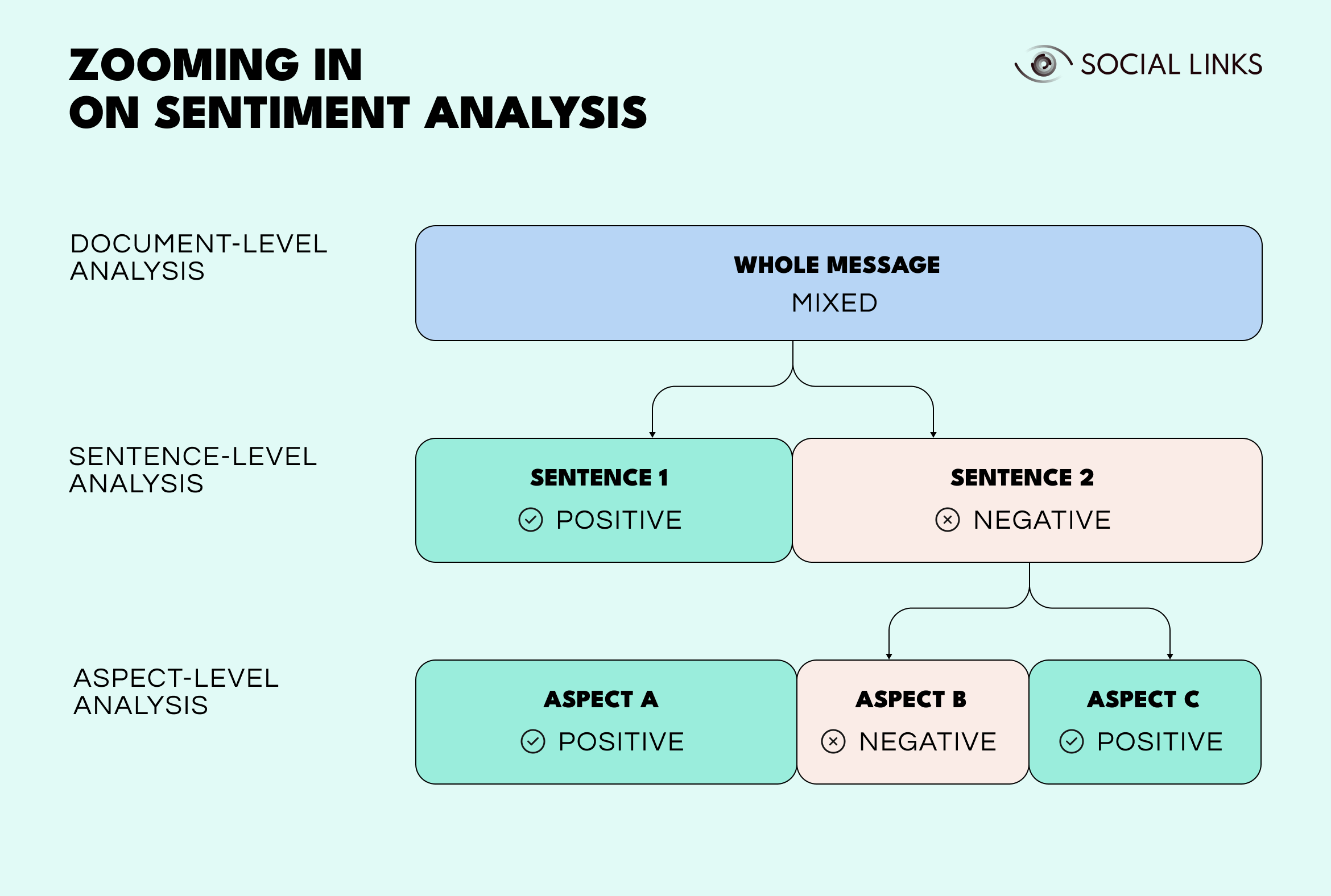
Document-level analysis assigns a single sentiment score to an entire piece of text. It's the fastest and simplest approach, but it forces a single verdict onto content that may contain more than one opinion.
Sentence-level analysis scores each sentence within a longer text separately, catching shifts in tone that a single document-level score would average away.
Aspect-level analysis goes further, identifying the specific topics or features mentioned within a text and scoring sentiment toward each one individually. This is the level that actually preserves a mixed opinion instead of flattening it into a single label.
Separately from granularity, sentiment analysis outputs also vary in kind: basic polarity (positive, negative, neutral), finer-grained scales (a range of intensity rather than three buckets), and adjacent but distinct tasks like emotion detection and intent detection. None of these sit on a ladder of increasing accuracy. A system can combine aspect-level scope with fine-grained output, and neither replaces the need for the other.
Turning raw text into a usable signal moves through a consistent sequence, regardless of which specific method does the classification.
Collecting and preparing the data means pulling text from whatever sources are relevant, social posts, comment forms, incident reports, and cleaning it: removing duplicates, handling different languages, and stripping anything that shouldn't be retained for privacy reasons before analysis begins.
Defining categories and labeling a sample sets the classification scheme the system will actually use and establishes ground truth by having a person label a representative sample by hand, work that determines how meaningful every later score will be.
Classifying and scoring applies the chosen method, rule-based, statistical, or a hybrid of the two, to the full dataset, producing a sentiment label or score for each piece of text.
Aggregating and tracking over time rolls individual scores up into a trend, a shift, or a comparison across sources, which is usually the level at which the output actually becomes useful to an analyst rather than a list of individually scored items.
Escalating for human review sends ambiguous, high-stakes, or unusually confident results back to a person before anyone acts on them, since no automated system should be the last check on a finding that matters.
Rule-based and lexicon methods score text against a fixed dictionary of words tagged with a polarity value. They're transparent and easy to audit, but brittle: negation, idiom, and unfamiliar vocabulary all break them in predictable ways.
Supervised models and transformer-based approaches learn patterns from labeled training data instead of a fixed dictionary, handling context and phrasing far better than lexicon methods. They require more data and more maintenance, and a model trained on one domain often performs noticeably worse on another.
Hybrid approaches combine both, using rules to handle clear-cut cases and a trained model for anything more ambiguous, trading some of the transparency of a pure lexicon method for meaningfully better accuracy on real-world text.
No method here is straightforwardly "better" in the abstract. A larger, more complex model isn't automatically the right choice if the actual text being analyzed is short, informal, and heavy on domain-specific slang that a simpler system might handle just as well.
Consider a hypothetical public post: "The shelter information was posted quickly, but nobody ever confirmed which locations still had space." A document-level system would likely average this out to a single, muted score, neither clearly positive nor clearly negative, and in doing so would lose the actual content of the complaint.
An aspect-level system would instead preserve both halves: positive sentiment toward the speed of the initial communication, negative sentiment toward the follow-through on shelter capacity. That distinction matters operationally. The finding isn't "sentiment was neutral"; it's "the initial response worked, but a specific follow-up step didn't," which points toward a concrete fix rather than a vague, mixed impression.
Before this kind of finding gets acted on, a human reviewer should confirm the aspect extraction actually matches what the text says and check for disagreement against the labeled sample the system was built on. A mixed result is not the same thing as a neutral one, and collapsing the two erases exactly the detail that made the analysis worth doing.
Building a genuinely useful labeled test set means including ambiguous cases and disagreement, not just the clear-cut examples that are easiest to label, since a test set made entirely of obvious cases won't reveal how the system handles anything difficult.
Reading precision, recall, and macro-F1 instead of raw accuracy matters most when one sentiment category dominates the dataset. A system that always predicts the majority class can post a high accuracy score while completely failing on every minority category, which is exactly what macro-F1 is built to catch.
Sarcasm and negation remain a genuine weak point. Sarcasm alone has been shown to account for as much as a 50% drop in classification accuracy, and negation, a word like "never" or "nothing" appearing near an otherwise positive phrase, causes similarly predictable failures in simpler systems.
Confusing neutral text with genuinely mixed opinion collapses two very different situations into one label. A factual statement with no opinion attached and a statement containing both praise and criticism can both score as "neutral" under a coarse scheme, even though they mean entirely different things.
Domain shift and drift over time mean a system trained on one type of text, or one period, can quietly degrade in accuracy as the language, topics, or context change, without anyone noticing until the output stops making sense.
A high confidence score is not the same as strong sentiment. Confidence reflects how sure a model is about its own classification, not how intensely positive or negative the underlying text actually is, and treating the two as equivalent leads to overconfident conclusions.
The right approach depends on the sources involved and the workflow it needs to fit into, not which method sounds most sophisticated. A few questions are worth answering before committing to one: does it cover the actual sources being monitored, does it produce aspect-level detail on genuinely mixed content rather than flattening everything to a single score, and does it perform consistently across every language and dialect actually in use, not just the one it was benchmarked on.
Just as important is whether errors can actually be inspected. A system that can't export its labels, show its reasoning, or support correction when it gets something wrong is difficult to trust with anything that matters. Running a small, representative pilot on real data, rather than relying on a vendor's published benchmark, is usually the fastest way to find out whether a given approach actually holds up on the text an organization deals with day to day.
Sentiment analysis works because it turns an unmanageable volume of text into something that can actually be tracked, compared, and watched for change over time. But the output is a measurement of language, not a verified account of what anyone actually felt, and treating a sentiment score as a conclusion rather than a lead is where this kind of analysis most often goes wrong.
The strongest use of sentiment analysis pairs the right level of granularity with a method matched to the text at hand, then routes anything ambiguous or high-stakes to a person before it shapes a decision. A shift in sentiment is a reason to look closer, not an answer on its own.
In most contexts, yes, the terms are used interchangeably. Some vendors use opinion mining specifically for aspect-level extraction, pulling out sentiment toward individual features within a text, but there's no universal industry standard that separates the two terms.
Document-level analysis assigns one score to an entire text. Sentence-level analysis scores each sentence separately. Aspect-level analysis identifies specific topics within a text and scores sentiment toward each one individually, which is the only level that preserves a genuinely mixed opinion.
Sentiment measures polarity, whether language is positive, negative, or neutral. Emotion detection and intent detection are related but distinct tasks that identify specific feelings or underlying goals in text, and a system can support one without the other.
Not consistently. Sarcasm alone has been shown to cause accuracy drops of up to 50 percent in some systems, and mixed feedback is easily miscategorized as neutral by coarse classification schemes that don't separate genuinely opinion-free text from text containing conflicting opinions.
By tracking precision, recall, and macro-F1 rather than raw accuracy, especially when one sentiment category dominates the dataset, and by testing on a labeled sample that includes ambiguous and ordinary cases, not just the clearest examples.
Want to see sentiment tracked as a signal instead of a snapshot? Book a personalized demo with one of our specialists and discover how SL Crimewall helps analysts watch sentiment shift over time, flag emerging narratives, and separate a genuine change in public mood from ordinary noise.