Anti-Money Laundering Investigations: Testing the Explanation
A bank's system flags a payment to a supplier it has never seen before, and an analyst has to decide what happens next: close the alert, ask for more information or pass it up the chain. Anti-money laundering (AML) depends on that decision being right, because it is where the rules meant to stop criminal money from passing as legitimate funds meet a real customer and a real payment.
The hard part is getting from "this looks unusual" to a conclusion that holds up. Customer records go out of date, and public sources sometimes disagree. Open-source intelligence, meaning information from public sources such as company registries, court records and news reports, lets analysts check a customer's explanation against the outside world. Combined with up-to-date records and clear ownership of each decision, it turns a vague alert into a clear answer.
In this article, we examine what AML covers and who investigates, why these reviews matter, what triggers them, a five-step investigation workflow, the techniques and tools behind it, and how to keep case files clear. A hypothetical example shows how evidence changes the decision.
AML is the set of rules and checks that requires banks, payment firms and similar businesses to know who their customers are, watch for unusual activity and report suspicious activity to the authorities when the rules call for it. The details vary by country, and the EU, for example, has its own rulebook, but the daily work looks much the same everywhere: compare what a customer does with what the institution expected, and explain the difference.
Know your customer (KYC) confirms who a customer is. Customer due diligence (CDD) goes a step further and records what the customer does, where their money comes from and what kind of activity the institution should expect. The Basel Committee on Banking Supervision tells banks to build customer profiles around this expected activity so that anything out of the ordinary stands out. A payment that does not fit the profile is unusual, but that alone does not mean anything criminal has happened.
The word "investigation" covers two different jobs. A bank or payment firm reviews its own records, checks the customer's explanation and, when the rules require it, sends a report to the national financial intelligence unit. Public authorities such as police, customs and prosecutors use legal powers the bank does not have to follow money across institutions and borders and bring criminal cases. Inside the institution, the roles usually stay separate: an analyst reviews the alert, a team lead approves closures and a designated reporting officer decides whether a report is filed.
Reports that come out of these reviews are a working tool for public investigators. U.S. financial institutions filed 4.8M suspicious activity reports in fiscal year 2025, according to FinCEN's Year in Review. The same report notes that IRS Criminal Investigation searched Bank Secrecy Act data in 94% of its cases, and that 11.7% of the investigations it opened started from a Bank Secrecy Act filing.
These figures cover the U.S. and a single agency, but the point carries: investigators rely on what institutions file, so the reviews behind those filings need to be sound.
Consider a hypothetical example. A personal account that normally receives one monthly salary suddenly starts receiving several transfers a week from different people, and the money leaves the account within a day. Without context, an analyst might dismiss the pattern or escalate it on instinct. With an up-to-date customer profile showing the customer's job and expected income, the question becomes much narrower: do these senders connect to a known, legitimate source?
Unusual activity reaches an analyst in several ways, and each one starts with its own first question.
Transaction alerts. Monitoring systems flag activity that does not match the customer's history, such as a sudden jump in volume or a payment to someone new. The first question is whether the customer's expected activity explains the payment.
Staff referrals. A relationship manager or branch employee notices something off, such as a customer reluctant to explain a cash deposit. The first question is what exactly was seen, by whom and when.
New customer information. A registry update, a negative news report or a change in ownership changes what the institution knows about a customer. The first question is whether the new information changes the customer's risk profile.
Each trigger starts a review; none of them settles it. The analyst's job is to find out whether an unusual event has an ordinary explanation the evidence supports, or whether a real concern remains.
A clear review follows the same path every time, whatever system an institution uses. The workflow below runs in five stages, each producing something the next stage builds on.
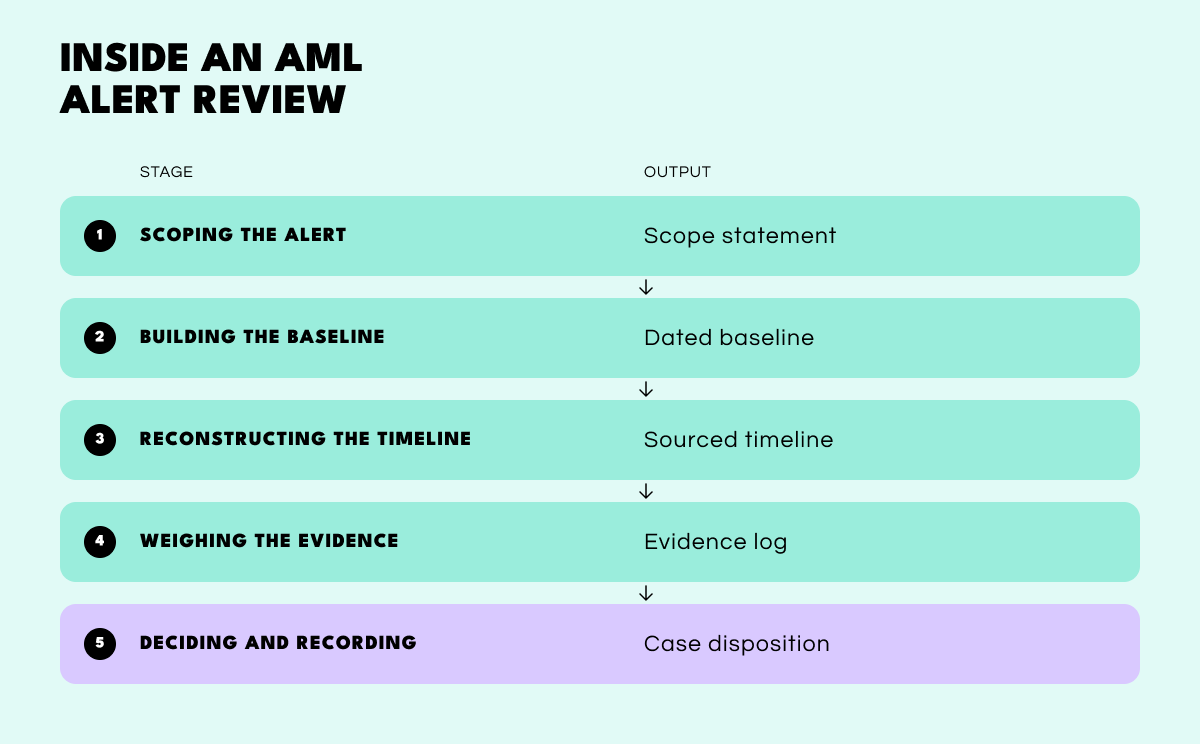
The analyst starts by defining what is being reviewed: the alert, the accounts involved and the period to look back over. A higher-risk customer or a bigger anomaly calls for a longer review period. Noting why that period was chosen lets anyone reviewing the case later judge whether it made sense. This step produces a short scope statement.
The baseline is what the institution knew about the customer when the alert fired: what the business does, who it usually pays, how large its payments tend to be and where its money comes from. Comparing the alert against this baseline shows exactly what is new. This step produces a dated customer baseline.
The analyst lists the relevant payments in order, with the date, amount, recipient and the record each detail came from. Facts the records show, such as money moving between two accounts, stay separate from guesses, such as two companies appearing to be connected. This step produces a timeline anyone can follow months later.
Every reason the alert fired needs its own answer. A new payee and an unusually large payment are two separate questions, and answering one does not answer the other. For each, the analyst looks for the most likely ordinary explanation and checks it against the evidence, keeping in mind what each source can actually prove: a company registry can confirm a name, an invoice can explain an amount, and a news report can only raise a question. This step produces an evidence log.
If the evidence answers every question the alert raised, the case closes with a short explanation and, under most institutions' policies, a team lead's approval. If anything remains unexplained, the analyst passes the case to a more senior reviewer. Whether to file a report with the authorities is a separate decision, made by an officer authorized to make it. The case record ends with the outcome, who decided it and when.
Two techniques turn an unusual payment into a well-supported conclusion: checking public sources against the right details, and recording conflicts honestly instead of picking the more convenient answer.
Each type of source can prove something specific, and each has limits.
Company registry entry. Confirms a company's registered name, status, officers and, where published, owners as of a given date. It cannot show why a payment was made.
Customer-supplied document. An invoice or contract explains what a payment was for. It needs to be checked against other records before it is taken at face value.
Negative news report. Shows that allegations exist about a person or company. It does not prove the allegations are true, or that they concern this customer.
Name matches are where most mistakes start. A news story about "J. Hartley Trading" and a customer called "Hartley Trading Ltd" share a name, but the match only holds if another detail, such as a registration number or address, also lines up.
Sometimes two records contradict each other, such as a registry and a customer's own declaration naming different owners for the same company at the same time. Rather than choosing a side, the analyst records both, notes the open question and asks for the documents needed to resolve it.
Anti-money laundering programs rely on several types of tools, and none of them makes the decision. The tools surface the right events and make sure nothing gets lost; the judgment stays with the analyst.
Transaction monitoring. Compares payments with the customer's profile and raises an alert when something does not fit. It works only as well as the profiles and rules behind it.
Name and news screening. Checks customers and the people they deal with against sanctions lists and news sources. A match on name alone stays unresolved until the reviewer confirms another detail, such as a date of birth.
Case management. Keeps alerts, evidence, notes and approvals in one place, so every decision has a clear record. It is only as complete as what analysts put into it.
OSINT investigation platforms complement these internal systems by helping analysts gather public information on companies and people, see how they are connected and document what they find.
The following scenario is hypothetical.
Halden Foods, a wholesaler that has banked with the same bank for years, sends €84,000 to Northmere Agri Supply, a company the bank has never seen before. Signal: the payment is also about 30% larger than Halden's usual monthly supplier payment, so the alert raises two questions: who is Northmere, and why is the payment so large?
Corroboration: Halden's customer file lists Kestrel Grain Traders as its main supplier. The company registry shows that Kestrel changed its name to Northmere in January and kept the same registration number, which answers the first question. Halden's invoice answers the second: it covers 120 tonnes of wheat at the usual price of €700 a tonne, totaling exactly €84,000. Halden simply placed a bigger order than normal.
Decision: with both questions answered, the analyst closes the alert, a team lead signs off and Halden's file is updated with the supplier's new name. Had the invoice shown a different price or product, the amount would have stayed unexplained, and the case would have gone to a senior reviewer instead.
In anti-money laundering work, a case file is written for someone who was not there, such as an auditor, a regulator or a colleague reopening the case months later. It should let that reader follow the decision without needing to ask the analyst anything.
A useful case note answers five things.
What happened. The alert, every reason it fired and the accounts and period reviewed.
What was expected. The customer's profile at the time of the alert.
What was checked. Each source, what it showed and the details that matched or did not.
What was concluded. The finding, plus anything the evidence could not prove.
Who decided. The outcome, the person who approved it and the date.
The most common mistake is a conclusion that claims more than the evidence shows. "Registry check confirms the payment is legitimate" overreaches, because a registry can confirm a name but not the purpose of a payment. A better version says what each source proved: the registry confirmed the supplier's new name, and the invoice explained the amount. Words such as "verified" or "no concerns" should always prompt a follow-up question: verified against what?
Contacting the customer makes sense when the file has a gap only they can fill, such as an unexplained payment recipient. Before reaching out, the analyst checks the institution's procedure for customer contact, since in some cases, such as when a report may follow, contacting the customer is not appropriate.
Anti-money laundering decisions hold up when they rest on what the institution knew at the time, public evidence checked against the right details and a named person behind every closure or escalation. The payment to an unfamiliar supplier can then be explained precisely: what changed, which record shows it and what that record cannot prove.
The heart of the process is the case file. When it shows what was reviewed, what was checked and why the decision was made, anyone can follow it, challenge it or build on it, and each closed case leaves the customer's profile more accurate for the next alert.
KYC records tell the analyst what the institution expected the customer to do, which is the yardstick for deciding whether a payment is unusual. The analyst compares the flagged activity with the customer's profile at the time of the alert. A confirmed change in the customer's business, such as a new supplier or owner, is a reason to update the profile.
No. An alert starts a review, and a report is filed only if an authorized officer decides the activity meets the reporting rules, which vary by country and type of institution.
Three roles share the work. A compliance analyst reviews alerts and builds the case file, a designated reporting officer decides whether to file a report with the authorities, and public investigators use legal powers to trace money and build criminal cases.
Public records can confirm facts about a company as of a specific date, such as its registered name, status, officers and, in some countries, owners. Matching a registration number is the most reliable way to confirm that two names belong to the same company. What registries publish varies by country, so any gaps should be noted rather than assumed away.
A closed case record typically shows what triggered the review, what was checked, what each source showed, what was concluded and who approved the decision. Each item carries a date, so the decision can be followed and repeated later.
Want to see how OSINT can help investigators verify counterparties, corroborate registry records and document every alert decision? Book a personalized demo to explore how SL CrimeWall brings public-source data collection, link analysis and reporting together in one platform.