OSINT Frameworks: Linking the Evidence
An investigation can produce hundreds of search results and still leave the team without a clear answer. Findings sit across browser tabs, spreadsheets and screenshots, relationships are hard to compare, and another analyst cannot easily reconstruct how a conclusion was reached. The problem is rarely a shortage of information. It is the absence of a structure that connects what was found to the question that started the work.
An OSINT framework supplies that structure. It links the research question to collection, analysis, verification and reporting, so that the work can be repeated and reviewed. Software helps teams put the structure into practice, and the useful questions are which capabilities support the investigation, what evidence they preserve and where analyst judgment remains essential.
In this article, we examine what a framework means in open-source work, why investigations need one, how frameworks differ by field, how methods, directories, collection software and platforms fit together, and how a documented workflow turns raw results into a supported or unresolved finding.
A framework, in this context, is a structured way of organizing open-source intelligence work. The term means publicly available material that has been evaluated and analyzed to serve a defined question. Public availability describes access. It does not describe accuracy, permission to reuse or identity.
The word also covers four related things, and confusing them is the most common source of poor advice.
Investigative methods. Repeatable sequences of decisions that run from the question to the report.
Resource directories. Curated lists of links that point to places where information might be found.
Collection software. Programs that query sources automatically, each with its own dependencies and access requirements.
Analysis platforms. Systems that store, link and visualize collected material.
The phrase is also a proper name. The OSINT Framework at osintframework.com is a web directory of links to free resources, and its data lives in a public GitHub repository. It is one example of the directory layer described below.
Open-source work fails in predictable ways when it has no structure. Collection grows without a boundary, because every new source looks like it might help. Results lose their origin, so a claim cannot be traced back to where it was observed. Conclusions drift beyond the evidence, because a pattern that looked convincing was never tested against alternatives.
An open source intelligence framework counters each of these. The intelligence cycle offers a useful model for structuring OSINT work, and other frameworks follow the standards of a specific field. Either way, the structure bounds the search through a written question and a permitted scope, keeps results traceable through a log of queries, addresses and dates, and separates what was observed from what was inferred. That separation is the line between a lead and a supported finding, and it also makes the work reviewable by a colleague or a client.
A framework carries the assumptions of the work it was built for, so two of them can be sound and still not interchangeable. What changes from field to field is the evidence standard, the form of the output and the people the process has to protect.
Human-rights and legal investigations. The UN human rights office's Berkeley Protocol on Digital Open Source Investigations sets international standards for online research into alleged violations of international criminal, human rights and humanitarian law, with methodologies for gathering, analyzing and preserving digital information. Its emphasis falls on ethics, preservation and the safety of investigators, witnesses and victims. It is a methodology for a specific field, not universal law.
Journalism and community research. The Bellingcat Online Investigations Toolkit is a directory built for researchers who need to find the right tool. Each entry carries a cost label and a fixed structure covering requirements, limitations and ethical considerations, and Bellingcat describes the toolkit as a work in progress that cannot guarantee inclusion of every submission.
Institutional intelligence. The US intelligence community describes its own process as a cycle that runs from planning through evaluation, organized around the priorities of decision-makers. Its distinguishing feature is that the requirement comes first and every later step answers to it.
Choosing among these starts with the decision the work will support. A framework built to survive legal scrutiny asks for more preservation than one built to find a lead quickly, and a framework built for an institution assumes a requirement that a solo researcher may need to write for themselves.
The four layers work together within one investigation. The method decides what to ask and what counts as evidence, a directory points to where to look, collection software gathers from those places, and a platform organizes and links what came back. These functions overlap, and a platform may combine several of them within one workflow.
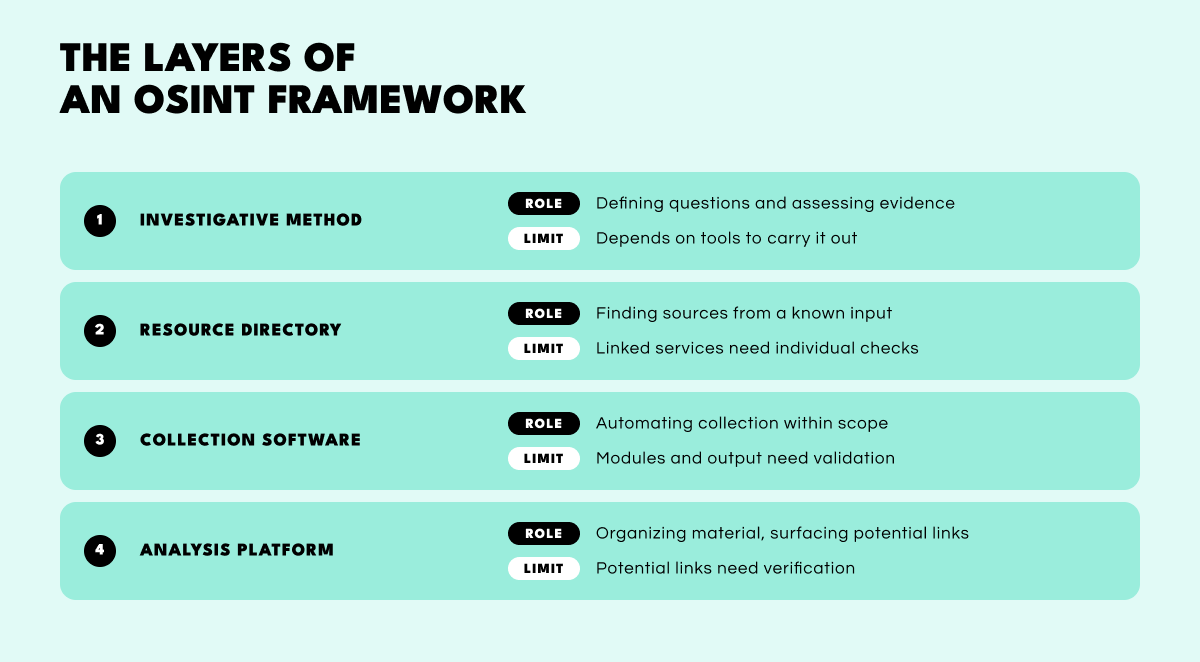
Investigative Methods. A method supplies decision rules: how the question is framed, how sources are weighed and how uncertainty is reported. It needs tools to carry it out.
Resource Directories. A directory helps a researcher start from a known input, such as a username or a domain, and find sources. A listing is a pointer, not an endorsement or a verified result, and each linked service sets its own conditions.
Collection software. Automated collection tools and modular command-line frameworks run searches against many sources. Evaluating one means reading its documentation for modules, dependencies and access conditions, and testing it on an authorized task before relying on it.
Analysis Platforms. Platforms add storage, link analysis and review to collected material, so that connections can be inspected and compared. Their output still needs corroboration, and no layer replaces the judgment that separates a lead from a finding.
A documented workflow is the working core of an OSINT framework. It turns raw results into a supported finding, and it has three parts. The first is scoping and selecting. The question and the permitted scope are written down, and sources are chosen because they match the input and the task, not because they appeared first in a list.
The second is collecting and validating. Every query and its date go into the log, and results are checked against independent sources before they count. Documenting digital evidence at the time of observation matters because online material changes and disappears. The log needs six fields: the research question, the resource and source address, the query or input, the retrieval date, the observation or publication date where available, and an assessment with its limitations.
The third is reporting and revisiting. Candidate associations, such as two entities that share a name, stay separate from supported findings. Unresolved outcomes are preserved with the reason they remain open, so that another analyst can pick the question up when a new source appears.
The following scenario is fictional and built for illustration. No real company, register or person is involved.
In this scenario, a researcher is asked whether a supplier’s website claim holds up. The site states that the company has operated since 2009 and lists a street address. The researcher uses a resource directory to locate the public company register for the stated country, then searches it and finds two similarly named entities: one incorporated in 2016 at the address on the site, and one incorporated in 2009 at an address in another city. Each search is logged with its query, address and retrieval date.
Before comparing dates, the researcher has to establish which entity, if either, is the supplier. The address match makes the 2016 entity a stronger candidate, but the association remains provisional until supported by a registration number or other reliable identifying information. The 2009 entity shares only a name. Even if the 2016 entity is confirmed as the supplier, its incorporation date would not necessarily contradict trading activity beginning in 2009: the business could have operated through a predecessor entity. Placing both entities and the website’s address in one view makes the candidates easy to compare, but it does not settle which one is the supplier.
The record distinguishes the website’s trading-history claim from the register’s incorporation dates. Neither the supplier’s legal identity nor its claimed operating history has been conclusively established. The candidate matches and outstanding questions remain documented, allowing another analyst to continue the investigation without starting over.
A framework makes discovery easy and structure visible, but it cannot make a source reliable. Six limits recur.
Dead links and changing access. Listed resources move, close or add registration, so each link is checked on the day of use.
Copied reports. Several pages derived from the same original report represent one evidence lineage, not independent corroboration, and verifying online sources means finding the origin.
Inferred associations. A matching username or shared image suggests a link without establishing common ownership or identity.
Missing versus negative results. A failed query, an inaccessible source and a genuine negative observation are different outcomes and are recorded separately.
Freshness and independence. Observation dates and publication dates are logged, because a result can describe an earlier state of the source.
Passive and active actions. Some resources only read existing public records, while others send requests to a target's systems, so the behavior of each tool is checked, not assumed from its place in a directory. Tool output needs assessment for source reliability, context and relevance before it supports a conclusion.
A short checklist covers most selection decisions. The task and the input are named. The permitted scope is confirmed. The collection requirements are clear: which sources, how often and with what access conditions. The team knows how relationships will be analyzed, what can be exported and how findings will be reviewed. The output matches the evidence the question needs, and repeatability is considered before the same searches have to run a tenth time.
Recurring collection is where the checklist carries the most weight. When the same searches repeat, when several analysts share one record, or when exports and audit trails matter, comparing OSINT tools against those needs is a sensible next step. Directories, tools and platforms sit at different layers of the same work, so the question is usually which layers the task needs, not which single option wins.
An OSINT framework is first a structure and only then a set of tools. It connects a research question to collection, analysis, verification and reporting, so that another analyst can see how a conclusion was reached. Without that structure, results lose their origin, and a pattern that looks convincing can pass for a finding.
The parts of a framework do different work. A method decides what counts as evidence, a directory points to where to look, collection software gathers from those places, and a platform organizes what came back. Fields such as human-rights research, journalism and intelligence apply these parts differently, so the right mix depends on the decision the work will support.
What turns results into a supported finding is the record kept along the way: queries, dates and limits, corroborated against independent sources. Where that record cannot support a claim, an unresolved outcome documented with its reason is more useful than a conclusion that cannot be defended, and the investigator’s judgment is what connects every layer.
It is a structured way of organizing open-source intelligence work, from the research question through collection and verification to a reported result. The term is also used for directories of resources, collection software and analysis platforms, which support a method without replacing it.
The answer depends on the task, the inputs, the technical skill available and the evidence the result has to support. A method defines and defends a finding, a directory suits discovery, collection software suits automation on an authorized task, and a platform suits organizing and comparing results. No single option covers all four.
The core capabilities are collection from the sources the task requires, relationship analysis, export of results, repeatable searches and support for review. Each should be assessed against the team's own requirements and against current product documentation, not assumed from a category name.
It builds verification into the sequence. Each result carries its source, retrieval date and observation date, claims are checked against independent sources, and candidate associations stay separate from supported findings. A reviewer can then see how a conclusion was reached.
No. A framework structures the work by bounding the question, recording sources and separating observations from inferences, but it cannot decide which sources are reliable or what a pattern means. Tools can surface candidate links, and the analyst still assesses them and decides what the evidence supports.
Want to see how a structured OSINT workflow helps investigators connect findings, analyze relationships and assess evidence? Book a personalized demo to explore how SL Crimewall supports public-source data collection, link analysis and the organization of findings in one platform.