OSINT in Anti-Human Trafficking: Reading Public Signals

Anti-human trafficking work depends on information that arrives in fragments: a job listing with inconsistent details, a tip phoned to a hotline, a payment record that does not match any registered business. Investigators, NGO analysts and compliance teams rarely receive a finished picture. They receive signals, and what happens next depends on how carefully those signals are handled.
OSINT has become one of the main ways such signals are tested. It can help identify potential indicators, corroborate accounts and document publicly observable evidence relevant to exploitation. Individual indicators, however, are not conclusive until their authenticity, context and alternative explanations have been assessed. A lead is a reason to look closer. A finding is a documented conclusion supported by evidence appropriate to the claim being made.
In this article, we examine how investigations move from a lead to a documented referral, how responsibilities divide between roles, which public sources support each stage and where each reaches its limit. Collection decisions can affect survivors and third parties who are unaware of the research, so survivor protection stays in view throughout.
The FBI describes human trafficking as the use of force, threats of force, fraud or coercion, covering both sex trafficking and labor trafficking. Under US federal law, commercial sex involving a person under 18 does not require proof of force, fraud or coercion to constitute sex trafficking. Definitions differ by jurisdiction, so the US framing serves here as an example, and legal conclusions belong to counsel and the competent authority.
Anti-human trafficking efforts are usually organized around four strands. Prevention reduces the conditions that traffickers exploit, such as unregulated recruitment. Protection secures safety, shelter and recovery for survivors. Prosecution holds offenders accountable, and partnership connects the agencies, NGOs and service providers that each hold part of the picture. The US Department of Justice states that the most effective way to detect and investigate human trafficking is a collaborative, multi-agency approach.
The scale explains why the response has to be broad. The UN Office on Drugs and Crime reported a 25% increase in detected victims in 2022 compared with 2019, with children accounting for 38% of all victims detected. Detection figures reflect what institutions find as well as what occurs, which is why investigative capacity matters as much as awareness.
Trafficking is also easy to confuse with smuggling. Smuggling involves the unlawful, consensual transport of a person across a border, and a smuggling situation can develop into trafficking if exploitation follows. Trafficking centers on exploitation and does not require a border crossing; its precise legal elements vary by jurisdiction. A person's initial agreement to travel or take a job does not rule out trafficking if the applicable legal elements are subsequently established. Ordinary migration is not a trafficking indicator by default.
A survivor-centered approach shapes what is collected, how it is stored and who sees it. The FBI describes its approach as trauma-informed and victim-centered and states that victim recovery is the primary goal of trafficking investigations. In practice, that means avoiding contact that retraumatizes, avoiding exposure of a person's location and addressing safety before treating a survivor as a source of evidence.
Roles follow from that principle. Law enforcement holds investigative authority and may obtain records through applicable legal processes. NGOs and service providers deliver support such as shelter and counseling, and often hold the earliest trusted contact with survivors. Analysts organize and test public information. Support services and investigative authority stay separate on purpose, because a person who seeks help should not be drawn into evidence collection without informed safeguards. Protecting practitioners from exposure during sensitive research belongs in the same conversation.
Trafficking takes several forms, and each leaves a different trail. Eurostat reported 10,793 registered victims in the EU in 2023. Among victims whose form of exploitation was recorded, 43.8% were trafficked for sexual exploitation and 36% for forced labor. No single pattern can anchor an investigation.
Labor trafficking. Investigations may begin with recruitment offers that do not match the work delivered. Job advertisements, recruiter profiles, company registrations and worker reviews may carry traces of deceptive recruitment. An advertised wage paired with an unusual fee structure can justify further review, but neither establishes forced labor or trafficking on its own.
Sex trafficking. Investigations into sexual exploitation may encounter advertisements, recycled images and recurring contact details. Payment records can be central, but they are not generally public and arrive through authorized institutional access or other investigative channels. Consensual adult sex work is not a trafficking indicator by default, and each signal needs assessment against the applicable legal elements, not assumptions based on the activity alone.
Forced criminality. Coerced participation in fraud, theft or similar offenses may appear as repeated activity linked to one organizer. Public information can show the pattern, while whether the participants acted under coercion is a question for those with the authority and training to assess it.
Anti-human trafficking investigations that rely on public information can follow a six-stage framework, which organizations can adapt to their mandate and jurisdiction. The stages provide a structured approach to routine investigative work, while urgent safety concerns require immediate escalation regardless of where the research stands.
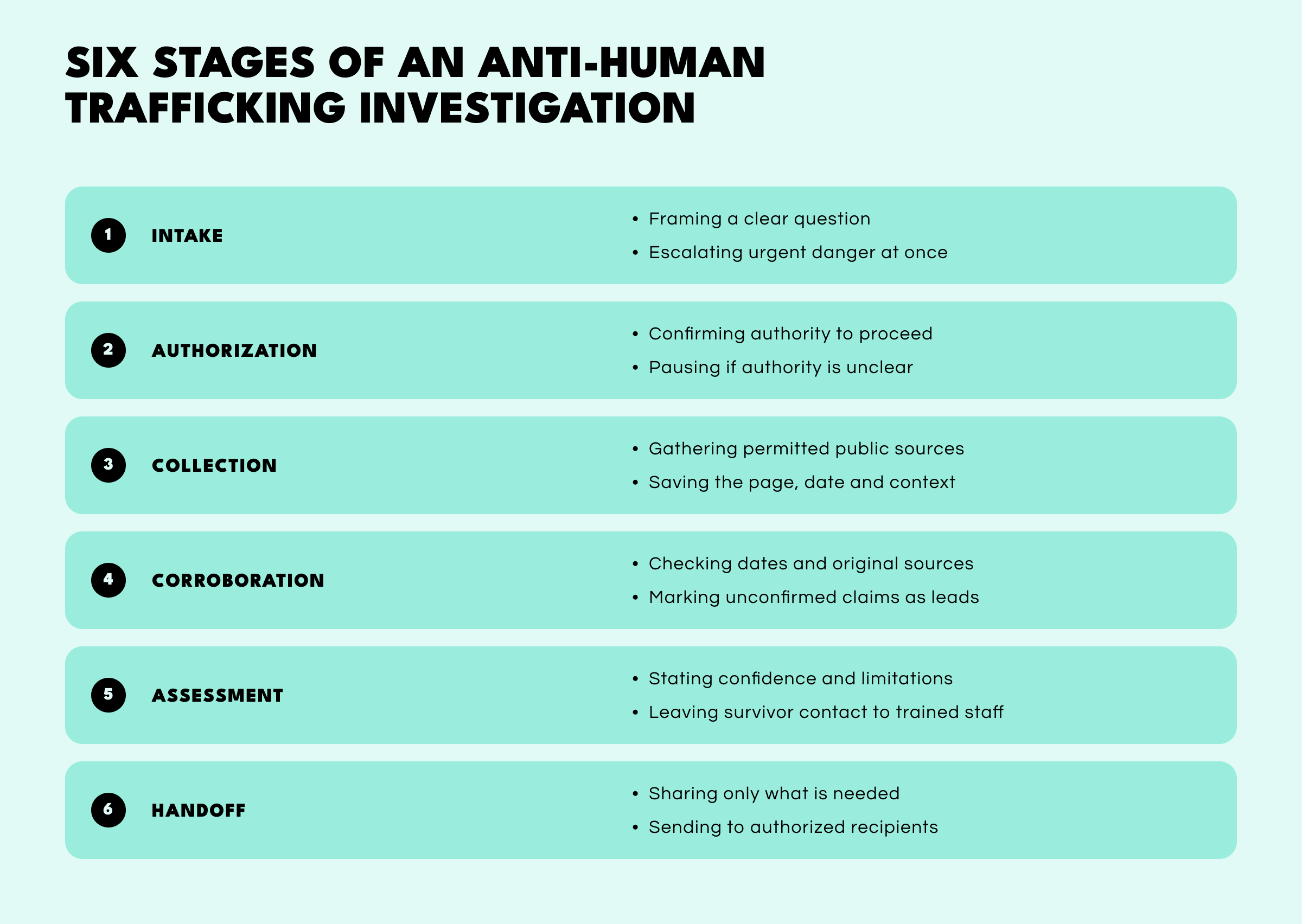
Intake. An analyst or coordinator turns a signal into a bounded research question. Signs of immediate danger go to the competent authorities at once, without waiting for further research.
Authorization. A supervisor or legal reviewer confirms that the work fits the organization's mandate, jurisdiction and policy. An unclear mandate should pause routine collection until it is resolved.
Collection. The analyst gathers only permitted public sources and preserves the address, capture time and surrounding context wherever possible. If material is unavailable or incomplete, the limitation is documented, because urgent reporting should not wait for a complete evidence package.
Corroboration. Dates, provenance and reused content are checked, and independent sources are sought for each material claim. Evaluating public-source information this way keeps assumptions apart from facts, and a claim that remains uncorroborated stays labeled as a lead.
Assessment. Where available, a second analyst reviews the reasoning, and the record states confidence and limitations. Questions that need legal authority or contact with a survivor go to someone authorized and trained for that role.
Handoff. A minimal, access-controlled package goes to an authorized recipient. The team records receipt and follows the agreed procedures for follow-up, retention and closure.
The role of OSINT in anti-human trafficking investigations is to test claims against public sources, identify potential indicators, and document what was observed. The Council of Europe's work on technology-facilitated trafficking recommends that law enforcement build capacity in areas such as online patrols and OSINT, and it identifies online job advertisements as a recruitment risk. Four source categories are particularly useful, each with a limit.
Recruitment posts. Job boards, classifieds and social posts show how an offer was made and how it changed. They can be copied, edited or deleted, and a copy repeats one claim rather than adding a second.
Business records. Corporate registries show whether the named employer exists, who is listed as an officer and where it is registered. Registry data lags, and a registered company can still be a front while an unregistered one can be innocent.
Images. Reverse image search shows where a photo appeared before, which often exposes borrowed or stock material. Similarity does not establish common authorship, and metadata is frequently stripped.
Shared identifiers. Responsible link analysis maps phone numbers, usernames and addresses that recur across listings. Entity resolution can merge different people who share a name or reuse a number, so each connection needs to be evaluated against its source, context and available corroborating evidence before it supports a broader conclusion.
The methods above determine what a tool needs to do. Four functions recur: search across public sources and registries, capture that preserves pages with timestamps and context, analysis that visualizes relationships, and case management that keeps the question, sources and decisions in one record. Comparing categories is more useful than ranking products, because a capability suited to one authorized need may be irrelevant to another.
Three criteria separate suitable tools from unsuitable ones. Coverage states which sources are reached and which are not, so missing results are not mistaken for absence of evidence. Provenance records where each item came from and when. Access controls restrict who can view sensitive material, while audit logs record access. AI-assisted triage can speed the first sorting of large volumes, but its output is a suggestion that a human reviewer verifies before it enters a case.
Whatever the tool, the record it produces decides whether a lead can be used. Online material disappears quickly, so documenting digital evidence at the time of observation is the practical defense against loss. The UN human rights office's Berkeley Protocol on Digital Open Source Investigations offers professional standards for gathering, analyzing and preserving digital information ethically and legally. It is a methodology, not universal law.
A usable record includes dated capture, the original context, an access log and a statement of uncertainty. Chain of custody, the documented trail showing who handled an item and when, supports later review. Retention should be limited to what the purpose requires, and public availability does not remove privacy or legal obligations. A referral should contain the minimum the recipient needs to act, with sensitive identifiers separated from the narrative. The COPS Office highlights a toolkit for police agencies that includes a case report checklist and policy considerations for trauma-informed, victim-centered investigations.
The following scenario is a fictional composite built for illustration. It contains no real handles, numbers or locations, and it does not end in a rescue.
In this scenario, an analyst notices a public job listing for overseas hospitality work with an inconsistent employer name and a salary far above comparable roles. After confirming the work is authorized, the analyst captures the listing with its timestamp and page context and compares the employer name with public business registries. A similarly named company exists but lists a different address. The listing's logo also appears on a second job advertisement, and an automated match suggests that both may share an operator.
The analyst checks further and finds the image on dozens of unrelated pages, a typical sign of stock material. With no shared phone number, payment detail or independent record linking the two listings, the analyst rejects the proposed connection. The employer mismatch remains an unresolved lead, not evidence of trafficking. Where available, a second analyst reviews the record, and the team determines whether the concern meets the authorized recipient's referral criteria. Any referral states what was observed, what was ruled out and what remains unknown: whether any exploitation occurred, who controls the listing and whether any real person has been affected.
Anti-human trafficking investigations depend on turning fragmented information into findings that can be assessed and acted upon responsibly. OSINT helps investigators verify public signals, trace connections and preserve evidence, but a suspicious indicator is not proof of exploitation. Each finding must be evaluated against its source, context and available corroborating evidence.
A survivor-centered approach sets the boundaries for this work. Clear authorization, careful documentation and appropriate handoff procedures help ensure that investigative progress does not come at the expense of those the investigation is intended to protect.
Investigations usually begin with a tip or referral from a hotline, an NGO, a survivor, a member of the public or another agency. The FBI notes that tips can be submitted by phone or online, anonymously if preferred. Procedures differ by jurisdiction, and not every tip becomes a case. Intake decides whether a signal is specific enough to test.
OSINT supports the work by testing claims against public sources: checking whether an employer exists, whether an image has appeared before and whether accounts share an identifier. It can help identify potential indicators and document publicly observable evidence relevant to exploitation. Findings are recorded with stated confidence and limitations.
Public-source material can contribute evidence of exploitation, but whether it is sufficient depends on authenticity, context, corroboration and legal assessment by the competent authority. Evidence, corroboration and proof are distinct concepts, and no universal rule treats a given body of open-source material as enough on its own.
Tools are best judged by function: search, capture, analysis and case management. Selection criteria include coverage, provenance, auditability and access controls, not a universal ranking. AI-assisted output requires human verification, and no tool should be expected to provide private messages or restricted records.
Investigators assess indicators by checking their source, context and reliability. A suspicious recruitment post, reused image or shared phone number may justify further investigation, but none establishes trafficking on its own. Cross-checking public records, examining source provenance and testing alternative explanations helps distinguish credible leads from misleading connections. Findings should document both what the evidence supports and what remains unverified.
Want to see how OSINT can help investigators trace recruitment networks, analyze connections and document public-source evidence? Book a personalized demo to explore how SL Crimewall brings data collection, relationship analysis and investigative findings together in one platform.