Threat Intelligence and Incident Response: Linking Evidence
An alert arrives with a feed match and no explanation, and an analyst must decide whether to escalate, ignore or act. Threat intelligence and incident response only strengthen each other when external context informs an assessment that responders test against evidence from the affected environment.
The handoff between the two functions is the integration gap where decisions slow down or go wrong. A workflow with named owners, quality checks and approval rules closes that gap without requiring a large program.
In this article, we examine how the two functions relate, which types of intelligence support response, a six-step integration workflow, the techniques and tools behind it, and the measures that show whether it works. Two hypothetical examples show how evidence changes decisions.
The two functions are complementary and exchange information in both directions. Cyber threat intelligence (CTI) is knowledge about adversaries, including their motivations, intentions and methods, that has been collected, analyzed and shared to inform decisions. Incident response (IR) investigates what happened in a specific environment and decides what to do about it. Intelligence informs the investigation, and the investigation produces new intelligence for the next case.
A raw indicator is a single data point, such as an IP address, domain or file hash. An assessed finding is an analyst’s judgment about what that data means, with a source and a confidence level attached. Incident evidence is what the affected environment shows, such as authentication logs, process activity or mail records. An alert’s match to a threat feed links an observed artifact to external reporting. It does not, by itself, establish malicious activity, compromise or the appropriate response.
CTI assesses context, responders investigate and act, and incident leadership coordinates business impact and authority. In a large security operations center (SOC), these are separate roles. In a small team, one person may hold several, but the decisions stay distinct: what the intelligence means, what the evidence shows and who approves the action.
Cyber threat intelligence and incident response show their value in specific decisions: which assets to examine first, which related activity to scope, which hypotheses to test and how proportionate containment should be. M-Trends 2026, Mandiant’s report on its 2025 investigations, reports a global median dwell time of 14 days, compared with 11 previously. In the access-handoff activity it analyzed, the median interval between initial access and transfer to a secondary threat group fell to 22 seconds.
Mandiant also found that organizations first detected malicious activity internally in 52% of its investigations, up from 43% in 2024, which makes triage of internally generated alerts a frequent starting point for applying intelligence. These figures describe cases that Mandiant investigated, not all organizations or attacks, and the handoff interval is not a time-to-ransomware measure.
Consider a hypothetical example. An analyst sees that an IP address in an alert appears on a feed. Without sufficient context, analysts may overreact to the match or dismiss a useful lead. With a handoff record, the analyst sees that the source has a stated reliability, the assessment carries moderate confidence, the indicator is nine days old, and the address is associated with infrastructure described in adversary reporting. The decision becomes narrower: check whether related behavior appears on a relevant host before choosing an action.
Intelligence types differ by audience, decision and shelf life, and organizations classify them differently, so the labels here are a working model rather than a universal standard.
Strategic. Sector-level assessments, such as which ransomware groups target an industry, inform leadership decisions about which scenarios to prepare for and fund. They are revisited when the threat landscape, business priorities or exposure change.
Operational. Campaign reporting on how a group intrudes and what it seeks helps incident commanders and SOC leads decide which hypotheses to test and which systems to scope first. It is revalidated as the campaign evolves and new reporting appears.
Tactical. Adversary tactics, techniques and procedures (TTPs) mapped to MITRE ATT&CK show responders and detection engineers which behaviors to hunt and which detections to tune. They are reviewed when adversary behavior or detection coverage changes.
Technical. IP addresses, domains and file hashes tell SOC analysts and automated tools what to search for and whether to block. They are checked for context, expiration and reassignment, because shelf life varies by artifact.
Each question calls for a different layer of intelligence. Whether a domain should be blocked is a technical question with a short answer window, because infrastructure changes hands. Where else an intruder may be operating is an operational and tactical question, and behavioral knowledge tends to outlast any single indicator.
NIST’s latest incident response guide, SP 800-61 Rev. 3, was published in April 2025 and replaces the previous edition. It treats incident response as part of everyday operations, not a task for one team. The workflow below is not NIST’s own model but a practical way to apply that idea, and it works with whichever response process an organization already follows. Threat intelligence and incident response run as one loop here: six stages, each producing an output the next stage can use.
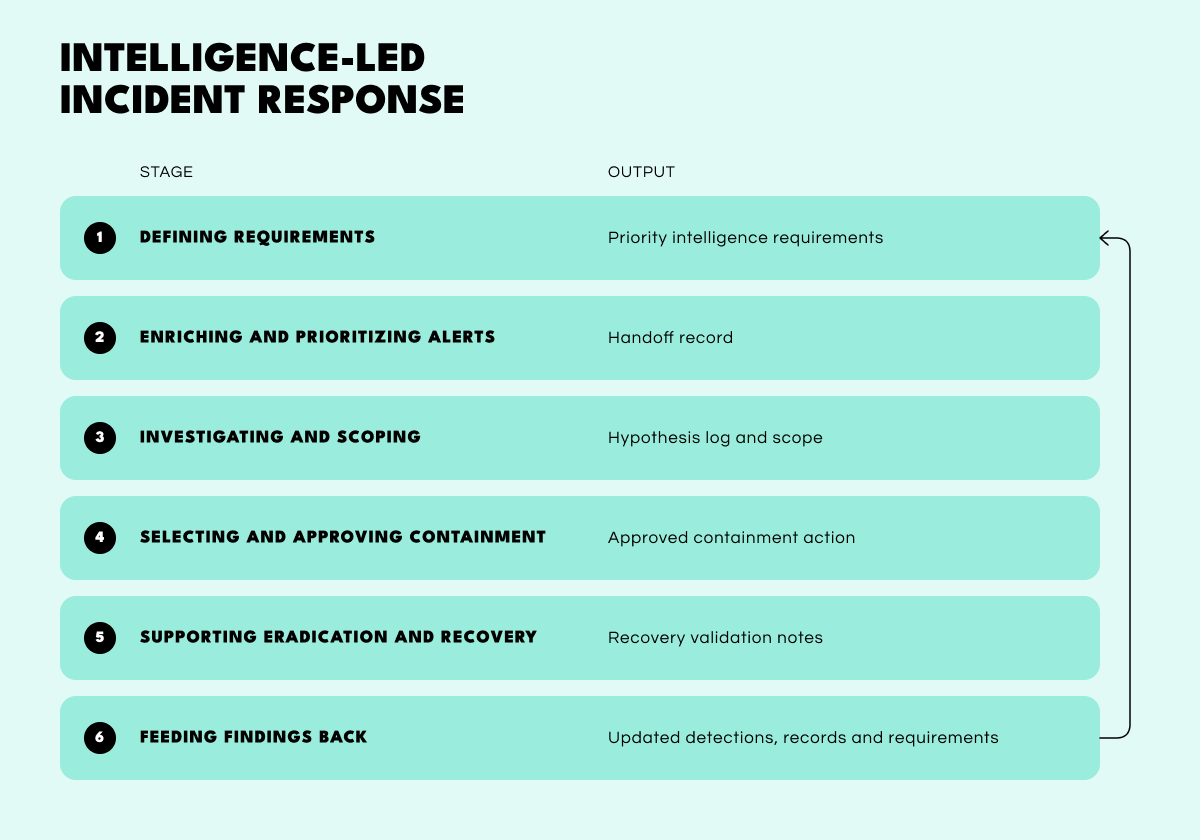
Requirements start with what the organization must protect and what it must be able to decide. Critical assets, likely scenarios, available telemetry, response authority and unanswered operational questions determine which intelligence is worth collecting. CIS describes this planning through Key Intel Questions and Priority Intelligence Requirements, which guide collection, analysis and reporting and are refined by feedback from recipients. The CTI lead and IR lead own this step together, and its output is a set of priority intelligence requirements.
Incident enrichment correlates external context with internal evidence, and the result is recorded in a handoff record so that CTI output is usable by responders. A CTI analyst and a triage analyst own this step, the decision is whether to investigate, deprioritize or escalate, and the output is the handoff record. A standard record keeps alert triage consistent across analysts, and missing fields expose information gaps, which are recorded while the available evidence is assessed for whether it supports investigation, escalation or containment.
The record groups nine fields by purpose.
Origin. Source, source reliability and timestamp show where the intelligence came from, how dependable the source has proved and when it was collected and last reviewed.
Assessment. Assessment confidence records how well this specific claim is supported, given the evidence, corroboration, gaps and uncertainty.
Relevance. Relevant asset and evidence tie the intelligence to the host, identity or service it may affect and to the internal telemetry that supports or contradicts it.
Action. Proposed action, owner and expiry state the recommended step and its expected impact, who is accountable for acting or declining, and when the record must be revalidated or retired.
Source reliability and assessment confidence are separate fields because a dependable source can still produce a weakly supported claim, and judging them independently prevents a trusted source from lending unearned certainty to a weak claim.
Starting from the handoff record and available telemetry, incident scoping expands from a single indicator to related accounts, hosts, behaviors and time windows, and investigations that combine forensics with open-source intelligence can link the activity to broader campaigns. Each hypothesis is logged together with the evidence that would disprove it, so the investigation does not settle on the first plausible story. Every hypothesis ends as confirmed, rejected or unresolved, and visibility gaps and residual uncertainty are documented instead of assumed away. The incident responder owns the step, and the hypothesis log and scope are its outputs.
Containment follows tested, preauthorized playbooks that define confidence, impact, scope, rollback and escalation criteria. An action inside those boundaries can proceed without further approval, but blocking is not inherently low impact: a domain used by a business service can disrupt operations, so the playbook states which assets and categories are excluded. Anything outside the boundaries, such as disabling a shared service account or isolating a critical system, needs human approval from the person with authority over the affected business function. The incident commander owns the decision, working from scoped findings and business impact, and the output is an approved containment action.
Containment alone does not explain how an attack succeeded, so intelligence also supports root-cause investigation and checks for persistence mechanisms, exposed identities and signs of recurrence after the visible activity stops. Removing an indicator of compromise does not prove recovery, because the adversary’s behavior may continue through another path. Responders and system owners decide together whether recovery criteria are met, and the output is a set of recovery validation notes that state what was verified and what remains uncertain.
The post-incident review turns the case record and lessons learned into updated detections, records and requirements: detection rules, intelligence records, response procedures and collection requirements. CTI and detection leads own the step, and each update has its own owner and due date, because feedback without an owner tends to stall. New observations also return to CTI as intelligence, and the updated requirements go back to stage 1, which closes the loop.
Four techniques turn a data point into a supported decision: contextual enrichment, behavioral correlation, hypothesis-led hunting and confidence assessment.
A search for indicators of compromise asks whether a known artifact has appeared in the environment. A behavior-based investigation looks for suspicious sequences of activity, using frameworks such as MITRE ATT&CK to organize observed techniques without requiring attribution to a specific actor. Indicator searches identify known artifacts, while behavioral analysis can reveal related activity even when infrastructure changes. Both depend on telemetry coverage and context, and both require corroborating telemetry before activity is treated as confirmed.
A short validation checklist keeps intelligence confidence consistent, and it avoids universal numerical thresholds because acceptable risk varies by organization.
Provenance. The source, collection method, reliability history and any prior corrections are known.
Freshness. The observation date and indicator expiration are recorded, since infrastructure is reassigned.
Relevance. The intelligence maps to an asset, identity, sector or exposure in the environment.
Corroboration. Internal telemetry or an independent source supports the finding.
Assessment confidence. The confidence level reflects the evidence, corroboration, gaps and uncertainty, separate from the source’s reliability.
In a hypothetical disagreement, one source labels a domain malicious while another lists it as a legitimate service. Rather than choosing a side, the analyst treats both as hypotheses, checks internal proxy and mail logs for suspicious context, and records the conflict in the handoff record until further evidence resolves it or the uncertainty is documented for the decision owner.
Intelligence-led incident response uses existing security tools in distinct roles, and no single category covers the whole workflow.
SIEM. Correlates logs and generates alerts, and it depends on reliable log sources and tuned rules. Alert volume without context grows faster than insight.
EDR. Provides endpoint evidence and response actions where agents are deployed, and its visibility ends at covered endpoints.
XDR. Correlates telemetry from connected sources such as endpoint, identity, email and cloud, and its coverage depends on which sources and integrations are connected.
Threat intelligence platform. Stores, deduplicates and distributes intelligence, and it needs defined sources, owners and expiry rules to avoid duplicated feeds and stale records.
SOAR. Orchestrates enrichment and approved actions through documented, tested playbooks, and automating consequential actions outside playbook boundaries can cause harm.
Case management. Records evidence, decisions and ownership in an agreed case structure, and it is only as complete as analyst input.
OSINT investigation platforms complement this internal telemetry by helping analysts collect external information, examine relationships and document findings for further validation.
STIX provides a structured representation of threat information, and TAXII defines how it moves between systems. The OASIS TAXII 2.1 specification describes TAXII as an application layer protocol that carries cyber threat information over HTTPS and is designed with STIX in mind. A threat intelligence platform manages this exchange, but its records are only as good as their sources and expiry rules. Structured exchange should preserve provenance, expiry, access controls and audit history, so that SIEM correlation rules draw on current, attributable intelligence.
For handling limits, the FIRST Traffic Light Protocol labels, such as TLP:AMBER and TLP:GREEN, tell recipients how far information may be shared.
The following scenarios are hypothetical.
In a bank’s security operations center, an employee reports a suspicious email.
Signal: a feed marks a newly registered look-alike domain as malicious.
Corroboration: mail logs show six recipients, proxy logs show two clicks, and identity logs show one sign-in from an unfamiliar address after a click.
Decision: a click followed by an unfamiliar sign-in is suspicious but does not establish credential compromise by itself, and the reputation score alone would not justify disabling accounts. The analyst validates the session, device and user: the device is new, and the employee does not recognize the sign-in.
Action: under an approved playbook, the incident lead authorizes a precautionary credential reset and session revocation, and the domain is blocked at the proxy after a check that no business service uses it.
Feedback: a detection for the look-alike pattern is added, and the handoff record is updated with the internal evidence and an expiry date.
In a hospital, an endpoint alert flags unusual use of administrative tools on a workstation, and operational reporting describes the same behavior as a precursor to ransomware. Endpoint evidence corroborates it: the tool ran under a service account, and file-rename activity is beginning on a file share. A business-impact review shows that the share supports a clinical imaging system.
A dependency check finds that the imaging system also authenticates with that service account, so revoking it could stop imaging. Urgent isolation of the workstation follows the approved emergency procedure, while the dependency check guides the credential changes. The team prepares a contingency plan, such as a replacement account and a manual workflow agreed with clinical operations, before the incident commander approves rotating the service-account credentials. Recovery checks cover persistence, exposed credentials and recurrence, and the case feeds a revised detection and an update to the response procedure.
Cyber threat intelligence and incident response programs depend on clear ownership of each decision.
A minimum viable workflow starts with one incident scenario, such as credential phishing, a defined owner for each decision, a few relevant sources and a tested response procedure. Small teams can begin here without a new program, and expansion follows evidence from actual cases instead of an attempt to cover every threat at once.
Several failure modes recur. Expired intelligence keeps triggering alerts after infrastructure has changed hands. Duplicated threat intelligence feeds inflate volume without adding information. Overconfident attribution steers an investigation toward the wrong adversary, and missing evidence turns an unsupported claim into an action. Enrichment is automated through approved integrations with access controls, data-handling rules, validation and audit logging, while containment stays within preauthorized playbooks and anything outside them requires human approval.
Three metrics show whether intelligence improves decisions. Each metric needs a defined population and calculation: start and end timestamps for time measures, and numerators and denominators for rates. Comparisons only hold between equivalent cases.
Time to triage. The time from alert creation to a documented disposition, reported as a median or percentile across alerts of comparable type and severity.
Validated-match precision. The number of confirmed true-positive matches divided by the number of adjudicated matches, using documented classification criteria. Unresolved matches are reported separately, and the remaining adjudicated matches show the false-positive share.
Actionable-intelligence rate. The share of reviewed handoff records that materially informed prioritization, scope, response or a justified closure, out of all handoff records reviewed.
Results should state their limitations, because a change in these numbers does not by itself show that intelligence caused the change.
Threat intelligence and incident response deliver the most value as one feedback loop. Requirements decide what intelligence is collected, enrichment turns indicators into evidence-backed assessments, and every consequential action follows rules for confidence, impact and approval.
The core of the workflow is the handoff. When intelligence arrives with its source, reliability, confidence and relevance attached, responders can act on it, challenge it or set it aside, and each case returns findings that improve the next response.
Threat intelligence assesses adversaries, their methods and the context around activity, while incident response investigates and acts on what happened in a specific environment. The two depend on each other: intelligence sharpens investigation, and investigation findings become new intelligence.
It adds context to an alert, such as known adversary behavior, indicator age and assessment confidence, so analysts can judge relevance and decide what to check first. It improves triage only when matched to internal evidence about affected assets and identities.
Intelligence becomes operationally actionable when it supports a defined decision with sufficient context and confidence. Relevance to the environment and recency matter, and ownership, review dates and asset relevance help responders use it consistently.
Yes, within limits. A small team can start with one incident scenario, existing telemetry and a few reliable sources, and assign named owners for enrichment and approval. The workflow scales by adding scenarios, not by adding tools first.
Only inside tested, preauthorized playbooks that define confidence, impact, scope, rollback and escalation criteria. Blocking a domain is not inherently low impact, so actions outside those boundaries need human approval, because stale or incorrect intelligence can cause harm of its own.
Want to see how OSINT can help investigators enrich leads, examine relationships and document findings? Book a personalized demo to explore how SL CrimeWall brings open-source data collection, link analysis and reporting together in one platform.