Financial Fraud Investigations: The Role of AI
For years, auditors at Wirecard signed off on financial statements showing billions of euros in cash that did not exist. Automated reconciliation systems processed the figures. Compliance checks cleared. When it finally collapsed in 2020, €1.9B in cash had simply never existed. Detection systems had access to the data. What they lacked was the investigative layer that would have asked whether the data reflected reality.
That gap sits at the center of how AI is changing financial fraud investigations. Detection has improved substantially. The problem most organizations face is not identifying suspicious activity. It is what happens after a flag is raised.
In this article, we examine what AI actually does well in fraud detection, where it falls short, how data analysis supports investigation beyond algorithmic monitoring, and what an effective fraud investigation pipeline looks like when detection and investigation work together.
AI has produced genuine, measurable improvements in fraud detection, and that should not be understated. Several capabilities stand out.
Anomaly detection in transaction data is where machine learning has had the clearest impact. Models trained on historical transaction patterns can identify deviations that would be invisible to rule-based systems, flagging unusual amounts, velocities, or geographic patterns within milliseconds. HSBC's AI-driven system reduced false positives by 60% while detecting two to four times more suspicious activity than its previous rule-based approach, analyzing more than a billion transactions a month.
Pattern recognition across large datasets allows AI to surface relationships and trends that would take human analysts far longer to identify manually. This is particularly valuable for organizations processing transaction volumes that make exhaustive manual review impossible.
Behavioral baseline modeling establishes what normal activity looks like for a given account, customer, or employee, then flags deviations from that baseline. This approach catches fraud that does not match any predefined rule but still represents a meaningful departure from established patterns.
Real-time monitoring at scale means detection no longer waits for periodic batch review. Transactions can be evaluated and flagged as they occur, narrowing the window between fraudulent activity and detection considerably.
These capabilities are real, and organizations that have not adopted them are operating at a structural disadvantage. The mistake is assuming that better detection alone solves the fraud problem.
Despite genuine progress, AI-driven detection has clear limitations that organizations consistently underestimate.
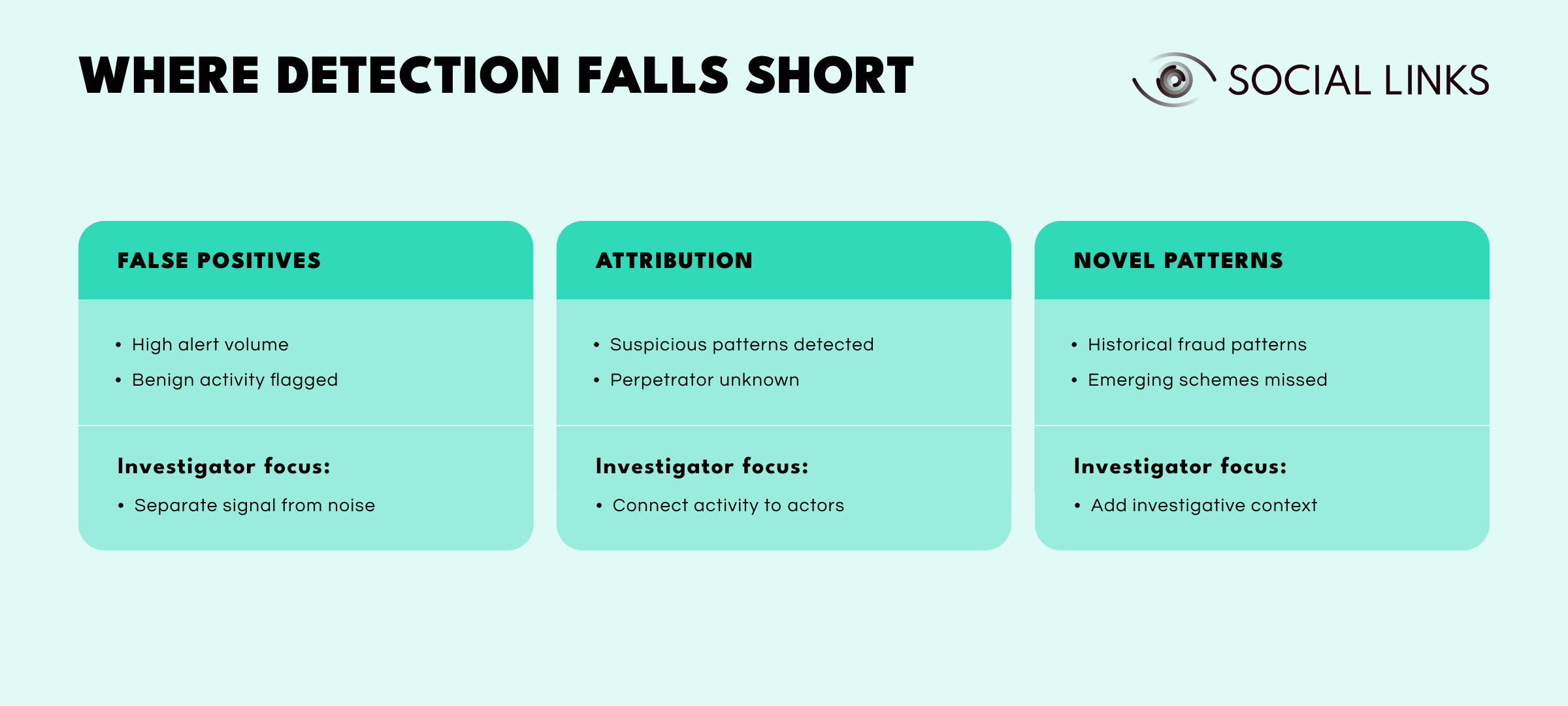
False positive rates remain a significant operational burden. Detection systems calibrated to catch fraud inevitably flag a significant number of legitimate transactions as well. The resulting alert volume produces analyst fatigue, where the sheer number of flags erodes the attention and scrutiny each one receives, and creates operational costs that compound as transaction volumes grow.
Attribution is not a capability AI detection systems provide. A model can flag that a transaction pattern looks anomalous. It cannot determine who initiated it, why, or whether the activity reflects fraud, error, or legitimate but unusual behavior. Detection identifies what looks wrong. It does not establish who is responsible.
Novel fraud patterns that fall outside training data remain a persistent blind spot. Models trained on historical fraud patterns are inherently backward-looking. Fraudsters who adapt their methods, particularly using AI-generated synthetic identities or documents, can produce activity that does not resemble anything the model has seen before, slipping past detection entirely until the pattern becomes common enough to retrain on.
This is where investigation provides what detection cannot: context. Rather than asking whether an event resembles historical fraud, investigators examine identities, relationships, communications, financial activity, and open-source intelligence to determine what the suspicious activity actually represents. Investigation adapts to new fraud schemes because it is driven by evidence rather than historical examples.
The difference between a flagged transaction and a fraud case is the difference between a signal and a conclusion. Detection produces the former. Building the latter requires a different kind of work.
Most organizations have invested heavily in detection capability and comparatively little in investigative capability, and the imbalance shows.
A flagged transaction sits in a queue. An analyst reviews it against a checklist. If nothing obviously legitimate explains it, the alert may be escalated, dismissed, or simply left unresolved due to volume. What rarely happens automatically is the deeper work of understanding who is behind the activity, whether it connects to other flagged transactions, and whether the pattern reflects an isolated incident or part of a broader scheme.
That gap matters in concrete ways. Without investigation, regulatory reporting obligations may go unmet because organizations cannot document what actually happened. Legal action becomes difficult or impossible without an evidentiary record connecting the flagged activity to a specific individual or entity. Asset recovery rarely happens without identifying where funds moved and who controls them now. A detection system can flag the same fraud scheme a hundred times without ever producing the case file needed to act on any of it.
Organizations that treat detection as the finish line consistently discover, after the fact, that flagged anomalies sitting unresolved for months have actually represented real, ongoing losses the entire time.
Investigation requires a different relationship with data than detection does. Detection algorithms process data continuously, looking for statistical deviation. Investigation requires analysts to engage with data analytically, asking targeted questions rather than waiting for automated flags.
Transaction pattern analysis examines flagged activity in the context of related transactions rather than in isolation, looking for structuring, layering, or other patterns that indicate deliberate concealment rather than a single suspicious event.
Network flow analysis traces how funds moved between accounts, entities, and intermediaries, often revealing relationships and pathways that individual transaction review would miss entirely.
Timeline reconstruction establishes the sequence of events surrounding suspected fraud, which is frequently essential for proving intent and for understanding how long a scheme operated before detection.
Ratio analysis compares financial indicators against expected norms for a given account type, business, or individual, surfacing inconsistencies that suggest reported figures do not match underlying reality.
These techniques share a common trait: they require an investigator to direct the analysis toward a specific question rather than waiting for an algorithm to surface a result. That directed, hypothesis-driven approach is what separates investigation from detection.
Transactional anomalies and behavioral signals are not the same thing, and conflating them limits what investigators can find.
A transactional anomaly is something a financial system flags directly: an unusual transfer, a deviation from spending patterns, a transaction that does not match an established profile. A behavioral signal is something broader: how a person communicates, how they access systems, what their declared circumstances suggest about their actual financial position.
Behavioral analytics identifies fraud indicators that pure financial analysis misses entirely.
Lifestyle analysis compares observable indicators of wealth or spending against declared income, surfacing inconsistencies that financial records alone would never reveal.
Communication pattern analysis examines whether the tone, timing, or content of correspondence aligns with normal business activity or suggests concealment, urgency, or coordination with other parties.
Organizational access pattern analysis looks at when, how, and how frequently an individual accesses systems or records relative to their role, flagging access that falls outside what their position would typically require.
None of these signals constitutes proof on its own. Together, they provide direction, helping investigators prioritize which flagged anomalies deserve deeper scrutiny and which behavioral inconsistencies warrant further inquiry.
When AI flags a suspicious transaction cluster, the output is a pattern, not a person. OSINT investigation is what connects that pattern to real-world entities and individuals.
Imagine a detection system that flags a cluster of transactions moving through a network of accounts associated with a vendor relationship. The algorithm can identify that the pattern is statistically unusual. It cannot determine whether the vendor is a legitimate business facing cash flow issues, a shell entity created to facilitate fraud, or a front for an individual already under investigation elsewhere.
Open-source intelligence closes that gap. Corporate registries reveal who actually controls the vendor entity. Adverse media may surface prior allegations involving the same individuals. Social media activity may reveal undisclosed relationships between the vendor's principals and employees at the organization being defrauded. Public records may connect the entity to other organizations exhibiting similar transaction patterns.
This is the layer that transforms a statistically significant cluster of transactions into an attributable case involving named individuals and documented relationships. AI identifies what is worth investigating. OSINT investigation determines who is actually behind it.
Closing the detection-to-investigation gap requires connecting automated systems to structured investigative workflows rather than treating detection output as an endpoint.
Detection trigger. The process begins when a system flags an anomaly, whether through transaction monitoring, behavioral baseline deviation, or manual referral. This stage should produce enough context, not just a flag, to give investigators a starting point.
Scope definition. Before deep investigation begins, the suspected activity, affected accounts or entities, relevant time period, and potential exposure need to be defined. This prevents investigations from expanding without direction or stalling without clear boundaries.
Evidence collection. Financial records, communications, transaction logs, and digital artifacts connected to the flagged activity need to be preserved promptly, before they can be altered, deleted, or lost to routine data retention policies.
Identity investigation. OSINT and identity analysis connect the flagged pattern to the individuals and entities actually responsible, closing the attribution gap that detection alone cannot.
Case building. Findings are organized into a documented, evidence-supported narrative capable of supporting whatever action follows, whether regulatory reporting, litigation, internal discipline, or recovery proceedings.
The organizational requirement underlying all five stages is the same: detection and investigation cannot operate as separate functions with no defined handoff between them. Without that connective tissue, organizations end up with sophisticated detection systems generating flagged anomalies that simply accumulate, unresolved, in a queue.
AI has genuinely improved fraud detection, and the gains in pattern recognition, anomaly detection, and real-time monitoring are real. What AI detection has not done, and was never designed to do, is identify who is responsible or build the evidentiary case needed to act on what it finds.
The organizations that recover the most value from their AI investment are not the ones with the most sophisticated detection models. They are the ones that built the investigative layer connecting detected signals to documented, attributable cases. Detection tells an organization that something is wrong. Investigation is what determines what to do about it.
AI can flag anomalous transactions and behavioral patterns at significant scale, but it cannot determine intent, identify who is responsible, or build the evidentiary record needed for legal, regulatory, or recovery action. Human investigation remains necessary to convert a detected anomaly into an actionable case.
Fraud represents a very small percentage of overall transaction volume, which creates highly imbalanced training data. Models calibrated to catch genuine fraud inevitably flag a significant number of legitimate transactions as well, requiring human review to distinguish between them.
Transaction monitoring identifies anomalies algorithmically and continuously. Fraud investigation is a directed, analytical process that determines who is responsible, how the scheme operated, and what evidence supports formal action. Monitoring surfaces signals. Investigation builds cases.
When AI detection flags a suspicious pattern, OSINT investigation provides the context needed to attribute that pattern to real individuals and entities, using corporate records, adverse media, public filings, and other open sources that financial systems do not capture.
An effective pipeline connects detection systems directly to investigative workflows through five stages: detection trigger, scope definition, evidence collection, identity investigation, and case building, with clear handoffs between each stage rather than detection output accumulating unresolved.
Want to see how OSINT strengthens financial fraud investigations? Book a personalized demo with one of our specialists and discover how SL Crimewall helps investigators identify the people behind suspicious activity, map hidden relationships, and build evidence-backed fraud cases.