Criminal Investigation Tools: When Evidence Isn't Enough
The tools used in criminal investigations have expanded far beyond fingerprint kits and evidence bags. Modern cases now involve DNA analysis, digital forensics, network analysis, and intelligence platforms that can process huge volumes of evidence. But tools alone do not solve cases. A fingerprint may identify a person, but it does not explain why they were there, what they did, or how that fits into a wider pattern. That still depends on investigative skill: turning separate facts into a coherent case.
In this article, we look at what investigation tools actually provide, how modern cases rely on physical evidence, digital evidence, and intelligence context, why tools alone are not enough, and how investigators turn separate findings into defensible conclusions.
Investigation tools are the instruments, technologies, and systems that support evidence collection, preservation, analysis, and documentation across the criminal investigation process.
In practice, that includes crime scene equipment that preserves physical evidence before it degrades, laboratory instruments that analyze biological and chemical materials, digital forensics platforms that recover and document electronic evidence, and intelligence systems that help investigators spot patterns across cases and jurisdictions.
What these tools ultimately produce is evidence: fingerprints, DNA profiles, digital artifacts, chemical analyses, scene documentation, and data correlations. They collect, preserve, and analyze material that can support or challenge a theory of what happened.
What they do not do on their own is explain what that evidence means, how it connects to other findings, or what should happen next. That still takes investigative technique.
Without effective tools, important evidence disappears, degrades, or becomes inadmissible before it can support a case.
Modern investigation tools help teams document scenes accurately, preserve biological material for DNA analysis, recover digital evidence before it is deleted, and analyze trace materials that connect suspects to places or victims. These capabilities matter because they give investigators reliable material to work with and help courts understand what happened.
But their value depends on how they are used. The same fingerprint can strengthen a case or complicate it, depending on context. DNA at a scene may be highly significant or completely explainable. Digital communication between suspects may point to conspiracy or ordinary contact.
Tools produce findings. Investigative technique turns those findings into a case.
Modern criminal investigations rarely depend on a single type of evidence. Strong cases are built by combining physical evidence, digital evidence, and intelligence context. Each category answers different questions, and each becomes more useful when tested against the others.
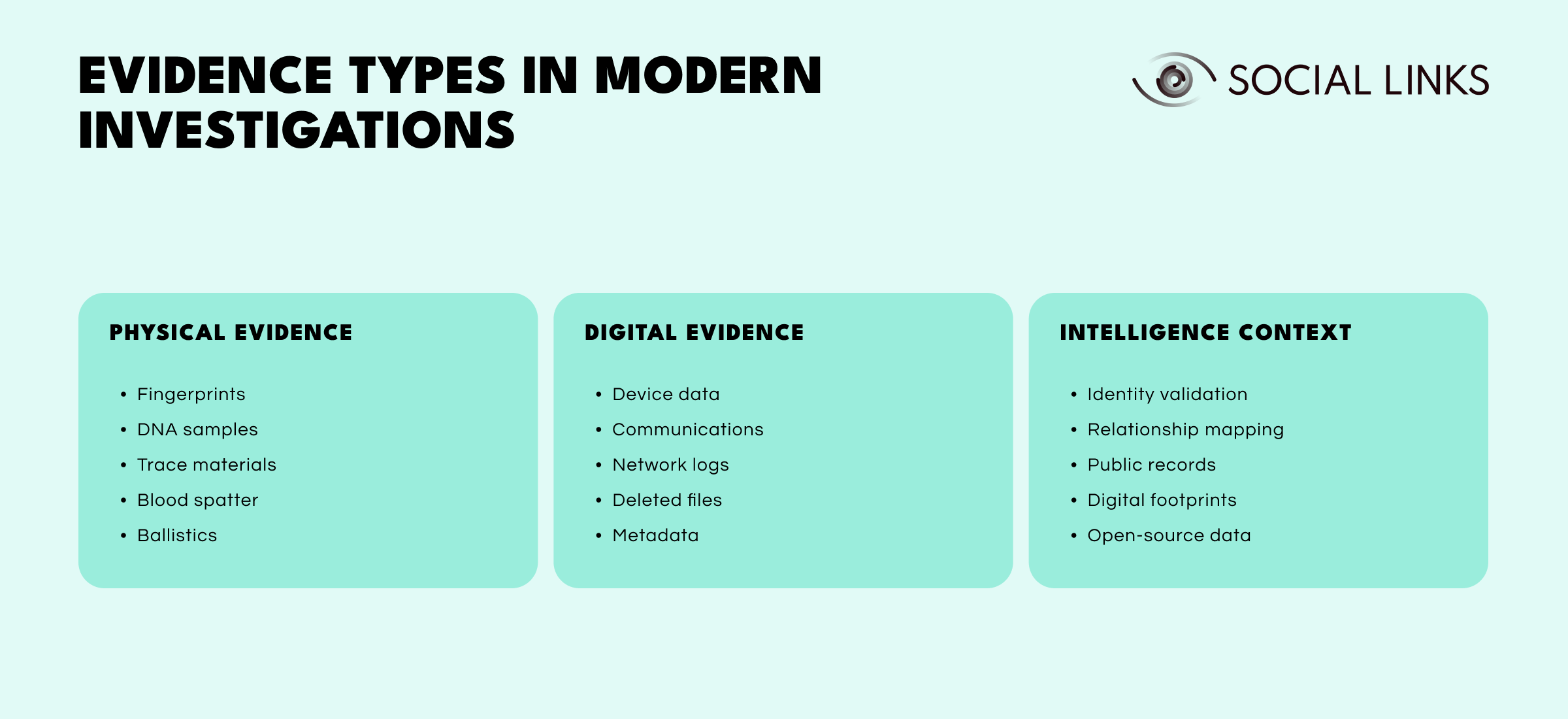
Physical evidence includes fingerprints, DNA samples, trace materials, blood spatter, ballistics, and other materials recovered from scenes, people, or objects. This evidence helps place individuals, reconstruct events, and connect suspects to locations or actions.
Digital evidence includes device data, communications, network logs, deleted files, metadata, and account activity. It often reveals timelines, planning, movement, coordination, and behavior that physical evidence alone may not show.
Intelligence context includes identity validation, relationship mapping, public records, digital footprints, and open-source data. This helps investigators understand who subjects are, how they connect, and whether separate findings fit into a broader pattern.
Good investigations do not treat these categories in isolation. They use each type of evidence to test, strengthen, or challenge the others.
Investigation tools are essential, but they are only part of the job. Collecting evidence is not the same as understanding it, and understanding it is not the same as proving a case. The real difference often comes down to whether investigators stop at gathering information or continue into interpretation and case building.
Tools help teams collect, preserve, and analyze evidence. Crime scene units document locations, recover samples, and secure physical materials. Forensic laboratories compare fingerprints, analyze substances, and develop DNA profiles. Digital forensics specialists image devices, recover deleted files, and preserve electronic records in admissible formats. This work creates a reliable factual foundation.
But evidence rarely speaks for itself. Investigators still need to decide why a fingerprint matters, whether a communication record supports intent, or how separate findings relate to one another. A DNA match may confirm presence, but not motive. A device may contain messages, but not clear context. A timeline may show movement, but not responsibility.
That is where investigative skill matters most. Good cases are built by connecting evidence, testing competing explanations, and turning isolated facts into a clear narrative that can withstand scrutiny.
Tools help uncover evidence. Investigative technique is what turns that evidence into a case.
Basic evidence collection is enough in straightforward cases. A burglary occurs, fingerprints are lifted from the entry point, they match a known suspect, and the physical evidence supports witness accounts. Collection and analysis may be enough.
Case building becomes necessary when evidence exists but its meaning is uncertain. Multiple suspects may have legitimate access to the scene. Digital evidence may show communication without clearly revealing intent. Physical evidence may place someone at a location without proving when or why they were there. Witness accounts may conflict.
At that point, the work shifts from collection to interpretation. Investigators establish timelines, explain why some findings matter while others do not, and build narratives that connect physical, digital, and testimonial evidence into a coherent account.
This is where tools provide raw material, but investigative work gives it meaning.
Crime scene investigation relies on tools that preserve and document physical evidence before it is disturbed or lost.
Photography and video equipment capture evidence placement, environmental conditions, and spatial relationships. Measurement tools and laser scanners record positions and scene geometry for later reconstruction. Evidence markers and sketching systems help organize documentation in a way that investigators, analysts, and juries can follow.
Evidence collection requires sterile containers, swabs, and kits that prevent contamination while preserving biological and trace materials. Fingerprint tools reveal and preserve latent prints. Blood pattern analysis uses measurement and documentation methods to reconstruct movement and force.
These tools are only useful when investigators know what to collect, how to preserve it, and which findings are actually relevant to the case.
Once evidence reaches controlled environments, specialized instruments analyze it in ways that produce court-admissible findings.
DNA analysis identifies genetic profiles and compares them to known individuals or databases. Toxicology equipment detects drugs, poisons, and chemical substances in biological samples. Ballistics analysis compares bullets and cartridge cases to weapons. Trace evidence analysis examines fibers, soil, glass, and similar materials to connect people, places, and objects.
These tools produce objective findings, but they do not interpret them in case context. A DNA match confirms identity. It does not explain whether that person is a suspect, a victim, or someone with innocent access to the scene. Ballistics analysis can show that a bullet came from a particular weapon. It does not explain who fired it or why.
Laboratory tools answer technical questions. Investigators still have to work out what those answers mean for the case.
Modern investigations increasingly depend on digital evidence that reveals communication, planning, intent, and patterns that physical evidence alone may not show.
Digital forensics tools create forensic images of devices, recover deleted files and metadata, extract data from mobile devices, and reconstruct communication patterns across accounts and platforms. Network analysis tools map relationships across devices, users, and systems.
This evidence can provide timelines, location data, communication records, and indicators of coordination. But digital evidence also introduces complexity. Data is volatile. Forensic methods must be rigorous. Timelines depend on time settings and synchronization. Messages require interpretation. Location data may show where a device was, not necessarily where its owner was.
Digital tools extract data. Investigators still have to work out what that data really means.
Intelligence context helps investigators go beyond what controlled evidence collection can show on its own.
Open-source intelligence, public records, digital footprints, and relationship mapping can help validate identities, explain associations, and reveal patterns that physical and digital evidence alone may not make obvious. This becomes especially useful when investigators need to understand who subjects are, how they connect, and whether the available evidence fits a broader pattern of behavior.
A suspect’s public digital footprint may reveal links that physical evidence does not. Public records may contradict statements made during interviews. Open-source data may place people, entities, or relationships into a wider context that strengthens or challenges the working theory of the case.
Intelligence context does not replace forensic tools. It extends the investigation by helping teams understand how separate findings fit together.
Even with sophisticated tools, investigators run into the same problems again and again.
Evidence is often fragmented across scenes, devices, laboratories, and intelligence systems that do not integrate easily. Many findings are ambiguous and can support more than one interpretation. Digital evidence creates scale problems because devices and platforms contain enormous volumes of potentially relevant data. Legal standards constrain methodology, meaning mistakes in collection or documentation can make useful evidence inadmissible. Time pressure adds another layer, as evidence degrades, deadlines approach, and suspects move.
This is why investigations require more than technology. Tools generate evidence. Investigative technique determines which parts matter and how they fit into a prosecutable case.
Effective investigations combine proper tool use with sound technique.
Strong teams maintain rigorous evidence collection standards so physical and digital materials remain admissible and reliable. They document thoroughly so decisions can be explained and defended later. They connect evidence across sources instead of treating each piece in isolation. They validate findings through multiple methods rather than leaning too heavily on a single source. And they communicate clearly about what the evidence shows, what it does not show, and where uncertainty remains.
The job is not just to collect evidence. It is to build cases that survive scrutiny and lead to just outcomes.
Modern investigations often require context that exists outside traditional evidence collection: who subjects are beyond official records, how people connect across jurisdictions and systems, what public information supports or contradicts case theories, and whether open sources reveal broader patterns.
Social Links platforms help investigators gather this context more efficiently. They can validate identities and backgrounds, map relationships across individuals and entities, analyze digital footprints, and connect public information to existing case evidence across multiple sources.
This becomes particularly valuable in complex investigations involving organized networks, digital crimes, cross-border activity, or cases where subjects attempt to conceal identities or relationships.
Investigation tools have never been more sophisticated. But tools are not investigations.
Tools collect, preserve, and analyze evidence. Technique interprets that evidence, connects it across sources, and builds it into narratives that make sense of what happened, who was involved, and how the pieces fit together.
Investigators who rely only on tools may end up with evidence reports but still struggle to build prosecutable cases. Those who combine proper methodology with sound investigative technique are much better positioned to build stories that juries understand and courts can rely on.
The difference between having data and solving a case is what investigators do with that evidence.
Criminal investigators use crime scene equipment for evidence collection and documentation, forensic laboratory instruments for DNA, chemical, and trace analysis, digital forensics platforms for electronic evidence, and intelligence systems for identifying patterns and connections across cases.
Tools collect, preserve, and analyze evidence. Technique interprets that evidence in context, connects it across sources, and builds narratives that explain what happened and how the pieces fit together.
Technology has expanded evidence sources beyond physical materials to include digital artifacts, network data, and open-source intelligence. It has improved forensic precision and increased investigative scale, but it has also made interpretation more complex.
Digital evidence reveals communication, planning, intent, and timelines that physical evidence alone often cannot show. It helps investigators understand who was involved, what they planned, and how events unfolded.
OSINT provides external context that helps validate identities, map relationships, corroborate evidence, and identify patterns visible in public sources. It extends investigation beyond controlled evidence collection into open-source analysis.
Want to see how OSINT supports criminal investigations? Book a personalized demo and discover how SL Crimewall helps investigative teams validate identities, map criminal networks, analyze digital footprints, and connect open-source intelligence to case evidence through integrated workflows.