Cyber Threat Intelligence Services: Beyond the Report
Most security teams are not short on data. Between SIEM alerts, endpoint telemetry, vulnerability scans, and threat feeds, the average organization collects more security information than analysts can realistically process. The challenge is not volume. It is that most of that data arrives without the context needed to understand whether it represents a genuine threat, how it connects to broader attacker activity, and what should happen next.
In this article, we examine what cyber threat intelligence services actually provide beyond raw indicator feeds, how the managed versus in-house decision plays out in practice, what effective CTI implementation looks like inside a security program, and why most organizations struggle to measure whether their intelligence investment is producing real security value.
Threat intelligence services and threat intelligence platforms are not the same thing, and conflating them leads to misaligned expectations.
A threat intelligence platform is a tool. It aggregates indicators, manages feeds, supports enrichment workflows, and integrates with SIEM and SOAR systems. Platforms are essential infrastructure, but they do not analyze anything on their own. They organize and surface data. What organizations do with that data depends entirely on the people and processes around the platform.
A cyber threat intelligence service provides analysis. Analysts investigate campaigns, monitor threat actor activity, track infrastructure, and produce intelligence that supports operational decisions. The service answers questions that platforms cannot: who is behind this activity, what are their typical methods, which assets are most likely to be targeted, and whether the indicators observed internally connect to a broader campaign already documented elsewhere.
The distinction matters because organizations often invest in platforms expecting the analytical capability that only services provide. A well-configured platform with poor analytical processes produces better-organized noise. Intelligence services provide the human judgment layer that connects observations to operational understanding.
Most mature programs eventually use both. The platform manages intelligence. The service provides interpretation. According to the SANS 2024 CTI Survey, 62% of organizations now combine in-house capabilities with external service providers, recognizing that neither approach alone provides sufficient coverage for the modern threat environment.
Understanding what CTI services provide is one thing. Understanding where they connect to security workflows is another. Intelligence that sits outside operational processes rarely influences the decisions it was designed to support.
SOC support is the most immediate integration point. When an alert fires on a suspicious IP or domain, CTI enrichment tells the analyst whether that indicator is associated with known campaigns, which threat actors have used it, and whether internal exposure is part of a broader pattern. That context reduces triage time and improves escalation decisions.
Incident response is where CTI becomes critical under pressure. When a breach is confirmed, intelligence helps responders understand the likely scope, identify related infrastructure that may not yet have triggered alerts, and connect internal evidence to external reporting on attacker TTPs. Investigations that begin with intelligence context consistently scope incidents faster than those starting from scratch.
Threat hunting shifts from reactive to proactive when driven by intelligence. Rather than waiting for alerts, hunters use known campaign infrastructure, attacker behavioral patterns, and sector-specific threat data to search for activity that detection rules have not yet caught. This is where following the infrastructure from indicators to campaigns produces the most direct security value.
Vulnerability prioritization benefits from intelligence because not all vulnerabilities carry equal operational risk. CTI services track which vulnerabilities are actively being exploited, by which threat actors, against which sectors. That context allows security teams to prioritize remediation based on actual attacker behavior rather than theoretical severity scores alone.
Executive risk visibility has become an increasingly important CTI function. The SANS 2025 CTI Survey found that 52% of executives now participate in setting intelligence requirements, up from 33% in 2024. Intelligence increasingly informs strategic decisions around vendor selection, geographic expansion, and regulatory exposure, not just technical security operations.
Once an organization decides it needs a CTI capability, the next question is how that capability should be built.
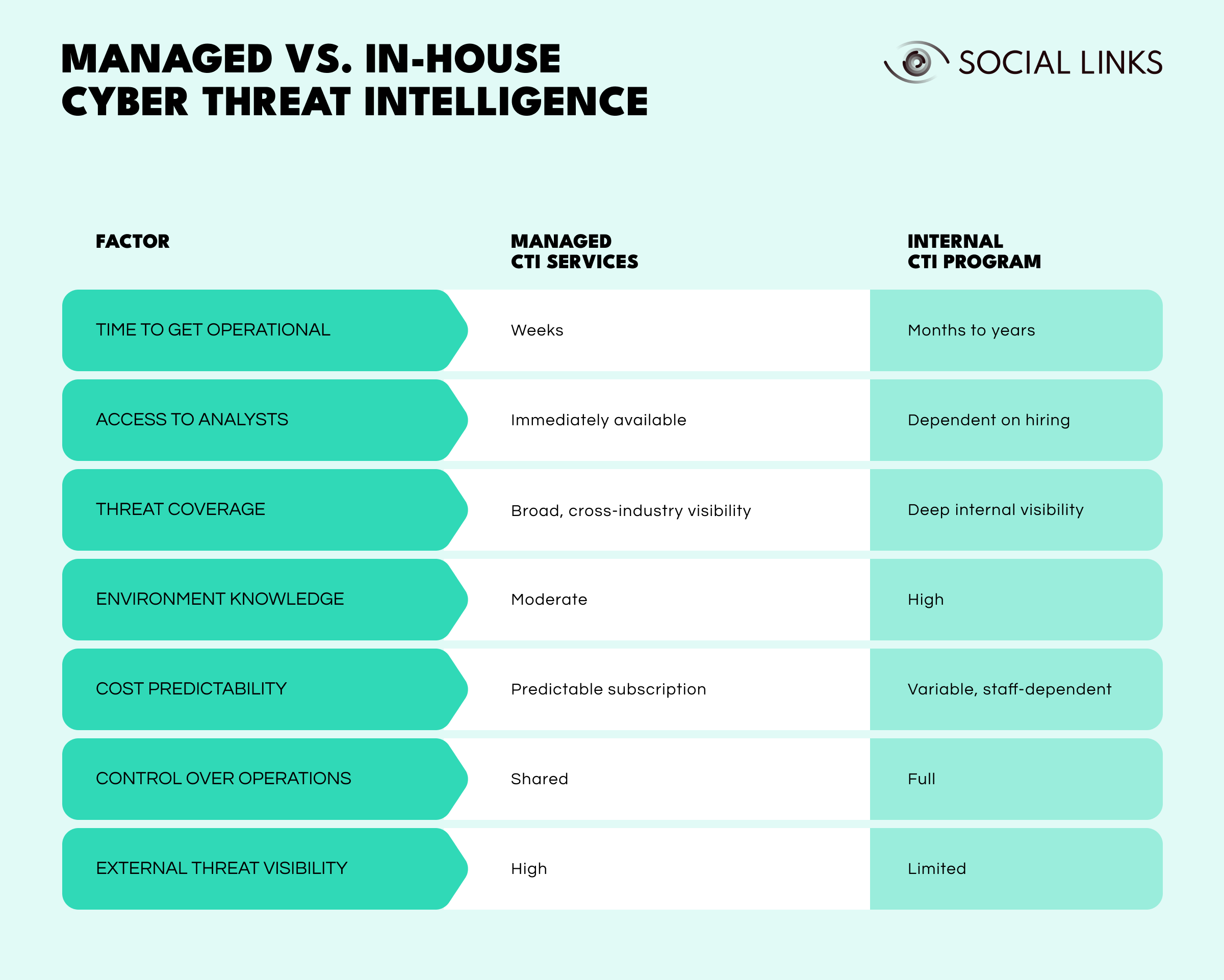
Building an internal program provides the highest degree of customization and operational control. Internal analysts develop deep familiarity with the organization's specific environment, threat model, and business context. That contextual knowledge is difficult to replicate externally. The tradeoff is significant: experienced CTI analysts are scarce, programs take considerable time to mature, and internal teams rarely have the cross-industry visibility that managed services provide. The SANS 2025 CTI Survey found that 34% of CTI professionals cite skills shortage as a key roadblock.
Managed CTI services deliver faster access to analytical capability and broader threat visibility. Providers monitor campaigns across many organizations simultaneously, which means they often detect emerging threats earlier than any single internal team could. The limitation is customization. Managed services may not develop the deep familiarity with a specific organization's environment that internal analysts build over time.
The hybrid model has become the most common approach precisely because it captures the benefits of both. Internal analysts handle environment-specific investigation and stakeholder communication. External services provide broader threat visibility, dark web monitoring, and analytical depth that internal teams cannot maintain alone. Organizations adopting this model need to define clear boundaries between what internal teams handle and what external providers deliver, because overlapping responsibilities and unclear handoffs are among the most common failure points.
Most CTI failures are not collection failures. They are dissemination failures. Understanding why requires looking at how intelligence moves through a program from requirements to operational action.
The intelligence lifecycle moves through six stages.
Requirements define what the program needs to answer: which threats matter, which teams need intelligence, and what decisions it should support.
Collection gathers raw data from feeds, dark web sources, internal telemetry, and external services.
Processing normalizes and enriches that data into usable form.
Analysis identifies patterns, campaigns, and operational relevance.
Dissemination delivers intelligence to the teams responsible for acting on it.
Feedback closes the loop, evaluating whether intelligence reached the right people in a useful format.
The breakdown almost always occurs between dissemination and action. Intelligence reaches a reporting platform or email distribution list, and that is where its journey ends. Analysts in SOC workflows, threat hunting operations, and incident response teams never encounter it because it was not integrated into their tools and processes. According to ASIS International 2025 research, only 21% of organizations process intelligence quickly enough to act on it operationally. That statistic reflects a dissemination problem, not a collection one.
Effective CTI implementation starts before selecting a provider or platform. Organizations need to define intelligence requirements: what threats matter most to this specific environment, which teams will consume intelligence and in what format, and what decisions intelligence should support. Without that definition, providers default to delivering generic threat landscape reports that may be accurate but rarely drive operational action.
This is where credential exposure data becomes operationally significant. Flashpoint's 2025 Global Threat Intelligence Report found that threat actors compromised over 3.2B credentials in 2024, a 33% increase from the year before. For most organizations, that exposure sits in dark web marketplaces and criminal forums long before it triggers any internal alert. CTI services that monitor those sources provide early warning that structured feeds and internal telemetry cannot. But that warning only produces value when it reaches the identity and access management teams who can act on it quickly.
Integration with security operations is where most CTI programs either generate value or become expensive documentation exercises. Intelligence needs to reach SIEM correlation rules, EDR enrichment workflows, threat hunting queries, and incident response playbooks. When intelligence sits in a separate reporting environment that analysts have to manually check, it rarely influences the decisions it was intended to support.
Stakeholder alignment ensures that intelligence requirements reflect actual organizational priorities rather than what CTI teams assume leadership cares about. Programs that communicate only in technical terms to technical audiences are missing a significant portion of the value they could deliver.
Clear escalation paths define what happens when intelligence becomes actionable. When a new campaign targeting the organization's sector emerges, who receives that information, in what timeframe, and with what expectation of response? Programs without defined escalation paths consistently fail to convert good intelligence into good security outcomes.
Most CTI programs measure the wrong things. Feed volume, indicator counts, and report frequency are easy to track but say nothing about whether intelligence is improving security outcomes.
Mean time to detect and mean time to respond are the most operationally meaningful metrics. Organizations with mature CTI programs save an average of $208k per breach according to IBM research, primarily through faster detection and more accurate incident scoping.
False positive reduction reflects intelligence quality. High false positive rates indicate that intelligence is not contextually appropriate for the environment, producing noise instead of signal. Tracking false positive rates over time shows whether intelligence is becoming more relevant and actionable.
Threat hunting effectiveness measures whether intelligence is enabling proactive security rather than purely reactive response. Hunts that surface confirmed attacker activity demonstrate that intelligence is reaching operational workflows and enabling security teams to find threats before they escalate.
Intelligence coverage against known threats asks whether the program has visibility into the threat actors and campaigns most relevant to the organization's sector and geography. Gaps in coverage represent unknown risk that neither metrics nor reporting will surface until an incident reveals them.
The broader challenge is connecting these metrics to business outcomes that resonate with executive stakeholders. Technical metrics matter to security operations teams. Business stakeholders respond more readily to avoided breach costs, regulatory exposure reduction, and risk quantification. Programs that can translate technical performance into business impact terms are significantly more likely to retain budget and organizational support over time.
Cyber threat intelligence services exist to provide what platforms and feeds alone cannot: the analytical context that connects isolated observations to operational understanding of attacker behavior, campaigns, and infrastructure.
Most CTI programs underperform not because they lack data but because intelligence never reaches the people and processes that need to act on it. The managed versus in-house decision, the intelligence lifecycle, the integration with security operations, and the measurement of outcomes are all expressions of the same underlying challenge: turning collected intelligence into better security decisions.
Organizations that treat CTI as an operational function rather than a reporting function are the ones that see measurable returns from their investment.
A threat intelligence platform is tooling that aggregates, manages, and distributes indicators and intelligence. A cyber threat intelligence service provides human analysis: monitoring campaigns, tracking threat actors, investigating incidents, and producing intelligence that supports operational decisions. Most mature programs use both.
Managed CTI typically makes sense when organizations need faster time to value, lack experienced analysts, require cross-industry threat visibility, or want predictable costs. Internal programs make more sense when deep customization to a specific environment is required and the organization can sustain the staffing and investment needed for a mature capability.
Most programs measure activity rather than outcomes. Feed volume and report counts are easy to track but do not reflect security improvement. Programs that connect intelligence to detection speed, response speed, false positive reduction, and avoided breach costs are significantly better positioned to demonstrate value to business stakeholders.
Intelligence should feed directly into SIEM correlation rules, EDR enrichment workflows, and SOAR playbooks so that analysts encounter context automatically rather than having to query separate systems. When intelligence requires manual lookup, it rarely influences real-time decisions.
Mean time to detect, mean time to respond, false positive reduction rates, threat hunting hit rates, and intelligence coverage against sector-relevant threat actors are the most operationally meaningful metrics. Business-level metrics such as avoided breach costs and regulatory exposure reduction matter for executive communication.
Want to see how SL Crimewall supports cyber threat intelligence workflows in practice? Book a personalized demo with one of our specialists and discover how organizations use integrated OSINT and investigation tools to enrich indicators, profile threat actors, and connect external intelligence to internal security operations.