Financial Fraud Investigations: The Identity Layer
Financial records are often where fraud investigations begin. Unusual transactions, suspicious transfers, undisclosed relationships, or unexplained movements of money can reveal that something is wrong. They show how funds moved, where they went, and how long a scheme may have been operating. What they often cannot do on their own is identify with certainty who was responsible.
That challenge has become more pronounced as fraud schemes rely more heavily on shell companies, synthetic identities, nominee directors, digital infrastructure, and cross-border operations designed to obscure attribution. Modern financial fraud investigations still follow the money, but they increasingly focus on the people behind it.
In this article, we examine why perpetrator identification has become one of the most difficult parts of fraud investigations, how identity-focused investigations and OSINT help bridge that gap, and why understanding the human element behind a scheme is often what transforms suspicious activity into a defensible case.
Fraudsters rarely operate under their own names. Modern financial crime frequently relies on layers of separation between the activity and the individuals directing it. Shell companies create legal distance. Nominee directors provide formal ownership structures that obscure real control. Digital services allow accounts and infrastructure to be created rapidly with limited verification requirements. Synthetic identities combine real and fabricated information to create personas that appear legitimate while masking the individuals behind them.
Jurisdictional complexity compounds the problem. A company may be incorporated in one country, operate in another, use banking services in a third, and communicate through infrastructure hosted somewhere else entirely. From an investigative perspective, the challenge is not simply proving that suspicious activity occurred. It is connecting that activity to a real-world individual who exercised control, benefited from the scheme, or directed its operation.
The seniority of the perpetrator shapes not only the scale of a scheme but the sophistication with which it is concealed. Owners and executives have longer tenure, deeper system access, greater authority over financial controls, and more organizational trust than lower-level employees. That combination means senior perpetrators can sustain schemes longer, cause greater losses, and create more effective layers of concealment before detection occurs. The financial trail reveals movement. The identity trail reveals responsibility.
Identity investigation focuses on understanding whether declared identities align with what investigation actually reveals. The process involves a series of connected questions: Is this person who they claim to be? Does their background support their stated role? Are they connected to other entities involved in the investigation? Do their public activities align with their declared identity? Are there undisclosed relationships that help explain the activity?
Investigators build profiles around people of interest by combining information from multiple sources. Corporate records identify directors and shareholders. Public records reveal business history. Professional networks provide evidence of employment and industry connections. Social media activity surfaces relationships, locations, or affiliations that do not appear in official filings.
The objective is not collecting information for its own sake. It is identifying the gap between who an individual claims to be and what investigation reveals. That gap is often where fraud becomes visible.
Open-source intelligence helps investigators answer questions that financial records alone cannot. Where financial statements show transactions, OSINT builds the human picture around them. Eight source categories contribute to that picture, each revealing a different dimension of who a person of interest actually is.
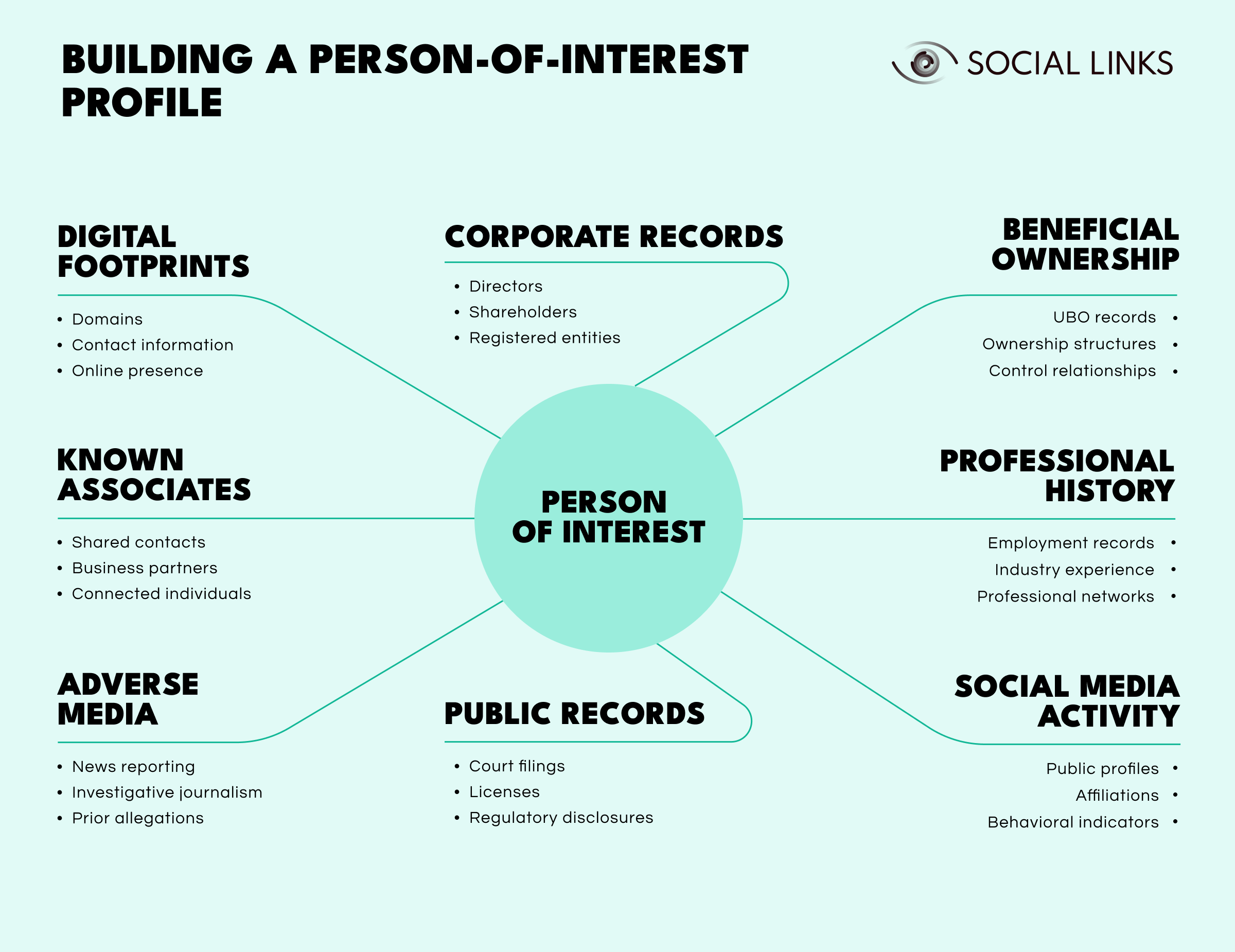
Corporate records identify directors, shareholders, and registered entities, establishing the formal structures an individual is connected to.
Beneficial ownership records go further, revealing who actually controls those structures through UBO filings and ownership hierarchies.
Professional history draws on employment records, industry experience, and professional networks to determine whether a person's declared role aligns with their actual background.
Social media activity surfaces public profiles, affiliations, and behavioral indicators that rarely appear in official documentation.
Public records include court filings, licenses, and regulatory disclosures that establish legal and compliance history.
Adverse media captures news reporting, investigative journalism, and prior allegations that may not appear in structured databases at all.
Known associates map shared contacts, business partners, and connected individuals who may link a person of interest to others under investigation.
Digital footprints cover domains, contact information, and online presence that reveal infrastructure connections.
Consider a nominee director listed across dozens of companies. On paper, the individual appears to be a legitimate corporate officer. Financial records show only that they hold formal positions. Open-source investigation may reveal something different. Their professional history may show no relevant industry experience. Their social media presence may indicate unrelated employment. Their online footprint may contain no evidence of involvement in the businesses they formally direct. Their name may appear repeatedly in corporate structures linked to unrelated entities operating across multiple jurisdictions.
None of those observations independently prove wrongdoing. Together, they provide context that helps investigators understand whether a declared corporate role reflects reality or merely serves as a layer of concealment. This is where OSINT becomes particularly valuable: connecting formal structures to observable behavior in ways that financial analysis alone cannot.
Financial fraud rarely involves a single actor operating in isolation. Even relatively simple schemes typically involve multiple individuals, companies, service providers, intermediaries, or financial accounts that support the operation. Investigators therefore move beyond individual profiling and begin mapping relationships.
Network analysis examines how people, entities, infrastructure, and financial activity connect to one another. Shared directors, common addresses, overlapping phone numbers, repeated counterparties, mutual associates, and linked digital infrastructure often reveal relationships that are not obvious when records are reviewed individually.
This process frequently changes how a case is understood. What initially appears to be a suspicious transaction involving one company may ultimately reveal a network of related entities operating under common control. A single individual may emerge as the central connector between organizations that otherwise appear unrelated. Linear investigations follow individual transactions. Network investigations identify structures. That distinction often determines whether investigators uncover isolated misconduct or a coordinated operation.
AI is changing identity-focused investigations in a different way than it changes fraud detection. Detection systems use AI to identify suspicious transactions and anomalous behavior. Identity investigations use AI to identify relationships.
One of the most valuable applications is entity resolution. People appear differently across different systems: names are misspelled, transliterations vary, addresses change, corporate affiliations shift over time. Investigators may encounter dozens of fragmented records that refer to the same individual. AI-assisted entity resolution helps connect those fragments into a coherent picture.
Relationship analysis provides another important capability. Large investigations may involve thousands of individuals, organizations, transactions, and records. Graph analysis helps surface connections that would be difficult to identify through manual review alone. Behavioral analysis can also identify inconsistencies between claimed and observed identity characteristics, comparing stated occupations, business activities, locations, and affiliations against observable indicators to flag anomalies that warrant closer review.
Human validation remains essential throughout. AI can surface potential relationships but cannot determine intent. It can identify patterns but cannot independently establish credibility. The strongest investigations use AI to accelerate discovery while relying on investigators to validate findings and determine their significance.
Financial records and transaction data tell investigators what happened. Behavioral analysis helps them understand whether what they are seeing makes sense.
The core question is whether observed activity aligns with declared identity and stated purpose. An executive reporting modest income who publicly displays assets suggesting otherwise raises an inconsistency worth examining. A company claiming to provide consulting services with no visible professional presence invites scrutiny about what it actually does. A director presented as independent who appears repeatedly alongside individuals connected to entities under investigation may not be as arm's-length as the corporate structure suggests.
None of these observations constitute proof. They provide direction. Behavioral analysis helps investigators identify where declared circumstances diverge from observable reality, which in turn helps prioritize where deeper scrutiny is warranted. Unusual communication patterns, sudden changes in behavior following key events, undisclosed affiliations, and lifestyle indicators inconsistent with reported income all serve as signals that something may not add up.
The distinction between a behavioral signal and evidence matters. Behavioral analysis informs inquiry. It shapes where investigators look and what questions they ask. Evidence is what supports the conclusions that follow.
An investigative profile and an evidentiary profile are not the same thing. Investigative profiles generate understanding. They help investigators identify relationships, assess credibility, prioritize leads, and guide the direction of a case. Evidentiary profiles must meet a higher standard.
Findings need to be documented, sourced, preserved, and capable of independent verification. Investigators must be able to explain where information originated, how it was collected, and why it supports a particular conclusion. This is particularly important when OSINT findings become part of legal, regulatory, or disciplinary proceedings.
A social media profile may identify an undisclosed relationship. A corporate registry may reveal common ownership. Public records may establish connections between entities. Those findings become valuable when they are documented systematically and integrated with financial evidence rather than presented in isolation. The strongest fraud investigations do not treat financial analysis and identity investigation as separate activities. Financial records establish what happened. Identity investigation helps establish who was responsible. Together, they create the evidentiary picture required to support action.
Behind every fraud scheme is a person, a network, or a group of individuals making decisions designed to conceal responsibility.
Financial records remain central to fraud investigations, but they rarely tell the entire story on their own. Modern investigations increasingly rely on identity analysis, open-source intelligence, network mapping, and AI-assisted analytical workflows to bridge the gap between suspicious activity and attributable actors.
The organizations that investigate fraud most effectively are those that connect financial evidence to the people behind it. Following the money remains important. Understanding who controlled it, benefited from it, and concealed it is what ultimately transforms a suspicious transaction into a complete investigation.
Identity investigation focuses on determining whether declared identities, roles, and relationships match observable reality. It helps investigators understand who is actually behind suspicious activity rather than relying solely on what financial records confirm.
OSINT provides context that financial records often cannot, including corporate ownership information, professional history, public records, social media activity, and adverse media reporting that connects financial activity to real-world individuals and networks.
Entity resolution is the process of determining whether multiple records, identities, or data points refer to the same individual or organization despite differences in names, locations, or other identifiers. It is particularly valuable when fraudsters operate across multiple jurisdictions or under varied identity presentations.
Network mapping helps investigators identify relationships between people, entities, accounts, and infrastructure that may not be visible when evidence is reviewed individually. It often changes how a case is understood, revealing coordinated operations rather than isolated incidents.
No. AI can accelerate entity resolution, relationship analysis, and pattern identification, but investigators remain responsible for validating findings, assessing credibility, and establishing the evidentiary support needed for legal or regulatory action.
Want to see how OSINT supports identity investigations and perpetrator profiling in financial fraud cases? Book a personalized demo with one of our specialists and discover how SL Crimewall helps investigators connect financial activity to individuals, map relationship networks, and build the evidentiary picture behind complex fraud cases.