Due Diligence: The Investigation Layer
A vendor questionnaire comes back clean. Documents are in order. The entity appears on no sanctions list, so the relationship moves forward. Six months later, it emerges that the company's actual controlling party has a history of regulatory enforcement in another jurisdiction, that several of its directors are nominees who appear across dozens of unrelated corporate structures, and that its registered address is shared by hundreds of other entities. None of that was visible in the questionnaire. All of it became visible during the investigation.
The difference between what standard due diligence confirms and what investigation reveals is not a gap at the margins. It is often the difference between understanding who an organization is actually dealing with and proceeding on the basis of what a counterparty chose to present.
In this article, we examine how investigative due diligence actually works, what methods surface the risks that verification misses, and how open-source intelligence connects formal structures to observable reality.
Standard due diligence is designed around disclosure. Counterparties fill in questionnaires. Documents are submitted. Databases are checked. The process confirms that what has been declared is internally consistent and that no obvious red flags appear in structured compliance databases.
That design works well for straightforward relationships in transparent jurisdictions with uncomplicated ownership structures. It works considerably less well for relationships where the significant risks are not visible in what a counterparty chooses to declare. The standard most organizations apply has not kept pace with what regulators, counterparties, and the complexity of modern ownership structures now require.
The structural limitation is not a failure of effort. It is a failure of method. Verification is inherently backward-looking and dependent on disclosure. Investigation is forward-looking and independent of it. The two approaches answer different questions. Verification focuses on whether declared information checks out. Investigation on the other hand, asks whether the full picture has been surfaced.
The risks that most commonly exploit this gap share a common characteristic: they are designed to be invisible to processes that rely on self-reported information. Layered ownership structures, nominee arrangements, cross-border concealment, and undisclosed relationships all operate precisely because standard verification was never built to find them.
Identifying who formally owns an entity is usually straightforward. Identifying who actually controls it, benefits from it, or directs its activity is frequently not.
Beneficial ownership investigation begins with corporate registries but does not end there. Registry filings establish the formal structure: who is listed as a director, who appears as a shareholder, what the registered address is, and when the company was incorporated. These are starting points, not conclusions. The patterns that emerge across multiple filings over time often tell a more significant story than any individual record.
Several indicators consistently signal that a formal structure may be concealing real control. A director who appears across dozens of unrelated companies in multiple jurisdictions is likely a nominee, a professional whose name is lent to corporate structures to obscure the identity of the real controlling party. A registered address shared by hundreds of other entities suggests a virtual office or corporate service provider arrangement. A company incorporated recently but claiming years of operational history. Directors whose professional backgrounds bear no relationship to the business they formally lead.
These patterns do not prove wrongdoing. They establish that the declared structure warrants closer examination. The investigative work then moves to connecting the formal structure to observable reality. Corporate registries in higher-transparency jurisdictions such as the UK's Companies House or equivalent EU registers may provide more detailed filing histories. Cross-referencing across jurisdictions using aggregated databases can surface connections between entities that no single registry would reveal.
A StratEast Insights investigation illustrates how this works in practice. Investigators reviewing a group of companies discovered that several shared registered addresses at neighboring residential properties in the same rural village. The listed directors and shareholders were local farmers with no apparent experience managing businesses of the scale the companies claimed. Further investigation revealed that all structures connected to a single controlling individual operating behind nominee arrangements who had a history he was concealing through the layered structure. None of that was visible in the formal filings. All of it emerged from cross-referencing patterns across multiple records.
Structured compliance databases contain what has been formally documented. They rarely contain what has been reported, alleged, investigated, or publicly discussed before formal enforcement reaches the records layer.
Adverse media review fills that gap by systematically examining what has been published about an entity, its principals, and its associated networks across news archives, regulatory announcements, court records, industry publications, and investigative reporting. The gap between when a problem surfaces in public reporting and when it appears in formal enforcement databases is often measured in months or years. Organizations that rely only on structured database checks consistently miss risk that is already visible in open sources.
Effective adverse media review is not a Google search. The most significant findings frequently appear in local-language reporting, regional regulatory announcements, niche industry publications, and investigative journalism that automated feeds in standard compliance tools do not reach. A fraud allegation that receives significant coverage in a regional news outlet in one jurisdiction may produce no results in an English-language database search. A regulatory sanction issued by a sectoral authority in a non-English speaking market may not appear in commercial compliance databases for months.
Source diversity matters as much as source depth. A thorough adverse media review examines mainstream publications, local and regional press, regulatory announcement portals, court record databases, industry-specific publications, and where appropriate, social media activity and forum discussions that may surface early warning signals before they enter formal reporting channels.
The validation challenge is significant. Public information can be incomplete, outdated, inaccurate, or deliberately misleading. A negative mention in isolation means something different from a pattern of consistent reporting across multiple independent sources over time. Investigative adverse media review cross-checks sources, distinguishes between substantiated reporting and unverified allegations, and assesses the credibility and independence of sources before drawing conclusions.
Individual entities rarely present significant risk in isolation. The risk most often lies in what they are connected to, and those connections are invisible to reviews that examine entities one at a time rather than as nodes in a broader network.
Network mapping traces the relationships between people, entities, addresses, phone numbers, email addresses, professional associations, and financial activity to surface connections that no single registry or database would reveal. A director who appears independently unremarkable may be the central connector between a series of entities that together constitute a pattern. An address that looks ordinary in isolation may appear across dozens of company filings suggesting a shared corporate service provider or a shell network operating from a common point.
The investigative approach treats corporate records as frameworks rather than conclusions. Incorporation dates, director appointments, shareholder changes, and capital movements are placed in sequence to build a chronological picture of how an entity developed. Relationships between individuals across multiple corporate structures are mapped to identify shared connections. Digital footprints are cross-referenced with corporate records to test whether declared identities and business activities align with observable reality.
The absence of a digital footprint is itself informative. Legitimate businesses operating for years leave traces across review platforms, industry directories, procurement databases, news archives, and social media. An entity claiming years of operational history with no observable presence is a significant investigative finding even though it represents a negative rather than a positive result.
Direct sanctions screening, checking whether an entity or individual appears on OFAC, EU, UN, or UK sanctions lists, is a necessary starting point. It is not a complete picture of sanctions exposure.
Indirect sanctions exposure operates through ownership and control relationships that standard list-checking does not surface. An entity may have no direct sanctions designation while being substantially owned or controlled by a sanctioned individual operating through nominees and layered corporate structures. The screening that matters for complex relationships is not whether the entity itself appears on a list but whether any of the individuals who ultimately control it, benefit from it, or maintain influence over it have sanctions exposure anywhere in the chain.
Politically exposed person screening presents a related challenge. PEP databases identify individuals in or recently retired from positions of public trust, but the definitions vary across jurisdictions and databases, coverage is uneven, and the real risk in PEP relationships often lies not in the PEP themselves but in their associates, family members, and connected entities. Investigative PEP due diligence examines the network around a politically exposed person rather than simply confirming their presence or absence on a list.
The most significant findings in sanctions and PEP investigations frequently come from connecting list data to OSINT investigation: tracing the ownership chain above a directly screened entity, mapping the network of associates around a politically exposed person, or identifying that a counterparty's principals have connections to sanctioned entities through business relationships that predate the sanctions designation.
Experienced investigators develop pattern recognition for the specific indicators that most reliably signal risk beneath the visible layer of a due diligence review.
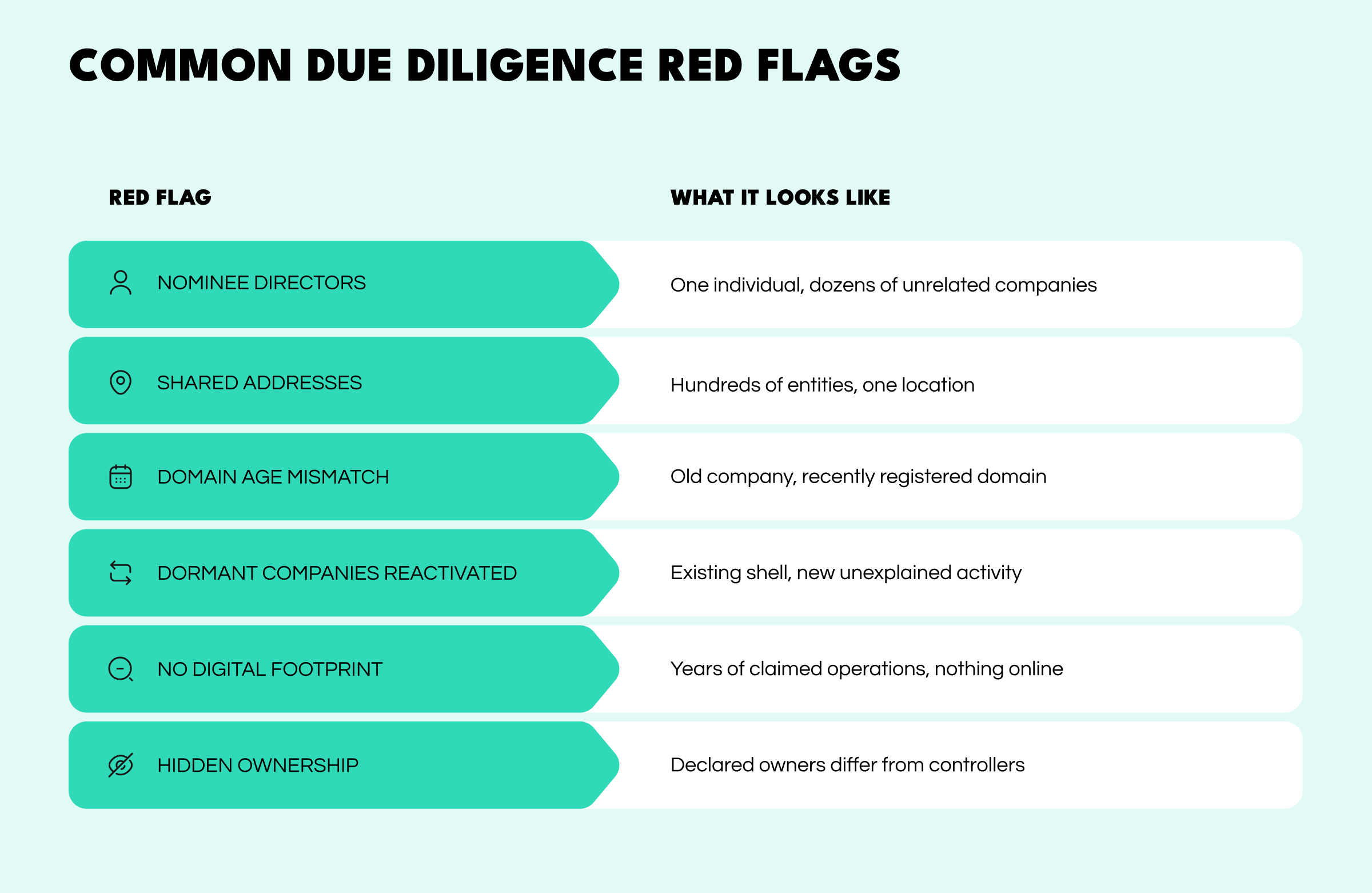
Nominee directors appearing across large numbers of unrelated companies are one of the clearest signals that a structure is designed to conceal rather than represent actual control. When a single individual appears as a director across dozens or hundreds of companies in multiple jurisdictions, the formal directorship is almost certainly not reflecting real management responsibility.
Shared registered addresses across multiple entities often indicate virtual office arrangements or corporate service providers maintaining multiple shell structures from a single location. This is not conclusive of wrongdoing but consistently warrants investigation into whether the entities sharing an address have undisclosed relationships.
Domain age mismatches surface when a company claims operational history that significantly predates its domain registration. An entity claiming ten years of operations with a domain registered eighteen months ago requires explanation.
Dormant companies suddenly activating can signal that an existing corporate shell is being repurposed for new activity. While this has legitimate explanations, it warrants investigation into what the entity was previously used for and why activation is occurring now.
The complete absence of an observable digital footprint for an entity claiming significant operational history is among the most consistent red flags investigation surfaces. Legitimate businesses leave traces. When nothing is there, the question is why.
Hidden ownership is perhaps the most significant red flag of them all. When declared owners differ from those who actually exercise control, the gap between formal structure and operational reality is where the most consequential risks tend to lie. Investigative due diligence exists to surface that gap.
The practical output of investigative due diligence is different in kind from the output of verification. Verification produces a confirmation that declared information is consistent with available records. Investigation produces a picture of what is actually true, drawn from sources independent of what the counterparty chose to present.
That difference matters most at the decision point. A verification result tells a decision-maker that the paperwork checked out. An investigative result tells them who they are actually dealing with, what connections that entity has that were not declared, what public record of conduct exists across jurisdictions and time periods, and whether the observable reality of how this entity operates aligns with how it has presented itself.
Organizations that treat verification as the completion of due diligence consistently discover, after the fact, that the most significant risks in a relationship were sitting in plain sight in public sources that the review never reached.
Investigative due diligence does not replace verification. It extends it into the territory that verification was never designed to reach. Beneficial ownership analysis, adverse media review, network mapping, sanctions proximity investigation, and red flag pattern recognition collectively surface the picture that counterparties would not voluntarily provide and that structured database checks cannot independently construct.
The organizations that understand this distinction invest in the investigative layer not because they expect every review to surface a problem but because the reviews that matter most are precisely the ones where the most significant risks are the least visible. Investigation is how those risks get found before they become consequential.
Standard verification confirms that declared information is consistent with available records. Investigative due diligence uses open-source intelligence, beneficial ownership analysis, adverse media review, and network mapping to determine whether the full picture has been surfaced, independent of what a counterparty chose to disclose.
A nominee director is an individual listed as a company officer who follows the instructions of the real controlling party rather than exercising genuine management responsibility. Nominee directors are used to obscure beneficial ownership. When a single individual appears as a director across dozens of unrelated companies, this is a consistent indicator of a structure designed to conceal real control.
Effective adverse media review examines what has been published about an entity and its principals across news archives, regulatory announcements, court records, and industry publications, including local-language and regional sources that standard compliance databases do not reach. The gap between when a problem surfaces in public reporting and when it appears in formal enforcement records is often measured in months or years.
Network mapping traces relationships between people, entities, addresses, and other identifiers to surface connections invisible to reviews that examine entities in isolation. A director who appears unremarkable individually may be the connecting node between a series of entities that together constitute a significant risk pattern.
The most reliable indicators include nominee directors appearing across large numbers of unrelated companies, shared registered addresses, domain age mismatches, dormant companies suddenly activating, the complete absence of an observable digital footprint, and hidden ownership where declared owners differ from those actually exercising control.
Want to see how investigative OSINT strengthens due diligence? Book a personalized demo with one of our specialists and discover how SL Crimewall helps analysts uncover beneficial ownership, map hidden networks, surface adverse media, and build the investigative picture behind every entity.