Brand Protection: Detecting Executive Impersonation
Executive impersonation has always relied on trust, but AI has fundamentally changed how that trust is exploited. Email spoofing has evolved into convincing voice clones, real-time video deepfakes, and synthetic identities capable of bypassing the verification habits organizations once considered reliable.
In this article, we examine how executive impersonation has evolved, why traditional defenses are struggling to keep pace, how investigators approach synthetic media, and what organizations can do to reduce the risk.
Executive impersonation is not new. Business email compromise, in which attackers pose as senior leaders to request fraudulent payments or sensitive information, has been causing significant financial losses for more than a decade. What has changed is not the underlying social engineering tactic but the quality of the impersonation.
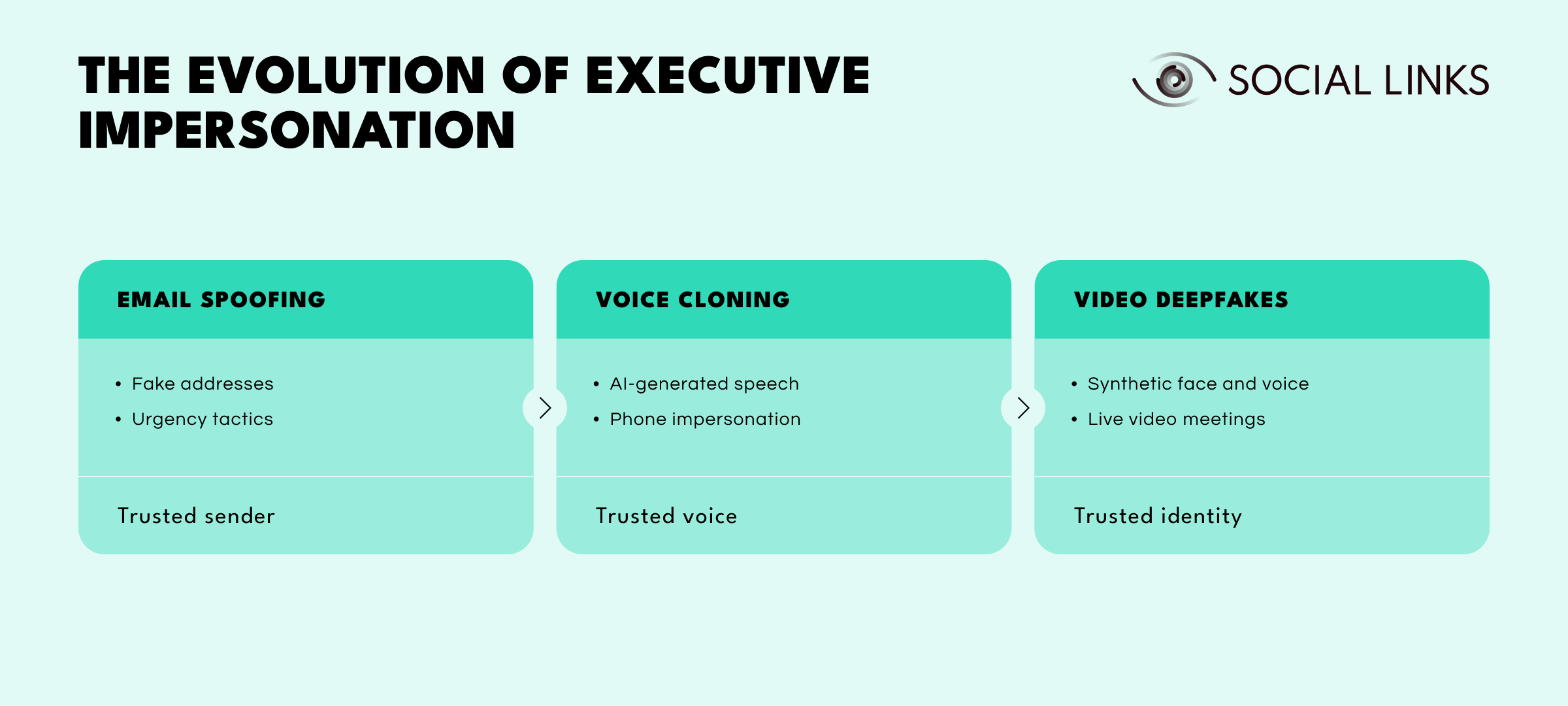
Early attacks relied on spoofed email addresses, fake domains, and urgency. Organizations responded by deploying email authentication, improving employee awareness, and requiring secondary approval for high-value transactions. Attackers adapted.
Voice cloning became the next step. In 2019, a UK energy company lost $243,000 after an attacker used AI-generated audio to impersonate the CEO of its German parent company during a phone call. The targeted executive recognized the voice's accent and melody and transferred the funds without hesitation.
Video deepfakes extended the threat further. In February 2024, a finance employee at engineering firm Arup joined what appeared to be a routine video call with senior colleagues, including the company's CFO. The faces were familiar, the voices sounded authentic, and the requests seemed legitimate. By the time the call ended, the employee had authorized fifteen wire transfers totaling $25 million. Every participant on the call had been an AI-generated deepfake. The result is a shift from impersonating messages to impersonating people.
Voice cloning is currently the most accessible form of executive impersonation. Modern voice synthesis can generate convincing speech from as little as three seconds of recorded audio.
For most senior executives, that material is already publicly available. Earnings calls, investor presentations, conference talks, interviews, podcasts, and social media videos provide more than enough source audio to build convincing voice models. Deepfake-enabled voice phishing surged more than 1,600% during the first quarter of 2025, reflecting how inexpensive and accessible these tools have become.
The Ferrari incident illustrates both the sophistication of these attacks and the importance of human judgment. In July 2024, attackers used AI-generated voice cloning to impersonate Ferrari CEO Benedetto Vigna during a WhatsApp call. The targeted executive became suspicious only after asking a question the real CEO would have known how to answer. The attack failed because of that verification step, not because the synthetic voice was detected.
Video deepfakes extend the same concept into face-to-face communication. Unlike email or voice calls, video combines multiple trust signals at once: facial expressions, eye contact, body language, and recognizable environments. Employees naturally assign more credibility to someone they can see than to someone communicating through text alone.
The Arup incident demonstrated how easily that trust can be manipulated. The employee was not responding to a single fraudulent message but participating in what appeared to be a normal meeting with multiple colleagues, all of whom were AI-generated.
This creates a difficult problem for defenders. Organizations have spent years teaching employees to verify requests through phone or video rather than relying on email alone. Deepfakes turn that advice against them by making the verification channel itself unreliable.
Many organizations still approach executive impersonation as an email security problem, even though the threat has moved well beyond email. Traditional security controls monitor endpoints, filter email, and inspect network traffic. They were not designed to determine whether the person speaking during a video call is genuine.
The awareness gap is equally significant. Only 25% of business leaders report being familiar with deepfake technology, while more than half of organizations have provided no employee training on responding to synthetic media attacks.
Regulation is evolving, but it does not solve the operational problem. Transparency requirements for AI-generated content may improve accountability over time, yet they offer little help to an employee who must decide in real time whether the person on the screen is genuine.
Detecting executive impersonation involves more than identifying manipulated media. It also requires understanding the infrastructure and identities behind an attack.
Technical analysis examines recordings for artifacts left by AI generation, including inconsistencies in facial movement, lighting, blinking, or audio synchronization. These methods are effective after an incident but rarely prevent one in real-time.
Behavioral analysis focuses on the person being impersonated. Changes in vocabulary, communication style, decision-making patterns, or requests that fall outside established norms can indicate that something is wrong, even when the media itself appears convincing.
Infrastructure investigation extends beyond the communication itself. Fraudulent domains, impersonation accounts, spoofed communication channels, hosting infrastructure, and related identities often leave traces across public sources. Investigators use OSINT to connect those pieces, determine whether an attack is part of a broader campaign, and identify the infrastructure supporting it.
Taken together, these approaches shift the investigation from asking whether a video is fake to asking who created it, how it was delivered, and who else is being targeted.
Technology alone is unlikely to solve executive impersonation.
Organizations need verification processes that remain effective even when audio and video can no longer be trusted. High-value financial requests should always require confirmation through a pre-established, independent communication channel, regardless of how authentic the original request appears. This single procedural change would have stopped the Arup incident regardless of how convincing the deepfake was.
Reducing unnecessary executive exposure also helps. While public-facing organizations cannot eliminate executive visibility, they can be more deliberate about what high-quality audio and video they publish and how widely it is distributed.
Continuous monitoring is equally important. Executive digital footprint monitoring can identify impersonation accounts, suspicious domain registrations, and emerging campaigns before they reach employees or customers.
Finally, incident response plans should explicitly address synthetic media. Organizations that define verification procedures, escalation paths, and investigative workflows before an incident occurs are far better positioned than those forced to improvise under pressure.
Executive impersonation has evolved from fraudulent emails into AI-generated voice calls, synthetic identities, and convincing real-time video. The attack surface is no longer limited to inboxes. It now includes every communication channel employees instinctively trust.
The organizations best prepared for this shift combine strong verification procedures with continuous monitoring and investigative capability. As synthetic media becomes more convincing, resilience will depend less on recognizing deepfakes and more on building processes that do not rely on trust alone.
Executive impersonation involves attackers posing as an organization's senior leadership, using email spoofing, voice cloning, or AI-generated video to deceive employees, customers, or partners into authorizing fraudulent transactions or disclosing sensitive information.
Modern voice synthesis tools can generate convincing speech from as little as three seconds of recorded audio, easily obtained from earnings calls, interviews, or public video content involving the executive.
Real-time detection remains technically difficult. Most reliable detection methods, including technical artifact analysis, work on recorded content after the fact rather than during a live call.
Out-of-band verification is the most effective procedural defense. Any high-value request received through video, voice, or email should be confirmed through a pre-established, independent communication channel before action is taken.
OSINT helps investigators trace the infrastructure behind an attack, including fraudulent domains, impersonation accounts, and related identities, to determine whether an incident is isolated or part of a broader coordinated campaign.
Want to see how OSINT investigation supports executive impersonation detection and brand protection programs in practice? Book a personalized demo with one of our specialists and discover how SL Crimewall helps analysts identify synthetic accounts, trace impersonation infrastructure, and monitor executive digital exposure through integrated investigative workflows.