Corporate Risk Assessment: Building Systematic Risk Visibility
Most organizations do not fail because they lack information. They fail because the information they had was fragmented across teams, buried in disconnected systems, or surfaced too late to change a decision already in motion. Consider a common scenario: a vendor passes onboarding checks in January. By March, its ownership structure changes, a regulatory investigation opens in another jurisdiction, and a key subcontractor suffers a breach. None of that gets flagged because the review was treated as a one-time exercise instead of an ongoing process. By the time the problem surfaces, the contract is signed, the relationship is embedded, and the exposure is real.
In this article, we examine what separates a corporate risk assessment program that actually improves visibility from one that mainly generates documentation. That means looking at where point-in-time reviews consistently break down, how OSINT and due diligence fit into a broader risk framework, and why continuous monitoring has become an operational requirement rather than a best practice.
Corporate risk assessment is the process of identifying, evaluating, and prioritizing risks that could affect an organization's finances, operations, compliance standing, or reputation before those risks turn into larger problems.
The definition is simple. The execution rarely is.
Critical risk events have become common across large organizations. Forrester's 2025 State of Enterprise Risk Management report found that nearly three-quarters of enterprises faced at least one significant risk event during the previous year, with repeated incidents occurring more often in organizations that lacked strong board-level visibility. The problem is rarely a lack of attention to risk. It is that many programs were built around periodic assessment cycles while the underlying exposure changes continuously.
Each vendor relationship, international partnership, and outsourced function introduces operational, financial, regulatory, and reputational dependencies that can shift continuously. A risk assessment program built entirely around periodic reviews will usually struggle to keep up. At best, it produces a snapshot of risk as it existed during the last review cycle. The goal of a mature program is different: maintaining continuous visibility across the relationships and dependencies that carry the most exposure.
Most corporate risk assessment programs still rely heavily on annual vendor assessments, onboarding questionnaires, scheduled compliance audits, and recurring certifications. Those processes were built for a slower operating environment than the one most organizations deal with today.
The numbers reflect that shift. According to a 2025 RapidRatings survey, 81% of organizations experienced supplier disruptions within the past two years, and nearly a third of those disruptions cost more than $5 million per event.
The problem is not just review frequency. It is the assumption that risk stays relatively stable between reviews. A vendor that passed a review six months ago may since have changed ownership, lost a certification, become linked to sanctions exposure, or suffered a breach that went undisclosed. None of that appears in last year's questionnaire.
Visibility depth creates another structural problem. Most organizations have reasonable visibility into direct vendor relationships, but that visibility becomes weaker once exposure extends into subcontractors, infrastructure providers, ownership networks, and indirect operational dependencies. McKinsey's 2025 supply chain research found that while 95% of organizations reported visibility into tier-one suppliers, only 42% maintained meaningful visibility beyond that level. That gap matters because some of the most serious operational and compliance risks sit precisely in those indirect relationships.
A useful corporate risk assessment program examines multiple forms of exposure together because risks rarely stay isolated inside a single category.
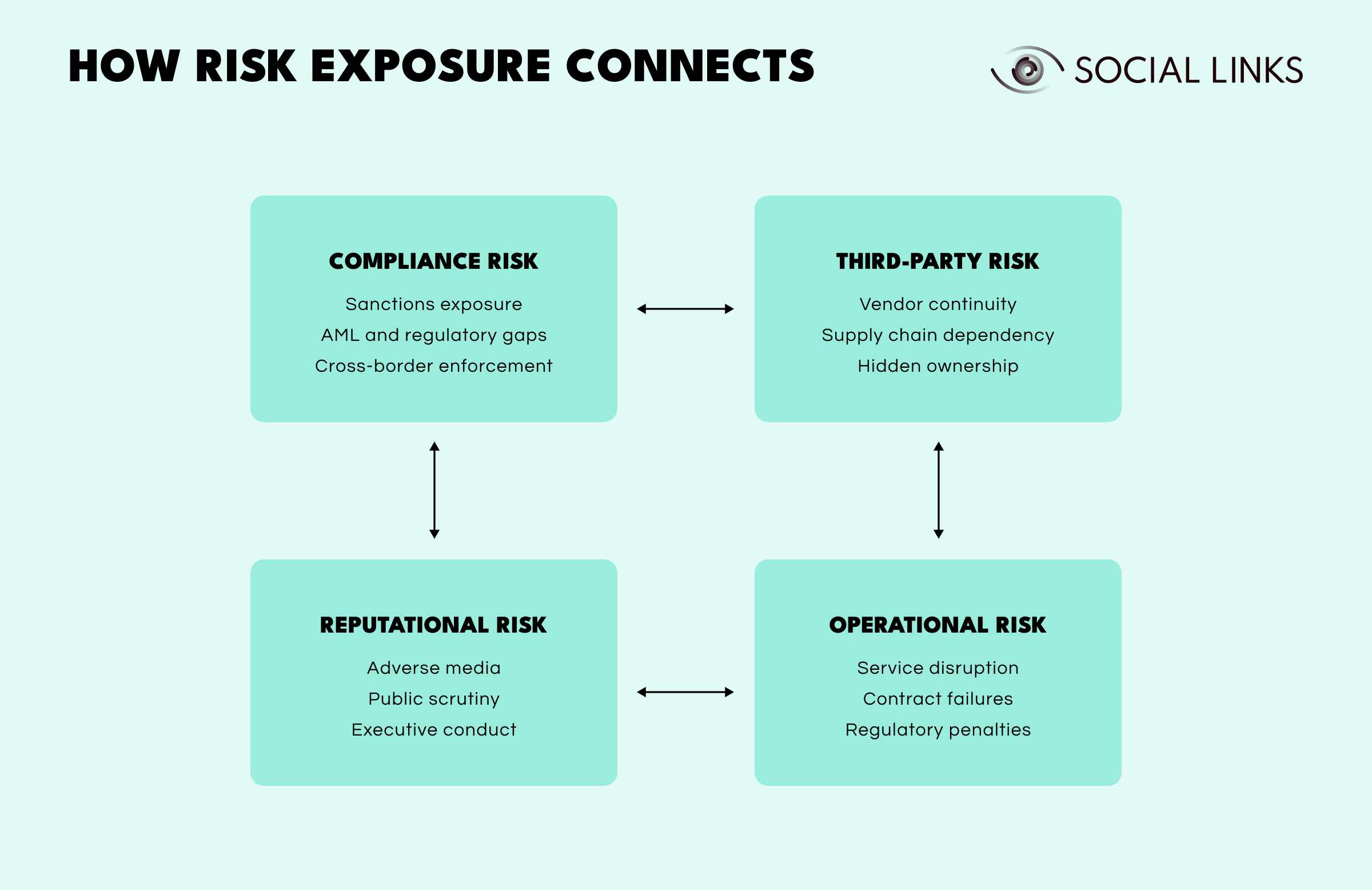
Compliance and regulatory risk examines whether an organization's activities, vendors, and partnerships create exposure to sanctions violations, AML failures, anti-corruption obligations, or data privacy requirements. This becomes especially difficult in cross-border environments where regulations vary by jurisdiction. A sanctions exposure problem rarely stays contained. It can quickly become a reputational issue, a vendor continuity problem, and a regulatory investigation simultaneously.
Third-party and vendor risk has become one of the largest areas of operational exposure. Third-party involvement in breaches doubled to 30% in 2024 according to Verizon's 2025 Data Breach Investigations Report. The exposure rarely sits only with the direct vendor. It moves through subcontractors, shared infrastructure, connected ownership structures, and outsourced relationships that may never appear in an onboarding form.
Financial and operational risk increasingly overlaps with supply chain concentration, geopolitical instability, and regional dependency in ways that were less common a decade ago. A single disruption can affect operations, regulatory obligations, contractual performance, and customer trust at the same time.
Reputational risk moves faster than structured databases. Litigation reporting, investigative journalism, executive conduct, and local media coverage can create significant reputational exposure long before formal enforcement actions appear. By the time those issues appear in regulatory records, customers, investors, and partners may have already reacted.
What makes these categories genuinely difficult to manage is that they bleed into each other constantly. A vendor's undisclosed ownership connection to a sanctioned entity is simultaneously a compliance problem, a reputational concern, and an operational dependency issue. Treating them as separate silos produces fragmented visibility at exactly the point organizations need a connected picture.
A risk assessment framework is only useful if it produces decisions rather than documentation. Organizations that get the most value from these programs tend to share several operational characteristics.
Connected functions. Risk rarely sits within a single team's view. Compliance sees sanctions exposure. Procurement sees vendor performance. Legal tracks litigation. Investigators surface ownership complexity and reputational signals. Programs work better when those functions share escalation criteria, shared visibility, and shared decision thresholds. Without that coordination, organizations end up with fragmented assessments where each team sees part of the problem but nobody sees the full picture.
Defined escalation thresholds. One of the most common failure modes is identifying warning signs without acting on them. Clear escalation criteria help by defining what happens when ownership structures become unclear, when adverse media appears, when sanctions proximity increases, or when inconsistencies emerge between declared and observable information. Organizations that lack defined escalation paths often continue moving relationships forward simply because nobody formally owns the decision to stop.
Risk scoring grounded in independent validation. Scoring models are only as useful as the investigation behind them. Programs relying entirely on self-declared questionnaire responses measure what vendors want organizations to know rather than what the actual exposure looks like. More mature frameworks incorporate independent validation, public records, third-party intelligence, and cross-source verification. The goal is not mathematical precision. It is evidence-based scoring that can actually support decisions.
Continuous monitoring as a default. Rather than reviewing relationships at fixed intervals, mature organizations increasingly monitor ownership changes, sanctions exposure, regulatory actions, adverse media, and operational disruptions as they happen. This allows organizations to react when risk changes rather than discovering those changes during the next scheduled review.
A corporate risk assessment framework defines the structure. OSINT and due diligence provide the investigative layer that fills it with accurate information.
Internal systems show what has been declared. Open-source intelligence helps determine whether those declarations hold up against external reality. That means reviewing reputational signals across media and regulatory reporting, validating whether business activity matches operational claims, mapping ownership relationships that do not appear in official filings, and identifying early warning indicators before they become formal enforcement actions.
Due diligence sits within this broader framework as the point where a specific relationship or decision gets examined in depth. That process involves more than running verification checks. It means understanding what entities claim versus what investigation actually reveals, tracing ownership through layered structures, and validating that declared activity matches observable reality. A well-structured risk program defines when that level of scrutiny is triggered and how findings feed back into ongoing monitoring.
The relationship between framework and investigation matters because organizations often treat them as entirely separate activities. Frameworks without investigative capability produce assessments built on incomplete information. Investigations without framework integration produce findings that never reliably influence decisions. Both need to be connected to be effective.
Regulatory expectations around continuous monitoring have hardened considerably. Frameworks including NIS2, DORA, and the SEC's cybersecurity disclosure requirements all push organizations toward faster visibility, faster escalation, and more continuous oversight. Under several of these frameworks, senior managers now carry personal liability for compliance failures, which changes how seriously organizations treat monitoring gaps.
The operational case is equally straightforward. Risk changes faster than annual review cycles can track. Ownership structures change. Regulatory status changes. Financial health changes. Reputational exposure changes. A vendor considered low risk at onboarding may look significantly different eighteen months later, and nothing in a periodic review process surfaces that shift until the next scheduled assessment.
The practical challenge is scale. Organizations working with hundreds of vendors across multiple jurisdictions cannot manually monitor every relationship continuously. Automation, centralized intelligence platforms, and defined monitoring triggers become essential. Not every relationship requires the same intensity. High-dependency and high-exposure relationships warrant continuous attention. Lower-risk relationships can be managed at appropriate intervals with automated alerts for significant changes.
Most corporate risk assessment programs fail in predictable ways.
Fragmentation across teams is the most common. Compliance, legal, procurement, and investigative functions each hold parts of the risk picture without connecting them. A vendor may raise concerns in adverse media that the investigations team surfaces but that never reaches procurement before the contract renews.
Over-reliance on self-reported information creates assessments that reflect what organizations choose to disclose rather than what is actually true. Questionnaires and certifications are useful baseline checks. They are not substitutes for independent validation.
Static risk registers updated annually create a false sense of control. A risk register that no longer reflects current conditions is not a risk management tool. It is a historical document.
Weak escalation in practice means warning signs get logged without generating action. Organizations identify ownership complexity, adverse media, or inconsistent records, note them as findings, and proceed anyway because escalation requires someone to make a difficult call under time pressure.
Scope limited to direct relationships misses the exposure sitting one layer back. Most organizations understand their direct vendor relationships reasonably well. Far fewer have visibility into what those vendors depend on, who ultimately controls them, or what indirect connections exist to high-risk entities or jurisdictions.
A corporate risk assessment program that generates documentation without improving visibility is not managing risk. It is managing appearances.
Organizations that genuinely reduce exposure share a common approach. They treat risk assessment as an ongoing operational function rather than a periodic compliance exercise. They connect the functions that hold different pieces of the risk picture. They validate information through independent investigation rather than relying on self-reported data. They monitor continuously rather than reviewing annually. And they build escalation processes that result in actual decisions rather than passive findings.
The challenge is rarely lack of information. It is building the infrastructure to connect fragmented signals into a coherent, current picture of exposure before decisions are made.
Corporate risk assessment typically focuses on evaluating specific operational, compliance, financial, or partnership-related exposures. Enterprise risk assessment operates at a broader strategic level, examining organizational resilience, governance, and long-term vulnerability across the business as a whole. In practice the two overlap significantly.
Point-in-time reviews only capture risk as it existed during the review itself. Ownership structures, regulatory exposure, reputational concerns, and financial conditions can change rapidly between assessment cycles without triggering any alert.
Open-source intelligence helps organizations validate whether declared information aligns with external reality. It surfaces reputational warning signs, maps ownership connections, identifies indirect sanctions exposure, and uncovers inconsistencies that structured databases would not capture.
A functional framework connects compliance, legal, procurement, and investigative functions around shared risk criteria and escalation paths. It defines what triggers investigation, incorporates independent validation rather than self-reported data, and operates continuous monitoring across different risk tiers.
Continuous monitoring matters most for high-dependency relationships, cross-border exposures, vendors with complex ownership structures, and any situation where a change in regulatory status, financial health, or ownership could create significant operational or compliance exposure quickly.
Want to see how SL Crimewall supports continuous risk monitoring and investigative due diligence workflows in practice? Book a personalized demo with one of our specialists and discover how organizations use connected OSINT and investigation tools to build systematic risk visibility across vendors, partners, and ownership networks.