Brand Protection: Social Media Impersonation

Social media platforms remove fake accounts at a scale that is difficult to comprehend. What they cannot do is remove them faster than attackers create them. Americans lost $2.1 billion to social media scams in 2025, an eightfold increase since 2020, most of it flowing through impersonation campaigns that platform enforcement consistently fails to contain before damage occurs.
In this article, we examine why platform enforcement at that scale still fails to contain social media impersonation, how AI has changed the economics of creating and sustaining fake accounts, what detection requires beyond platform reporting, and how OSINT investigation surfaces the coordinated networks behind impersonation campaigns rather than treating each fake account as an isolated incident.
Social media impersonation operates across several distinct formats, and understanding the differences matters for detection and response.
Fake brand pages replicate an organization's official social presence, typically to intercept customer inquiries, redirect traffic to phishing pages, or run fraudulent promotions. These accounts often acquire followers through legitimate engagement before pivoting to fraudulent activity, making them harder to detect and giving them a degree of social proof that raw new accounts lack.
Fake executive profiles create synthetic representations of an organization's leadership on professional platforms, particularly LinkedIn. These accounts are used for business email compromise-style outreach, recruitment fraud targeting job seekers with fake offers, and investment scams leveraging executive credibility. The professional context of LinkedIn makes recipients significantly more likely to trust unsolicited contact from what appears to be a known executive.
Fake customer service accounts target customers who publicly complain about a brand, offering to resolve issues through direct messages. Once in private conversation, attackers harvest credentials, redirect payments, or install malware through links. These accounts exploit the expectation that brands will respond publicly to complaints, and they often respond before the legitimate brand team can.
Counterfeit product promotions use brand identity to drive traffic to fraudulent marketplaces or harvest payment details through fake purchase flows. These campaigns frequently run as paid advertising using stolen or fraudulently created ad accounts, allowing attackers to reach targeted audiences at scale.
In practice, coordinated campaigns often chain these formats together. A single operation may maintain fake brand pages for traffic, fake customer service accounts for credential harvesting, and fake executive profiles for financial fraud, all referencing the same brand identity across different platforms simultaneously.
The volume of fake account removal that platforms now report reflects an equilibrium that has been fundamentally altered by AI. Creating convincing fake accounts previously required manual effort: writing plausible profile descriptions, selecting appropriate images, generating posting histories, and maintaining consistent personas over time. Each of those steps has been automated.
82% of phishing operations in 2025 used AI for text and visuals, producing brand-specific content and synthetic profile photos that pass casual inspection. Generative AI allows attackers to create hundreds of accounts with coherent identities, plausible posting histories, and realistic imagery in the time it previously took to create one. The accounts that survive platform detection long enough to reach customers are increasingly the ones that AI has optimized to avoid automated detection.
This shift has two practical implications for brand protection programs. The volume of accounts requiring review has increased beyond what manual monitoring can process. And the accounts that reach customers are more convincing than earlier generations of fake accounts, because AI optimization has removed many of the obvious markers that previous detection approaches were trained to identify.
Platform reporting is a necessary component of social media brand protection. It is not sufficient as a primary detection and response strategy.
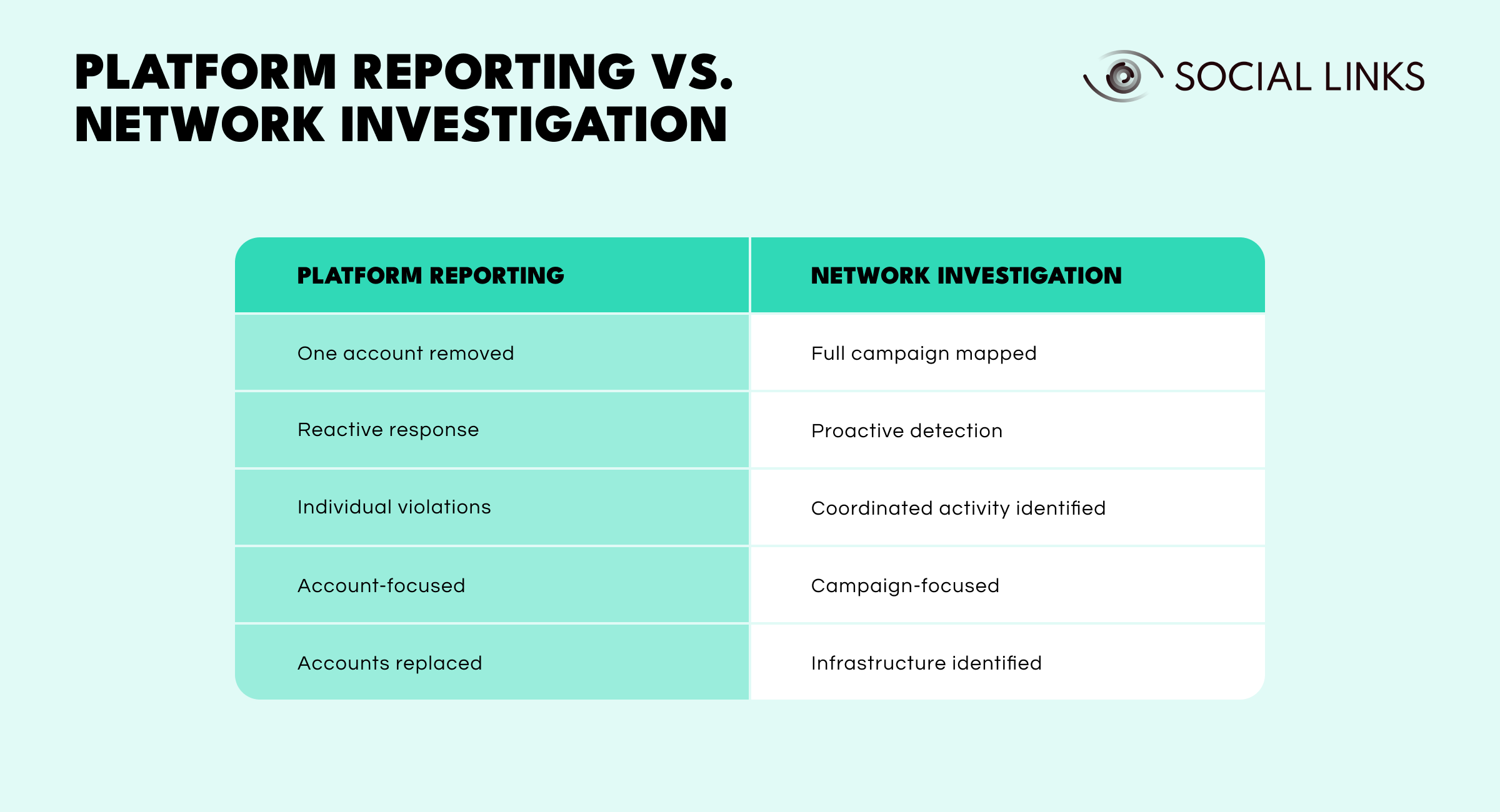
The problem is timing. Platform reporting is reactive: it responds to accounts that have already been identified, which means accounts that have already reached customers. For fake customer service accounts targeting complainants, the fraud often completes within hours of the account contacting its first victim. For investment scams using executive profiles, a single convincing interaction can result in significant financial losses before any report is filed.
The volume problem compounds this. Platform enforcement teams process millions of reports. Individual reports from brand protection teams compete with the broader reporting queue. Urgency is difficult to communicate through standard reporting interfaces, and expedited enforcement channels typically require established relationships with platform trust and safety teams that most organizations have not developed.
The coordination problem is perhaps the most significant. Most platform reporting treats each fake account as an isolated incident. When an impersonation campaign involves fifty coordinated accounts across three platforms, reporting each one individually produces fifty separate enforcement actions on an indeterminate timeline. The campaign operator replaces removed accounts faster than sequential reporting can take them down.
Effective response requires identifying the network behind a campaign, not just the individual accounts it has deployed. That investigative step does not happen inside platform reporting workflows.
The investigative approach that produces the most value in social media brand protection operates at the network level rather than the account level.
When a fake brand page appears, it does not typically exist in isolation. It shares infrastructure with related accounts: similar registration patterns, linked email addresses, overlapping device identifiers, coordinated creation timing, and posting behavior that suggests automated management. Identifying these network connections means that removing one account produces information about the broader campaign rather than simply eliminating one node.
OSINT investigation methods surface these connections through several approaches. Account network analysis maps relationships between fake accounts through mutual followers, coordinated posting patterns, and shared infrastructure. Domain and URL analysis traces the phishing pages and fraudulent sites that fake accounts link to, connecting social media presence to backend infrastructure. Registration and metadata analysis examines creation timing, profile consistency, and behavioral patterns that distinguish coordinated synthetic accounts from organic ones.
This investigative layer serves two purposes. It accelerates platform enforcement by providing evidence of coordinated inauthentic behavior, which platforms treat as higher priority than individual account violations. And it produces intelligence about threat actors and infrastructure that is useful beyond the immediate response, enabling organizations to identify related activity before it reaches customers.
Effective social media brand protection requires connecting detection to response through defined workflows rather than treating each discovered account as a one-off response task.
Detection should operate continuously across the platforms most relevant to the organization's audience. Monitoring for variations of brand names, executive names, product names, and visual identity markers provides earlier warning than waiting for customer reports. AI-assisted detection helps manage the volume by flagging suspicious accounts for human review rather than requiring analysts to manually search for impersonation.
Documentation before reporting matters more than many teams realize. Capturing screenshots, URLs, account identifiers, posting history, and any linked content creates an evidence record that supports both platform enforcement and, where warranted, legal action. Platform reporting without documentation leaves organizations with no record if enforcement is delayed or contested.
Coordinated reporting across all accounts in a campaign, submitted simultaneously with evidence of coordination, receives different treatment from platforms than sequential individual reports. Most platform trust and safety teams have escalation pathways for coordinated inauthentic behavior that move faster than standard queues.
Customer notification when impersonation campaigns are active protects customers who may not see enforcement actions and helps contain the reputational damage that impersonation causes even when fraudulent accounts are eventually removed.
Post-removal monitoring confirms that campaigns do not reconstitute under new account identities after enforcement. Organizations that treat removal as resolution frequently encounter the same campaign operating under new accounts within days.
Social media impersonation has become the highest-volume brand threat most organizations face, and the platform enforcement that removes billions of fake accounts each quarter has not contained the problem. Brand impersonation now accounts for more than half of all browser-based phishing activity, and social media is the primary channel through which that activity reaches customers.
Organizations that rely entirely on reactive platform reporting will consistently discover impersonation campaigns after customers have already been harmed. Those that combine continuous monitoring, network-level investigation, and coordinated response workflows are better positioned to detect campaigns at the creation stage and neutralize them before they scale.
Social media brand impersonation involves creating fake accounts, pages, or profiles that mimic an organization's official presence, its executives, or its customer service operations to deceive customers, harvest credentials, redirect payments, or spread disinformation.
Platform reporting is reactive and treats each account as an isolated incident. Coordinated impersonation campaigns replace removed accounts faster than sequential reporting can eliminate them, and processing times mean fraudulent accounts often complete their objectives before enforcement occurs.
AI enables attackers to create convincing fake accounts at scale, generating synthetic profile photos, brand-specific content, and plausible posting histories with minimal manual effort. This increases the volume of accounts requiring detection while making individual fake accounts harder to identify through casual inspection.
Network-level investigation maps the relationships between fake accounts in a coordinated campaign, identifying shared infrastructure, creation patterns, and behavioral coordination. This approach produces intelligence about the full campaign rather than individual accounts and supports faster platform enforcement.
Organizations should document all discovered accounts before reporting, submit coordinated reports with evidence of the campaign's scope, notify customers through official channels, and monitor for campaign reconstitution after enforcement. Defined response workflows reduce the time between detection and action.
Want to see how OSINT investigation supports social media impersonation detection and coordinated brand protection response? Book a personalized demo with one of our specialists and discover how SL Crimewall helps analysts map fake account networks, trace impersonation infrastructure, and build the evidence needed to support platform enforcement and legal action.