Brand Protection: The Evolving Threat Landscape
Brand protection used to mean trademark registration, domain monitoring, and the occasional cease-and-desist letter. Those concerns have not disappeared, but they now represent the smallest and most visible layer of a problem that has grown considerably more complex.
The FTC reported $2.95 billion in losses from impersonation scams in 2024 alone, and the Identity Theft Resource Center documented a 148% spike in impersonation incidents between April 2024 and March 2025. Behind those numbers is a structural shift: AI has lowered the cost and complexity of brand attacks to the point where sophisticated impersonation campaigns are no longer the domain of organized criminal groups. They are accessible to almost anyone.
In this article, we examine what brand protection actually covers today, the seven threat types organizations need to monitor, how AI has changed the scale and sophistication of each, and what effective brand protection requires when threats operate across surfaces that traditional monitoring was never designed to reach.
Brand protection is the set of strategies, processes, and tools organizations use to detect, investigate, and respond to the unauthorized use of their brand identity by third parties.
That definition sounds straightforward. In practice, the scope has expanded significantly. Traditional brand protection focused on legal mechanisms: trademark registration, copyright enforcement, domain dispute processes, and marketplace takedowns for counterfeit products. Those remain relevant. But the attack surface has moved well beyond the legal domain.
Modern brand threats operate across social media platforms, email infrastructure, domain registries, mobile app stores, e-commerce marketplaces, messaging platforms, and increasingly the AI-generated content layer sitting above all of them. A brand can be impersonated through a spoofed website, a fake LinkedIn profile, a deepfaked executive video, a phishing email using the organization's visual identity, a counterfeit product listing on a major marketplace, or a coordinated fake review campaign, often simultaneously.
The distinction that matters for how organizations approach brand protection is between reactive enforcement and proactive detection. Reactive enforcement responds to threats after they have already reached customers or caused damage. Proactive detection identifies threats at the infrastructure and content creation stage, before they deploy at scale. AI has made the gap between those two approaches considerably more consequential.
Brand threats do not operate in isolation. A single coordinated campaign can simultaneously involve spoofed domains, fake social media profiles, phishing emails, and counterfeit marketplace listings, all referencing the same brand identity. Understanding each threat type is the starting point for understanding how they connect.
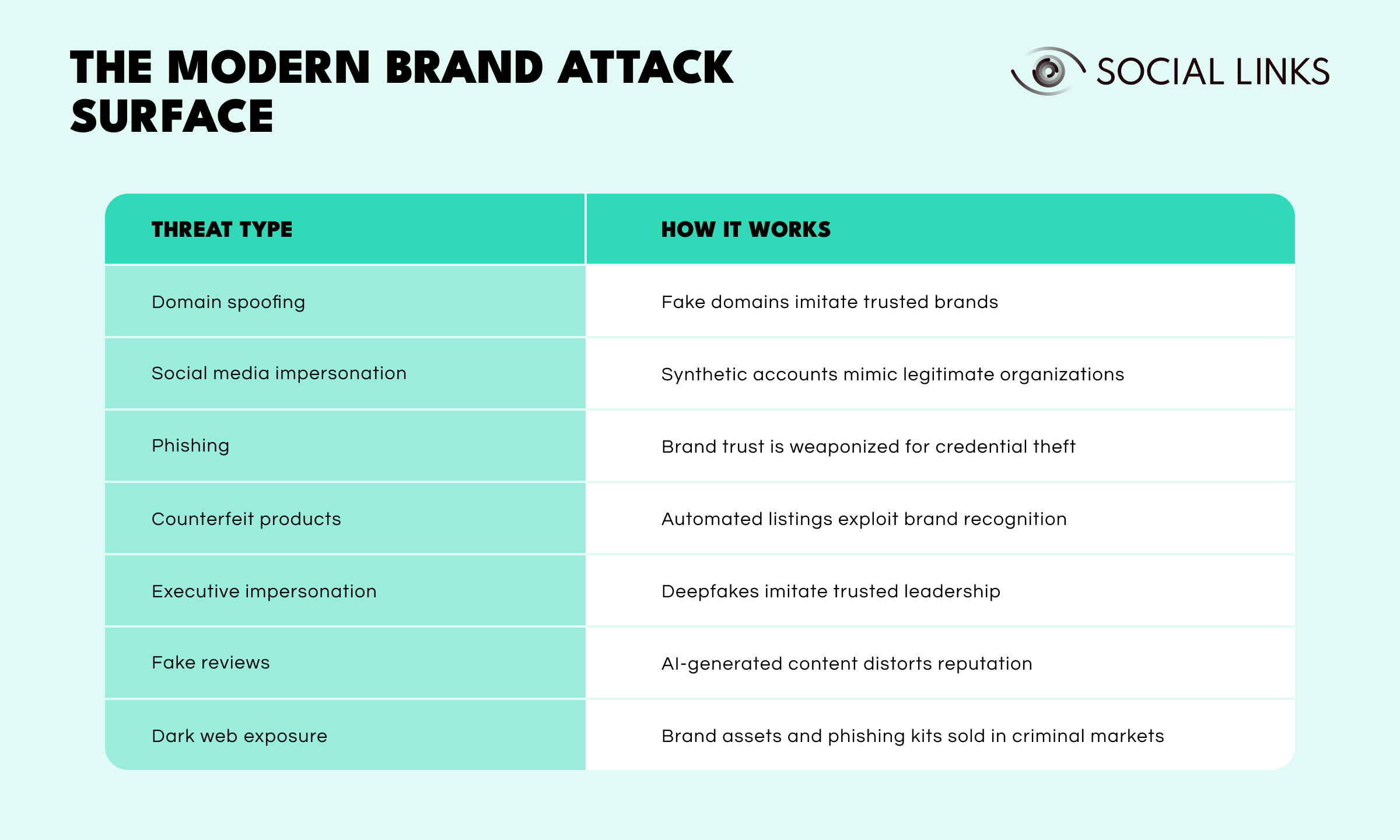
Domain spoofing and typosquatting involve registering domains that closely resemble a legitimate organization's domain to intercept traffic, harvest credentials, or host phishing pages. Common techniques include character substitution, adding prefixes or suffixes, and using alternative top-level domains. Attackers can register dozens of spoofed domains in minutes. Cybercriminals created nearly one million new phishing sites each month in 2024, a 700% increase since 2020, reflecting both the scale of the problem and the degree to which automation has removed the friction from creating malicious infrastructure.
Social media impersonation and fake accounts involve creating profiles that mimic an organization's official presence to deceive customers, solicit payments, spread disinformation, or harvest credentials. Impersonation operates at every level, from fake brand pages to counterfeit customer service accounts to synthetic executive profiles. AI-generated accounts are increasingly difficult to distinguish from legitimate ones at the account level.
Phishing and credential theft use brand identity as the mechanism for deception. 89% of phishing emails now involve impersonation tactics according to the Egress Phishing Threat Trends Report, with attackers impersonating organizations their targets are likely to trust. The brand being impersonated is often not the primary target of the attack. It is the trust vector used to reach the actual target. This creates a brand protection problem that exists entirely outside the impersonated organization's own systems.
Counterfeit products and marketplace fraud affect organizations selling physical products across e-commerce platforms. Counterfeit listings exploit brand recognition to sell inferior or dangerous products under established names, eroding customer trust and creating legal and regulatory exposure for legitimate brands. AI has accelerated counterfeit listing creation by enabling automated generation of product descriptions, images, and seller profiles at scale.
Executive impersonation and deepfakes have moved from fake email addresses and social profiles to AI-generated audio and video capable of deceiving employees, customers, and partners under real-time conditions. In February 2024, a finance worker at the engineering firm Arup was tricked into transferring $25 million after a video call featuring deepfaked likenesses of the company's CFO and other senior executives. The incident illustrates how deepfake-enabled fraud has moved from a theoretical concern to an operational risk for organizations of every size.
Fake reviews and reputation attacks involve coordinated campaigns to manipulate the perception of an organization through fraudulent positive reviews on competitors, fake negative reviews targeting the organization, or disinformation spread across forums and review platforms. AI-generated review content has become significantly harder to detect because it does not carry the linguistic patterns that earlier detection methods were trained to identify.
Dark web brand exposure covers the circulation of brand assets, phishing kits, and credential data in criminal markets before those assets are deployed in attacks. Phishing kits built around specific organizations' visual identities are sold and distributed in dark web forums, enabling attackers with minimal technical skill to launch convincing brand-impersonation campaigns. Leaked credential databases tied to an organization's customers or employees circulate in the same markets, enabling account takeover attacks that exploit the brand's existing customer relationships.
Each of the threat types above existed before generative AI became widely accessible. What AI changed is not the nature of the threats but the economics and scale at which they operate.
Creating a convincing phishing page previously required design skills, technical knowledge, and time. Generating a convincing executive voice clone required access to specialized audio processing tools. Creating hundreds of synthetic social media accounts with coherent posting histories required significant manual effort. Each of those barriers has been substantially reduced.
The 82.6% AI adoption rate in phishing operations documented by Whalebone in early 2026 is not a projection. It reflects current attack infrastructure. The window between domain registration and active phishing campaign deployment has collapsed to hours in many cases.
For brand protection programs, this acceleration has two practical implications. Detection approaches that rely on identifying known patterns become obsolete faster. And the volume of threats requiring investigation and response has increased to the point where manual workflows are no longer viable at scale.
Brand protection programs that were designed around periodic monitoring, legal enforcement, and reactive takedowns are structurally mismatched with the current threat environment. Several capabilities have become essential rather than optional.
Continuous monitoring across surfaces. Threats do not announce themselves. Domain registrations, social media account creation, marketplace listings, and phishing infrastructure all appear before attacks deploy. Monitoring needs to operate continuously across registries, platforms, marketplaces, and open web sources to surface threats at the creation stage rather than after they reach customers.
Infrastructure investigation. Identifying that a phishing site exists is less useful than understanding the infrastructure behind it: which hosting provider it uses, which other domains resolve to the same server, whether the same registrant has created additional attack infrastructure, and whether the campaign is isolated or part of a broader coordinated operation. This investigative layer is where OSINT methods produce the most operational value in brand protection, connecting individual threat indicators to the networks and actors behind them.
AI-assisted detection. The volume of synthetic content, fake accounts, and malicious domains exceeds what manual review can process. AI-assisted detection helps brand protection teams identify impersonation attempts, flag suspicious domain registrations, surface coordinated account networks, and prioritize which threats require immediate response versus ongoing monitoring.
Coordinated response workflows. Detection without response produces documented problems rather than resolved ones. Effective brand protection connects detection to takedown requests, legal action, platform reporting, and law enforcement escalation through defined workflows that do not depend on manual triage of every individual incident.
Cross-surface visibility. The most damaging brand attacks typically operate across multiple channels simultaneously. A coordinated campaign might include a spoofed domain, fake social media profiles, phishing emails, and counterfeit marketplace listings all referencing the same impersonated brand identity. Visibility that is siloed by channel will identify pieces of the campaign without surfacing the full picture.
Brand protection has moved well beyond trademark and domain enforcement. The threat landscape now spans social media impersonation, AI-generated executive fraud, phishing infrastructure, counterfeit networks, and dark web exposure, all of which have accelerated significantly as AI tooling has made sophisticated attacks more accessible.
Organizations that continue to approach brand protection as primarily a legal and reactive function will consistently discover threats after they have already reached customers. Those that combine continuous monitoring, infrastructure investigation, and OSINT-driven analysis are better positioned to identify threats at the creation stage and respond before organizational and reputational damage compounds.
Brand protection covers the strategies and processes organizations use to detect and respond to unauthorized use of their brand identity. It matters because impersonation, phishing, counterfeiting, and fake accounts all exploit brand trust to defraud customers, damage reputation, and generate financial losses that affect the organization even when attacks operate entirely outside its own systems.
The most prevalent threats are domain spoofing, social media impersonation, phishing using brand identity, counterfeit products, executive impersonation, fake reviews, and dark web exposure of brand assets and customer credentials.
AI has lowered the cost and complexity of creating convincing brand impersonation at scale. Phishing pages, synthetic social accounts, deepfaked executive communications, and counterfeit product listings can all be generated faster and in greater volume than manual detection workflows were designed to handle.
Brand monitoring identifies when and where a brand is mentioned or used. Brand protection extends that to detecting unauthorized or malicious use and responding to it through takedowns, legal action, platform reporting, or investigation. Monitoring is one component of protection, not a substitute for it.
Effective programs combine continuous monitoring across surfaces, infrastructure investigation to understand the networks behind attacks, AI-assisted detection for volume, and coordinated response workflows that connect detection to action. Programs that rely only on periodic monitoring and reactive enforcement consistently miss threats until after customer damage has occurred.
Want to see how OSINT investigation and connected intelligence workflows support brand protection programs in practice? Book a personalized demo with one of our specialists and discover how SL Crimewall helps analysts detect impersonation infrastructure, investigate coordinated attack networks, and connect brand threats to the actors behind them.